When you click on links to various merchants on this site and make a purchase, this can result in this site earning a commission. Affiliate programs and affiliations include, but are not limited to, the eBay Partner Network.
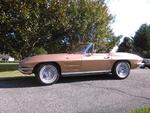
A person with a Tri-Power told me he blocked off the end carbs and runs on only the middle carb. He said he never revs it beyond 3,500 RPMs, so he doesn't need the end carbs.
Any thoughts on this, pros/cons ???
The center #3660 flows around 350 cfm so it's like the primaries on a 4-bbl. The outer carbs are around 466 cfm each so the grand total is over 1200 cfm. It is a bit different to own a Tripower Vette and not have the secondaries available. As Keith mentioned, he keeps his foot out of it, they just sit there...but damn, what a shame.
Mike T - Prescott AZ
Thanks for the answers, I didn't think closing the end carbs made any practical sense.
As I recall, he was an older gent, well above 70 Y/O, and his car was a garage queen.
I had a tripower on my old '62 406 Ford and one of the great joys was hearing those things open up at full throttle.
That being said, it took me a month with my newly built motor in my vette to realize the heatshield under my carb was keeping the secondaries on my QF750 from opening! It seemed to have more than enough power but that could be since it had about 200 more horsepower than the previous motor. And now that I've fixed that problem, I can't seem find any place to really open it up.
Thanks for the answers, I didn't think closing the end carbs made any practical sense.
As I recall, he was an older gent, well above 70 Y/O, and his car was a garage queen.
He should leave it in the garage if he can't afford the fuel to drive it like its meant to be driven. Then he can just sit in it and pretend he's driving ... won't burn any fuel then! Just saying.
He should leave it in the garage if he can't afford the fuel to drive it like its meant to be driven. Then he can just sit in it and pretend he's driving ... won't burn any fuel then! Just saying.
That might be the answer. I recall him saying that he shifts from 1st to 3rd to save gas. That struck me as odd, I never heard that before.
In high school I had a friend at my after school work who had a 64 tri-power GTO. Seems strange now but back then as a teen ager friends and co-workers were always tossing me the keys to their rides and telling me to take it for a spin and see what I think of it. So this guy did too and I said great. But as I was headed for the car he told me by the way he had the end carbs disconnected so it may seem a bit down on power to me if I get on it. Ha ha. Anyway, I think a lot of people did that for years under the misconception that it would help their gas mileage or self control. It seems like they didn't understand progressive linkage or vacuum operation or accept that just keeping your throttle foot off the floor worked just as well.
Just for another perspective ... from one of those "old" guys... I have actually considered this as well on my '67. Not for gas mileage but because Holley spelled backwards is LEAK! As many of you know, if you don't use a Holley often enough to keep gas in the bowls, eventually the gaskets dry out and then when you DO put gas in the bowls, it either runs out onto the intake manifold or the engine runs like crap. Given the performance of a big block on just the center carb, I admit to being tempted to block the fuel to the front and rear carbs remove the linkage and vacuum lines and then put a block off plate under the carbs.
I discovered a trick years ago that mitigated the problem for me. When I'm done with the car for a while, after the last drive, I pull the air filter and using a pump oiler, put a couple of squirts of two cycle oil down the three vent tubes. That mixes with the gas and after the gas evaporates, the gaskets are still moist with oil and don't shrink. Before doing this, I was replacing gaskets on the 2300's every couple of years. Since starting the oil trick about 7 years ago, I haven't replaced a gasket (or tightened a bowl screw) again and the car runs great after priming the carbs with fuel before the next start. The downside is the oil WILL wick out of the carbs and get on the intake but that's a small price to pay for not having to spend a day replacing gaskets on Holley carbs.
I too am one of those old 70+ geezers, but I have decided that when I get too old to enjoy my cars I am going to pass them along. Making a 427 tri-power into a single 2 barrel is a sin. As others have said, if you drive it conservatively the end carbs are not in play. If you decide to enjoy your life a little, just step on it and get a reminder of why the car was built in the first place. I also had the problem of leaking carbs until they came out with the blue gaskets. The new gasket material does not seem to dry out even when the car sits for a while. Tell your friend to buy a Prius and sell you his Corvette.
The center #3660 flows around 350 cfm so it's like the primaries on a 4-bbl. The outer carbs are around 466 cfm each so the grand total is over 1200 cfm. It is a bit different to own a Tripower Vette and not have the secondaries available. As Keith mentioned, he keeps his foot out of it, they just sit there...but damn, what a shame.
Mike T - Prescott AZ
Not true! Few realize that 2-bbl carb flow is rated at 3" Hg depression versus 1.5" used for 4-bbl carbs. Since flow is proportional to the square root of depression it's easy to convert one to the other either way and when you compute the "4-bbl equivalent" to the three two-barrels that are rated at 3" depression you get about 900 CFM at 1.5" depression.
As far as blocking off the end carbs because you never exceed 3500 RPM is concerned I wonder why the guy even owns the car. A couple of years ago I was helping a buddy practice for a NCRS PV with his L-71. During the WOT test to 90 percent of redline it was clear something was wrong as the car just didn't pull. In fact it was a stone. Investigation showed that the throttle valves of one of the end carbs were jammed in the bores preventing both end carbs from opening up. Freeing them up turned it into a totally different car.
I seem to remember people doing this back in the day. Gas was about 50 cents/gallon for 260, so I guess it was just a money thing, although speeding tickets were expensive as well!
I was hitching somewhere (we did that a lot back then) and got picked up by a guy in a C-1 he had put 6-2's on. Scariest ride I ever had!
My first car (15 years old) was a '55 Ford with a modified 312 with 3 -2's. It ran pretty well, and punching in those carbs was the whole idea!
That might be the answer. I recall him saying that he shifts from 1st to 3rd to save gas. That struck me as odd, I never heard that before.
Wayne your friends antics are getting to be a lively head-scratcher LOL. So he's late 70's, with a 67 L68 or L71, worth $150k, to which he probably has it insured for that value and paying a decent premium for insurance, changing plugs every 3rd trip around the block because he drives like a *****, all to save the odd $20 in gas!
I blocked off the end carbs when I was doing some engine work. It improved the mileage so much, I thought, blocking them all would make the mileage even better!
It wasn't....
Last edited by 6T7L71CPE; Dec 6, 2020 at 11:34 AM.
Not true! Few realize that 2-bbl carb flow is rated at 3" Hg depression versus 1.5" used for 4-bbl carbs. Since flow is proportional to the square root of depression it's easy to convert one to the other either way and when you compute the "4-bbl equivalent" to the three two-barrels that are rated at 3" depression you get about 900 CFM at 1.5" depression.
As far as blocking off the end carbs because you never exceed 3500 RPM is concerned I wonder why the guy even owns the car. A couple of years ago I was helping a buddy practice for a NCRS PV with his L-71. During the WOT test to 90 percent of redline it was clear something was wrong as the car just didn't pull. In fact it was a stone. Investigation showed that the throttle valves of one of the end carbs were jammed in the bores preventing both end carbs from opening up. Freeing them up turned it into a totally different car.
Duke
Duke - I missed that day in Math Class...hell I probably missed most of them, but just so I can get a better idea of what that means...are the CFM ratings listed for those 2-barrel carbs not accurate and in the end, the 1200 combined CFM is actually around 900 due to that 3" Hg depression?
Mike T - Prescott AZ


















 Dennis




 Tri-Power Question