When you click on links to various merchants on this site and make a purchase, this can result in this site earning a commission. Affiliate programs and affiliations include, but are not limited to, the eBay Partner Network.
I know this is a long shot but my hope is some of the guys with racing experience can chime in.
Would you have any tips on stringing a Vette for alignment purposes?
I'm particularly interested in how to compensate for the track width difference and establishing the centerline of the chassis.
I've got toe plates and a caster gauge. Real issue is I have to work alone so I'm being methodical here.
Thanks
I stingline from the front hubs to the rear hubs. But like you said there are track differences. On a 66 Satellite I recently did a garage alignment on the front track is 1” wider than the rear. So using a long straight edge (about 4’ I think) I laid it against the sidewall across the hub center and level and kept adjusting the steering slightly until I had equal dimensions to the taunt string line from the straight edge. Basically the distance to the string line was around 5/16 - 3/8” but it doesn’t matter as long as it’s equal on both sides. Then I know my tires are straight ahead with the chassis (except see next para) and after setting camber/caster, I set toe and verify I still have equal distance to the string line. I may need to center the steering wheel too when setting toe. On the Corvette I do basically the same thing with the straight edge across the rear tires to get equal toe on both sides and total toe in specs.
Now if you do the front and then progress to the rear and find you had an existing variance in rear toe from right to left - that probably threw your measurements on the front off some as the string line is influenced by the front of the rear tire turned in or out. So you end up doing everything twice in all likelihood in a wiggling in process. But for home garage alignment I’ve found it’s best to repeat everything at least twice until you get repeatable results.
And then when you get it on the road, you may find that the road crown typical for your roads throws your steering wheel alignment off slightly ( usually CCW to the left a little to compensate for the crown). And that is when you have to lengthen the tie rod distance a bit on the right and shorten it an equal amount on the left to center your wheel and maintain your toe setting.
The hardest part of doing a Vette is that you MUST find the center line of the chassis. Everything comes from the centerline. And you floor needs to be very level, if not put pads under the lower wheels. I use a plumb bob and drop from a known good point on the chassis. Lower a arm bolts in the front and strut rod bolts in rear or if you trust it find the center of the rear frame. Find your center then run a string front to rear out past the car. Now you can run your side strings and make them equal front and rear. You are basically making a big rectangular box around your car. You can check it by going corner to corner and the numbers should be equal. Now you can check, front toe, rear toe, wheel offset. This is how I have done all my race cars from Corvettes to Formula cars. The next step would be chassis scales.
Stringing a car is very straightforward, but time consuming to do right with a plumb bob, jack stands, and monofilament. I always seem to kick one of the jackstands by accident and have to start over.
Smart Strings are a bit pricey for the average guy that will only do his car once or twice, but they set up super fast and are easy to use just about anywhere. A level plane (or floor) is required for caster and camber, but not that critical for toe as long as you are on a reasonably flat surface. Smart Strings work on just about any car or truck.
Stringing a car is very straightforward, but time consuming to do right with a plumb bob, jack stands, and monofilament. I always seem to kick one of the jackstands by accident and have to start over.
Smart Strings are a bit pricey for the average guy that will only do his car once or twice, but they set up super fast and are easy to use just about anywhere. A level plane (or floor) is required for caster and camber, but not that critical for toe as long as you are on a reasonably flat surface. Smart Strings work on just about any car or truck.
That thing is absolutely neat, but can you use it on a Corvette?
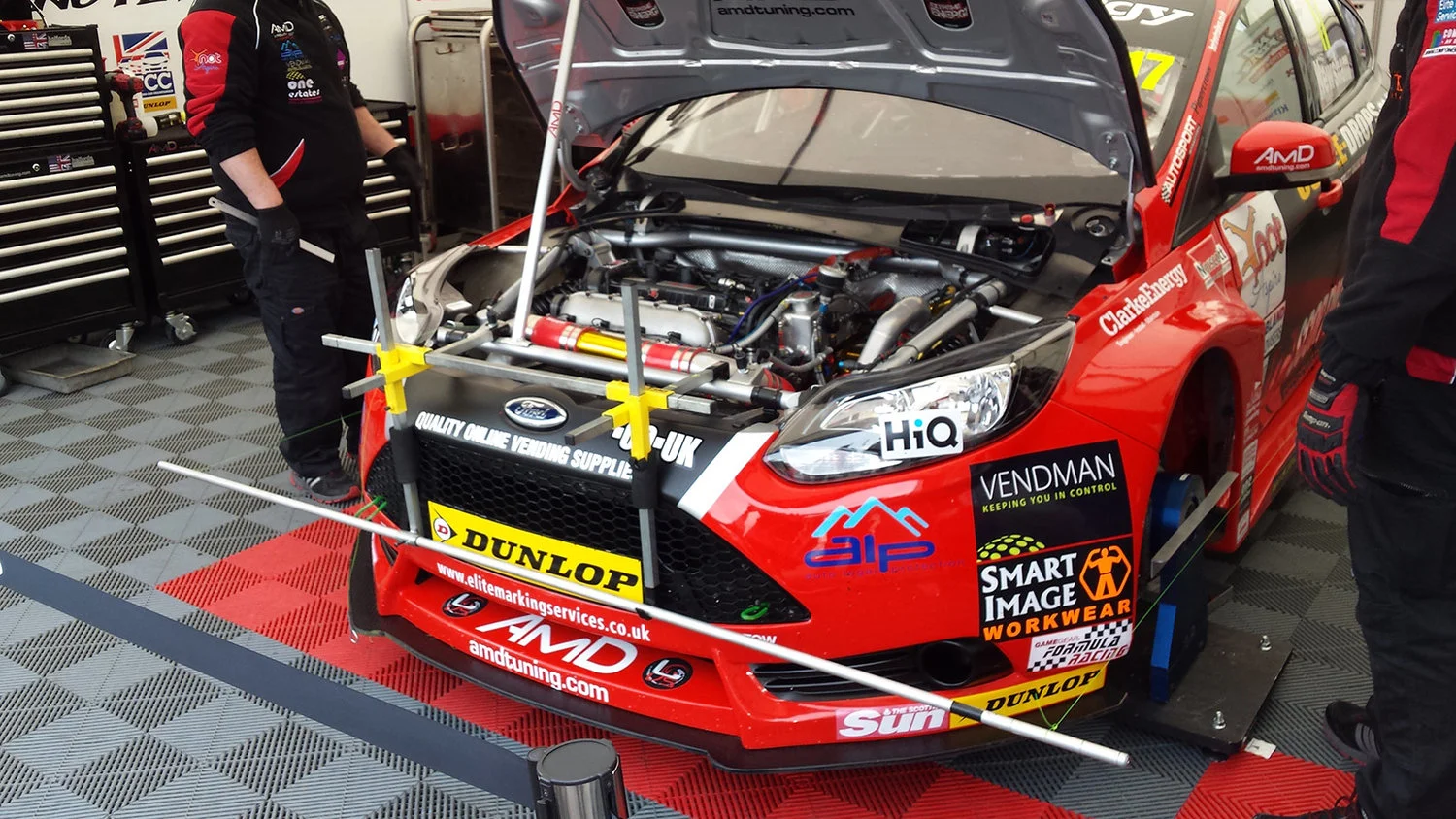
From looking their site over it appears you need a trunk, rear hatch, tailgate, or some other opening in the rear of the car to mount the back half of it too, which obviously you don't have when playing with 63-82 Corvettes. We have access to a computerized alignment machine, but it requires loading the car up and hauling it 45-50 minutes each way. The Smart Strings would be nice for checking the set up between races, without always having to haul it to the alignment machine, and also make it easy to check and/or make set up changes at the track.
Smartstrings are very cool and can be mounted to the bumpers or wheel wells. I like them more from the ease of set up and the fact they connect to the vehicle vs separate meaning you can move the car to settle the suspension after any adjustments without disturbing the set up. They also set up quickly once you determine the best mounting approach for your car and are much easier to get accurate measurements compared to my cataract vision and skewed old man eyes. All of that said, they are expensive! While I am never one to shy away from some fancy new gadget, this is one where I like knowing a friend more gadget obsessed than me!
Are we talking abount an allignment here? Please excuse my ignorance. I've only had my 59 for two weeks. Here tofore, getting my C6 alligned was as easy as taking it to the dealership and an hour later I was back on the road happy as a clam. So please tell me what am i missing?
Shims. That is what you are missing. As in the current “alignment technicians” needing an eccentric to turn as they adjust the alignment to the specs in their alignments machines computer. Your C1 has no eccentrics and is not going to appear in most alignment computers.
Shims. That is what you are missing. As in the current “alignment technicians” needing an eccentric to turn as they adjust the alignment to the specs in their alignments machines computer. Your C1 has no eccentrics and is not going to appear in most alignment computers.
If you could see my face you would see the "Deer in the head lights". Please if I could trouble you to explain in simple terms what you just posted. I really would appreciate it. Please do not interpret this as any critisism, but rather that you are dealing with a simple man. Tow in I get, maybe even camber,but that's it. Allignments are like electrcity: black magic. I've been accused of eccentricacy in the past, but my car?
I have done several of these with string, and I can tell you it is as good or better than any alignment done on modern equipment. They local guy who used to do these for me passed away a couple years ago, so I had no choice but to figure it out.
I am doing my 63 this way currently--it is very time consuming. But my plan was to start a thread about it or add it to my 63 "wake-up" thread that I haven't updated in a long time. My businesses and kids have kept me busy....
Section 3 of the GM Service Manual (mine is a 68 year) gives you definition and guidance on performing alignments. Once again, the books the first place to start to understand alignment. Keep in mind, the radial tires need different specifications than will be provided in your manual.
Finding the centerline of the car / frame as Pop says and getting the car level are the first important steps. I used masking tape to put reference marks on the floor and concrete blocks to hold the dumb end of the string. The first step is finding reference points (ball joints, A-frame arm bolts, etc.) on each side of the frame to plumb down to the floor and then splitting the dimensions in half to find the centerline front and rear.
Once you mark the reference points from the frame, and establish centerline from those reference points, I snapped a centerline with a chalk box on the floor and used making tape to maintain the reference points. I used a 8 foot straight edge and a drywall square to establish parallel lines on each side of the car equidistant from the center line. Once again, you can use concrete blocks, heavy jack stands, etc. to hold the ends of the strings on these reference lines. Verify the box created by the parallel lines is equidistant at front and back (parallelogram).
Then, plumb out and down from the same point on each rim or hub to find the track width by measuring over to the reference lines on each side. Calculate the track difference of the front and rear suspension. Your track width will change when you adjust toe on the rear.
Once you establish the box around the car, follow the Service Manual to perform the alignment.
I ultimately used plastic bags (with a shot of grease in them) sandwiched between two hard plastic sheets to allow the tires move.
I created fixtures to attach to each wheel with magnets to establish / obtain toe-in and camber. Makes it easier.
I'm no expert and there may be situations where my method doesn't work great, but I did do a successful string alignment on my Cheetah while it was on my 4-post lift. Here's what I did to set the toe in.
Run string between the two front posts at about the height of the center of the wheels. Repeat with the two rear posts.
Tie a string to the front string on the left side of the car and run it to the rear string, keeping it taught. Repeat on the right side of the car.
Slide the side strings along the front/rear strings toward the car until they are very close but not touching the centers of the wheels.
Slide the front/rear strings up or down on the posts until both side strings are aligned with the centers of the wheels. At this point the height of the front/rear strings is set and should not be moved.
The purpose of the next step is to end up with the side strings parallel to each other with the same distance from the string to the center of the wheel hub at each axle. Record your measurements on a drawing for easy recall and reference. Recheck your measurements after each string movement.
Measure the distance between the side strings at the front and the back strings..
Increase the distance between the side strings at whichever end they are closer together. For example, if the side strings are 4" closer together at the front, move each front side string half of that (2") away from the car.
Measure the distance between each string at the center of each wheel hub. Make small adjustments to the side strings until the distance between the strings and the hubs are the same at each axle (e.g., 2" at the front and 3" at the rear), AND the distance between the side strings is the same at front and rear.
At this point you can measure the toe in/out of each wheel by measuring from the strings to comparable places at the front and rear of each tire.
The hardest part of doing a Vette is that you MUST find the center line of the chassis. Everything comes from the centerline. And you floor needs to be very level, if not put pads under the lower wheels. I use a plumb bob and drop from a known good point on the chassis. Lower a arm bolts in the front and strut rod bolts in rear or if you trust it find the center of the rear frame. Find your center then run a string front to rear out past the car. Now you can run your side strings and make them equal front and rear. You are basically making a big rectangular box around your car. You can check it by going corner to corner and the numbers should be equal. Now you can check, front toe, rear toe, wheel offset. This is how I have done all my race cars from Corvettes to Formula cars. The next step would be chassis scales.
Thanks for posting that. That is exactly what I wanted to know.
I have done several of these with string, and I can tell you it is as good or better than any alignment done on modern equipment. They local guy who used to do these for me passed away a couple years ago, so I had no choice but to figure it out.
I am doing my 63 this way currently--it is very time consuming. But my plan was to start a thread about it or add it to my 63 "wake-up" thread that I haven't updated in a long time. My businesses and kids have kept me busy....
I agree with you. I met ONE alignment guy that knew what he was doing, but he retired and sold his business. I'll just do it myself rather than gamble on finding someone







 stringing a Corvette