



[C2] Is compression always compression?

Thread Starter
Race Director

Joined: Nov 2003
Posts: 10,696
Likes: 3,090
From: Cottonwood AZ
C1 of Year Finalist (performance mods) 2019
 Is compression always compression?
OK, here is the real question behind this with regard to my upcoming engine build of an aluminum head 383 I question using flat top verse dome pistons.
1. Is there a h.p. performance difference? I know it likely depend on different things in different engines but I am taking specifically about MY engine build with Brodex aluminum heads and a planned on TRUE 10-1 compression.
2. Would there be a difference in octane requirements between the flat tops and domed pistons? I plan to run on 91 octane pump gas hence my questions.
1. Is there a h.p. performance difference? I know it likely depend on different things in different engines but I am taking specifically about MY engine build with Brodex aluminum heads and a planned on TRUE 10-1 compression.
2. Would there be a difference in octane requirements between the flat tops and domed pistons? I plan to run on 91 octane pump gas hence my questions.

Drifting


Joined: Nov 2004
Posts: 1,500
Likes: 673
From: Folsom Ca
OK, here is the real question behind this with regard to my upcoming engine build of an aluminum head 383 I question using flat top verse dome pistons.
1. Is there a h.p. performance difference? I know it likely depend on different things in different engines but I am taking specifically about MY engine build with Brodex aluminum heads and a planned on TRUE 10-1 compression.
2. Would there be a difference in octane requirements between the flat tops and domed pistons? I plan to run on 91 octane pump gas hence my questions.
1. Is there a h.p. performance difference? I know it likely depend on different things in different engines but I am taking specifically about MY engine build with Brodex aluminum heads and a planned on TRUE 10-1 compression.
2. Would there be a difference in octane requirements between the flat tops and domed pistons? I plan to run on 91 octane pump gas hence my questions.
As you know, octane requirements vary depending on a lot of factors, compression (static compression) being only one factor….
cam (and dynamic compression) can affect octane requirement as well.
chamber design ( swirl, quench, etc), dome size and design, etc, material, finish (cnc work, polished chambers, etc)
Race Director

Joined: Mar 2018
Posts: 10,668
Likes: 2,150
From: Golden Colorado
Heres a thought.
Conventional wisdom says more compression makes more power all else being equal.
However, newer thinking is less or no dome, smaller combustion chamber and even a dish in the piston top is superior. Compression ratio can still be adjusted as desired.

Conventional wisdom says more compression makes more power all else being equal.
However, newer thinking is less or no dome, smaller combustion chamber and even a dish in the piston top is superior. Compression ratio can still be adjusted as desired.

Team Owner


Joined: Nov 2005
Posts: 28,183
Likes: 2,872
From: Beach & High Desert Southern California

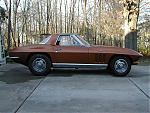
My 0.040" 350 was built with flattops poking 0.007" above the deck, and has a true 10.45 CR and 0.040" quench with the Cometic 0.047" head gaskets (we cc'd the Bowtie Phase 6 heads and matched each chamber volume). It runs on 91 octane. There are options other than high domes below 11:1 CR.
Le Mans Master


Joined: Feb 2008
Posts: 6,461
Likes: 1,888
From: Folsom CA
The Piston engineer at Sealed Power developed or redesigned most of the Forged Piston line they still sell today. He told me he could make more power with a dished piston every time if he could keep the compression within 1/2 point of the flat top or dome. It had to do with enhancing flame travel and a more complete burn and he could run a little more timing without detonation. So in the old small block Chevy's smaller combustion chamber cylinder heads with a dish or flat top can outperform a Domed piston with a larger chamber head. Assuming the chamber designs are of equal quality for air flow.
Detonation is different from engine type also. A 327 will inherently have less detonation than a 350 or 383 if all other parts are equal, same head design, same compression, same deck clearance. Comparing what works well in a 327 or 350 to build a 383 is not exact. You need to know what works well in a 383, the longer stroke affects things and makes it a little more prone to detonation. Even Rod length makes a difference as it changes dwell time of the piston at TDC. Lots to think about. One more thing, all flat tops are not equal, some have 2 valve reliefs and some have 4. Some are destroked by .020 and some are full deck height. For performance full deck height is preferred.
Mark
Detonation is different from engine type also. A 327 will inherently have less detonation than a 350 or 383 if all other parts are equal, same head design, same compression, same deck clearance. Comparing what works well in a 327 or 350 to build a 383 is not exact. You need to know what works well in a 383, the longer stroke affects things and makes it a little more prone to detonation. Even Rod length makes a difference as it changes dwell time of the piston at TDC. Lots to think about. One more thing, all flat tops are not equal, some have 2 valve reliefs and some have 4. Some are destroked by .020 and some are full deck height. For performance full deck height is preferred.
Mark
Drifting


Joined: Jul 2014
Posts: 1,545
Likes: 783
From: Massachusetts
OK, here is the real question behind this with regard to my upcoming engine build of an aluminum head 383 I question using flat top verse dome pistons.
1. Is there a h.p. performance difference? I know it likely depend on different things in different engines but I am taking specifically about MY engine build with Brodex aluminum heads and a planned on TRUE 10-1 compression.
2. Would there be a difference in octane requirements between the flat tops and domed pistons? I plan to run on 91 octane pump gas hence my questions.
1. Is there a h.p. performance difference? I know it likely depend on different things in different engines but I am taking specifically about MY engine build with Brodex aluminum heads and a planned on TRUE 10-1 compression.
2. Would there be a difference in octane requirements between the flat tops and domed pistons? I plan to run on 91 octane pump gas hence my questions.

Racer

Joined: Feb 2014
Posts: 372
Likes: 93
The dome piston allows for open combustion chambers which can dramatically reduce valve shrouding making more power than any other mod. In the end, the only way to get more torque from an engine at low engine speed is with more displacement or higher compression. Pick and choose the poison just about every mod has a plus and a minus.
Corvette Stories
The Best of Corvette for Corvette Enthusiasts

Top 10 Most Explosive Corvettes Ever Made: Power-to-Weight Ratio Ranked!
Joe Kucinski
150 hp to 1,250 hp: Every Corvette Generation Compared by the Specs That Matter
Joe Kucinski
8 Coolest Corvette Pace Cars (and Replicas) of All Time
Verdad Gallardo
Top 10 Corvette Engines RANKED by Peak Torque (70+ Years of Muscle!)
Joe Kucinski
Corvette ZR1X Will Be Pacing the Indy 500, And Could Probably Race, Too!
Verdad Gallardo
Top 10 Corvettes Coming to Mecum Indy 2026!
Brett Foote
Top 10 C9 Corvette MUST-HAVES to Fix These C8 Generation Flaws!
Michael S. Palmer
10 Revolutionary 'Corvette Firsts' Most People Don't Know
Joe Kucinski