When you click on links to various merchants on this site and make a purchase, this can result in this site earning a commission. Affiliate programs and affiliations include, but are not limited to, the eBay Partner Network.
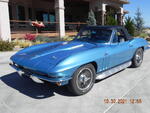
My ‘66 427-390 has an ancient MSD ignition, which I believe replaced its original transistor ignition in the seventies (or earlier).
Looking up its ECL code in Noland Adams book tells me that its “AA” ECL code is for TI on L36 without C60, so
I think it should be TI rather than standard ignition. Is this correct?
I also have the original (I think) distributor, so can someone ID it in the pic Below?
Mike - Here's a couple pics of my friends 66 L72 Roadster showing the TI box mounted on the front of the core support, drivers side. If your's is MIA, there might still be the '3' triangular holes in the core support.
Mike T - Prescott AZ
Curious that they’d put the MSD on and just leave the TI amplifier sitting there. Wonder if its still good?. I’ll have to ask the previous owner (since the 70s) if he knows what’s happening here. This is my first 427 and I’ve never had TI on any of my Vettes before, so I have no clue…
Last edited by Vettrocious; Aug 2, 2022 at 11:33 PM.
There are test procedures for the amplifier in the FSM. There are also updated circuit boards for them. The plug to the unit is often quoted as a problem and needs to be good and clean. If the distributor looks good with no sign of damage to the magnet and the pole piece, then it’s probably good. If a ballast resister was installed for the other distributor, it will need to be removed. In good shape a TI will provide you with good service and performance.
The car runs so well with the MSD that I’m hesitant to change it back, but it just looks so out of place. The wiring harness is a bit hacked up in the hood hinge area, so I’m gong to have to study the schematic and some photos of correct cars to see exactly what should be there and what should not. In the meantime, I’m going to send the distributor out for restoration.
If you really want to put the TI back into use it’s probably worthwhile to bite a bullet and buy a new TI harness. It has the proper resister conductors in it, new plug and terminals for connection to the engine harness. You may need a new coil too which are rare and expensive. But there is an economical coil available from Summit Racing that meets the specs. If you’re interested I can go check the part number on it for you. Could be you may still have the original coil. If any printing or numbers on it I would check them out.
A new TI harness is probably a good idea. I’m not a big fan of repro engine harnesses (the plugs suck compared to the originals) so I’d like to save the original engine harness, if possible. I may have the original coil, I’ll check.
Don’t take this for absolute fact, but I’ve read that if you want the best quality wiring components and best original quality plugs and terminals, use M&H over LectrIct Limited. I just put an M&H harness in a 66 Plymouth and all the original accessory harnesses that I re-used mated up fine. Everything seemed top quality. There were a few conductor color discrepancies to the original, but there were discrepancies between the original and the 66 FSM so who knows.
I am fairly sure 207 is the TI coil for SB. Not sure what the differences if any to a BB one. You can see someone painted over the factory TI label. I know the SB TI coil was sold over the counter for ALL TI apps
I’ll bet it works. If you have an ohm meter check the primary and secondary winding ohms. Even if OK it might still break down once hot but the old, original ones seem to hold up pretty well.
Checked both resistances, both are unacceptably low. Coil is Junk.
Read up on TI a bit. I don’t relish the thought of putting a Chineses repro low-winding coil with an original TI amplifier’s fragile transistor. May have to try to find a good original TI coil before changing, or consider altering the amplifier.
Checked both resistances, both are unacceptably low. Coil is Junk.
Read up on TI a bit. I don’t relish the thought of putting a Chineses repro low-winding coil with an original TI amplifier’s fragile transistor. May have to try to find a good original TI coil before changing, or consider altering the amplifier.
I bought this coil recently to carry as a spare for my original one. it is supposed to be compatible. There is no markings on the coil or box of point of manufacture? I believe it is law that if it is made outside of the USA it has to be marked as such?
Hard to see but the top of the coil is marked J21.
I bought this coil recently to carry as a spare for my original one. it is supposed to be compatible. There is no markings on the coil or box of point of manufacture? I believe it is law that if it is made outside of the USA it has to be marked as such?
Hard to see but the top of the coil is marked J21.
Probably not going to see a restored distributor any time soon, so I’ve got a while to investigate the coil. The problem with coils, in general, as I understand it, is that the repros are all pretty much the same under the skin, dressed up so as to seem different. The original TI coil was apparently made with many more windings than the “normal” Delco coil, which put the fragile transistors(s?) in the TI amplifier at less risk. (I have no first-hand knowledge of this).
Other than opening up the coil and counting the windings, is there a way to determine that it is actually fully “compatible” rather than just able to “function” on the TI system? Forgive my ignorance here, just trying to understand the issues.
Probably not going to see a restored distributor any time soon, so I’ve got a while to investigate the coil. The problem with coils, in general, as I understand it, is that the repros are all pretty much the same under the skin, dressed up so as to seem different. The original TI coil was apparently made with many more windings than the “normal” Delco coil, which put the fragile transistors(s?) in the TI amplifier at less risk. (I have no first-hand knowledge of this).
Other than opening up the coil and counting the windings, is there a way to determine that it is actually fully “compatible” rather than just able to “function” on the TI system? Forgive my ignorance here, just trying to understand the issues.
Thanks,
Mike
This coil was recommended in another thread here about K66 and was supposedly tested and is supposed to be acceptable.








 ‘66 l36 ti