When you click on links to various merchants on this site and make a purchase, this can result in this site earning a commission. Affiliate programs and affiliations include, but are not limited to, the eBay Partner Network.
Rear crank journal and rear cam bearing both get their oil from the same pressurized passage. That passage also feeds the lifter oil galleries from the far side of the rear cam bearing
Doesn't answer my question, though. What keeps 300-400 lbs of oil pressure forward force from building behind the back of the cam. It would seem there would have to be a drain to somewhere.
Did you mean to say 30 to 40 psi? Unless there is 10 square inches of contact area back there (??!!!) I fail to see how 300 to 400 lbs of force could be generated.
There's no drain. Whatever forward force is generated by oil pressure on the rear plug is balanced by other rearward force on the cam, like the distributor gear and the lifters acting on the tapered cam lobes. The oil all blows out through clearance between the cam journal and the bearing shell anyway, so the force isn't all that much. A few PSI of pressure acting on 4 square inches of area is all.
and the cam bearing diameter is 2.5", you have 1.25" x 1.25" X pi x 60 PSIG = 294 pounds force forward on the cam if the rear of the cam pocket is pressurized at full oil pressure, and that pressure carries over to both sides of the bearing oil ejection annulus
Now oil can and does leak out the front of the cam bearing, but it is fed to the center of the bearing at 45-60 PSIG, so some of that pressure is going to the back half of the bearing. Maybe the front of the bearing clearance is the pressure relief and it never builds that high behind the car journal.
So the area is a bit under 3.14 sq. in. Go with 3 for grins. Even at a full 60 psi the forward force from oil pressure would be under 200#. And as you've noted, the oil pressure at the plug is likely quite a bit less than line pressure. It's a big pressure drop as a result of oil leaking out the front end of the bearing and fluid friction loss between the cam and the bearing shell. The answer to your question is the same: there's no oil pressure relief in the block. The counterforce generated by the distributor gear and the cam lobe/lifer action is more than enough to offset any forward force from oil pressure.
Where this is all going, if there is no oil drain, is i think thats why Chev got rid of the groove in the rear cam journal (BBC) and went with a more expensive groove under the rear cam bearing. Back when, mid 1960s a cam button and thrust reinforcement on the inside of the timing cover was highly recommended for BBC racers, and yes they were using flat lifters.
The new bearing with its one small hole oiling the rear cam bearing, doesn't pass huge amounts of oil, but the 360* grooved rear cam journal would let lots of pressurized oil into the rear pocket behind the cam,and i could see at high RPM, how that would cause enuf pressure to push the cam forward.
Chev didn't get rid of a less expensive manufacturing operation for no reason at all.
Designer Imagines A Corvette That Looks More Like a Corvette Than the Corvette
Slideshow: A Jaguar designer's personal project imagines what a modern front-engined Corvette might look like if Chevrolet revisited the golden age of the Stingray.



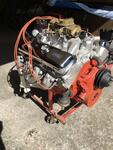






 Stoopid engine block question






 Well dont I feel stupid now.