When you click on links to various merchants on this site and make a purchase, this can result in this site earning a commission. Affiliate programs and affiliations include, but are not limited to, the eBay Partner Network.
I'm looking for some help to determine root cause of failure on my steering box. As background, in June of 2022 I returned my 1966 small block roadster to the road following 6 years of a body-off restoration. It's been a long labor of love but was a great feeling to get it back on the road. In the restoration, the steering box was rebuilt using a Paragon rebuild kit. All wear items including bushings, ball joints, steering coupling were replaced. Since then I've been completing some small items and sorting out some issues that have cropped up without too much drama and have driven the car just over 3000 miles.
A few weeks back I took the wife out for a ride and noticed a clunking noise during a slow speed turn while backing out of our garage. During our ride thru the countryside I noticed a significant increase in the looseness of the steering. There was a solid 1/8 turn of the steering wheel before you felt any steering response. We got home without incident. A few days later I had my buddy who rebuilt the steering box for me come over to check out the steering. While backing out of the garage the steering became VERY hard to turn. We were fortunate to be able to get it back into the garage.
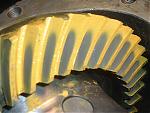
I removed the steering box and quickly saw what had happened. The ball guides had "popped" open. It's apparent that something had blocked the path of the ball bearings and the hard steering that I felt was probably enough to pop open the ball guides.
On further disassembly you can clearly see that the obstruction where one of the tabs on one of the ball guides is bent over and there is a clear sign that a ball bearing had been jammed into the outer side of the ball guide, clearly blocking the path of the ball bearings through the guide. One of the other guides had a tab broken off. I found the remnant of the tab in the grease during disassembly.
The worm shaft and all other parts are in good shape. No signs of palling damage in any of the ball bearing paths. Bushings and seals are in great shape. All else looks good. My plan is to reassemble using a new Borgeson worm rebuild kit that includes new guides, guide clamp, clamp screws and ball bearings.
I have a pretty good idea of what happened but I'm not clear on why it happened. I'd appreciate any suggestions on a likely root cause of failure. Also it would be good to hear if anyone has had a similar issue and what you found as the cause. Just trying to make sure I'm not missing something that needs to be addressed before reassembly.
I'm looking for some help to determine root cause of failure on my steering box. As background, in June of 2022 I returned my 1966 small block roadster to the road following 6 years of a body-off restoration. It's been a long labor of love but was a great feeling to get it back on the road. In the restoration, the steering box was rebuilt using a Paragon rebuild kit. All wear items including bushings, ball joints, steering coupling were replaced. Since then I've been completing some small items and sorting out some issues that have cropped up without too much drama and have driven the car just over 3000 miles.
A few weeks back I took the wife out for a ride and noticed a clunking noise during a slow speed turn while backing out of our garage. During our ride thru the countryside I noticed a significant increase in the looseness of the steering. There was a solid 1/8 turn of the steering wheel before you felt any steering response. We got home without incident. A few days later I had my buddy who rebuilt the steering box for me come over to check out the steering. While backing out of the garage the steering became VERY hard to turn. We were fortunate to be able to get it back into the garage.
I removed the steering box and quickly saw what had happened. The ball guides had "popped" open. It's apparent that something had blocked the path of the ball bearings and the hard steering that I felt was probably enough to pop open the ball guides.
On further disassembly you can clearly see that the obstruction where one of the tabs on one of the ball guides is bent over and there is a clear sign that a ball bearing had been jammed into the outer side of the ball guide, clearly blocking the path of the ball bearings through the guide. One of the other guides had a tab broken off. I found the remnant of the tab in the grease during disassembly.
The worm shaft and all other parts are in good shape. No signs of palling damage in any of the ball bearing paths. Bushings and seals are in great shape. All else looks good. My plan is to reassemble using a new Borgeson worm rebuild kit that includes new guides, guide clamp, clamp screws and ball bearings.
I have a pretty good idea of what happened but I'm not clear on why it happened. I'd appreciate any suggestions on a likely root cause of failure. Also it would be good to hear if anyone has had a similar issue and what you found as the cause. Just trying to make sure I'm not missing something that needs to be addressed before reassembly.
Thanks in advance for the help.
That looks like what could happen if an extra ball were installed in that race during the rebuild. Not a difficult error to make. Just food for thought.
I would say it was assembly error. I have taken apart 100's of them and never had that issue. The ball screw is acid etched, I bet the preload was choppy- did you check it?
With a new worm I would be checking true center, arm position, high lash as they most likely will be off now. Steering gears are not machine matched like a ring and pinion, you may find it interesting dialing in the new worm. It might be ok or out 90*.
Good Luck. When done there should be -0- play in the box on high lash, which isn't always center.
Thanks Gary. I appreciate your input. You come highly recommended!
The preload was set at assembly. We did not check it before disassembly. You mention the ball screw (is that the worm shaft?) is acid etched. What is the significance of that? Just trying to fully understand.
One clarification. I was not planning to replace the worm shaft itself. It was not replaced when it was rebuilt 3000 miles ago. The worm shaft appears to be in good shape with no damage in the ball bearing runs. The Borgeson worm rebuild kit I got from Summitt does not include a new worm shaft. The kit includes new guides, guide clamp, guide clamp screws and ball bearings. Does that change any of your guidance?
Last edited by 1966KIX; Oct 11, 2023 at 04:53 PM.
Reason: clarification
If there was no restriction in the worm nut or guides, I don't know why they opened up like that. They are slip fit parts.
The worm is made up a ball screw, common in machinery, nut, guides and ball bearings. I do not use kit parts sold by vendors, so I can't say if that is where the problem was to start. I used to machine my own bushing but now have them made to my specs. I size every bushing to every sector after I first check and polish them. There is a difference in build quality between fit bushings and kit bushings made to fit all. Same for assemble procedures. The GM manual is close, online "how to's" are not.
I don't know the quality of the Borgeson parts, again I don't use them or others for my parts. I would mic the old bearings and the new to see how close they are. The other parts should be fine.
Old grease becomes acidic or dries out. Moisture gets in the box and attacks the bearings and the ball screw, I can see that in your picture. That is why I asked about the preload on the new bearings. You need a dial 0-30 in/lb wrench to see it, a beam TW isn't going to do it. Some, many in fact, will disagree and I would bet you lunch many rebuilders go by feel only. I have read some online procedures and wouldn't advise most of what I read. It comes down to what level of quality you want. There are some things I do with every build that sets them apart from the common boxes sold today or done at home. I no longer share that information since some took advantage of what I have posted in the past.
When all is said and done, there should be a smooth and steady preload you need to know what it is. It should hold through the range, the lash should come up to the high point and drop back off again. There should be no play- none- at the high lash point. Hand pressure alone on the input of one of my boxes moves the output. Going by center is a mistake 99% of the time, it will work and probably be better than it was, but it won't be the best.
Done right, you don't need a faster ratio box, the car will handle better than new. Done wrong and there will be play driving straight down the road. That's when guys get frustrated and toss out the system for a Borgeson or Rack. PS leaks account for a lot of that frustration as well and a lot of that is due to the quality of parts sold today. It never was when you could buy any PS part from any Chevy dealer in the country.
Designer Imagines A Corvette That Looks More Like a Corvette Than the Corvette
Slideshow: A Jaguar designer's personal project imagines what a modern front-engined Corvette might look like if Chevrolet revisited the golden age of the Stingray.



 C2 Steering Box Failure Analysis