









[C2] Engine Redline
Thread Starter
Instructor


Joined: May 2016
Posts: 191
Likes: 53
From: Medford OR
 Engine Redline
I recently had my 1965 327/300hp engine rebuilt. Forged pistons/connecting rods, roller rockers and cam, etc. engine builder broke in the motor on the dyno and I have added 300 miles on it so far. I havn’t really babied it but also not driven exceedingly hard.
engine builder told me max RPM is 5500-6K max. Yes I know that is higher than stock 327/300hp but my motor is more of stock appearance and upgraded internals.
I decided to finally get on it to see what it could do and hit almost 6K rpm in first gear. That wasn’t my intention but by the time I looked down at the tach, that’s where I was and quickly shifted to second.
Finally my question- engine builder told me max RPM is 5500-6K. Why is there a 500 RPM swing. Am I ok to occasionally hit 6K or never go past 5500?
my cam card says “basic operating range 1600-5400rpm.
again just wondering why in my case redline is 5500-6K and not just 5500 being the cut off?
car is running great and haven’t noticed any negative effects since hitting 6K rpm but not planning on doing it again. I am assuming that is not particularly good for my new motor.
thanks for any help clearing this up!
engine builder told me max RPM is 5500-6K max. Yes I know that is higher than stock 327/300hp but my motor is more of stock appearance and upgraded internals.
I decided to finally get on it to see what it could do and hit almost 6K rpm in first gear. That wasn’t my intention but by the time I looked down at the tach, that’s where I was and quickly shifted to second.
Finally my question- engine builder told me max RPM is 5500-6K. Why is there a 500 RPM swing. Am I ok to occasionally hit 6K or never go past 5500?
my cam card says “basic operating range 1600-5400rpm.
again just wondering why in my case redline is 5500-6K and not just 5500 being the cut off?
car is running great and haven’t noticed any negative effects since hitting 6K rpm but not planning on doing it again. I am assuming that is not particularly good for my new motor.
thanks for any help clearing this up!

Popular Reply
Oct 29, 2024, 07:34 AM
Race Director


Joined: Feb 2007
Posts: 15,500
Likes: 8,973
From: northern california
C2 of Year Finalist (track prepared) 2019
Thread Starter
Instructor
Joined: May 2016
Posts: 191
Likes: 53
From: Medford OR
Thank you for the reply. I understand valve float or lifter float at redline.
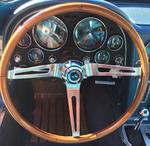
I was just wondering on my factory tach for example why redline starts at 5300 and stops at 5500. Why the 200 RPM buffer? Why wouldn’t it just be 5300 without a buffer? In that example would it be ok to 5500 rpm?
that was what I am curious about?
thanks!
I was just wondering on my factory tach for example why redline starts at 5300 and stops at 5500. Why the 200 RPM buffer? Why wouldn’t it just be 5300 without a buffer? In that example would it be ok to 5500 rpm?
that was what I am curious about?
thanks!
Le Mans Master


Joined: Feb 2012
Posts: 5,388
Likes: 2,891
From: Western Massachusetts
2024 C2 of the Year Finalist - Unmodified
2023 C2 of the Year Finalist - Unmodified
2019 C2 of Year Finalist (stock)
2015 C2 of the Year Finalist
Thank you for the reply. I understand valve float or lifter float at redline.
I was just wondering on my factory tach for example why redline starts at 5300 and stops at 5500. Why the 200 RPM buffer? Why wouldn’t it just be 5300 without a buffer? In that example would it be ok to 5500 rpm?
that was what I am curious about?
thanks!
I was just wondering on my factory tach for example why redline starts at 5300 and stops at 5500. Why the 200 RPM buffer? Why wouldn’t it just be 5300 without a buffer? In that example would it be ok to 5500 rpm?
that was what I am curious about?
thanks!
Dan
Thread Starter
Instructor
Joined: May 2016
Posts: 191
Likes: 53
From: Medford OR
Thank you for the responses. Much appreciated! I guess the moral of the story is since my engine builder told me 5500-6K max RPM, I probably should stay under 5500. Not a real high HP motor but it was able to make about 350hp at 5500RPM when it was on the dyno.
the “visual buffer” makes sense.
thanks!
the “visual buffer” makes sense.
thanks!
Race Director
Joined: Feb 2007
Posts: 15,500
Likes: 8,973
From: northern california
C2 of Year Finalist (track prepared) 2019
For my money, there are two considerations in determining an engine redline. One is what is the RPM beyond which the engine stops making useful power. The other is what is the RPM beyond which the engine is likely to experience RUD.
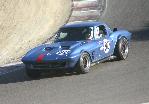
Good case in point is the engine in my road race Grand Sport. The engine will survive 6500 RPM just fine. However, it doesn't make useful power at that RPM. Through experimenting at Laguna Seca, I discovered that my best lap times happen when I shift just below 6000. Speed is my objective so that's where I redline that engine.
Good case in point is the engine in my road race Grand Sport. The engine will survive 6500 RPM just fine. However, it doesn't make useful power at that RPM. Through experimenting at Laguna Seca, I discovered that my best lap times happen when I shift just below 6000. Speed is my objective so that's where I redline that engine.
Corvette Stories
The Best of Corvette for Corvette Enthusiasts

Corvette & Porsche 911: How Two Icons Conquered the Last 25 Years
Joe Kucinski
2027 Chevrolet Silverado 1500 First Look: Everything You NEED to Know!
Michael S. Palmer
5 Best & 5 Worst Corvette Daily Drivers
Joe Kucinski
The Headlights of Every Corvette Generation Explained
Joe Kucinski
5 Best & 5 Most Overrated Corvette Track Packages of All Time!
Joe Kucinski
Every 2027 Corvette Engine Explained
Joe Kucinski
Designer Imagines A Corvette That Looks More Like a Corvette Than the Corvette
Verdad Gallardo
10 Ugly Corvettes That We Still Kinda Love
Joe Kucinski
Top 10 Most Expensive Corvettes Ever Sold on Bring A Trailer
Brett Foote







Pro


Joined: Mar 2010
Posts: 623
Likes: 20
I just had my big block rebuilt 2 years ago. Similar experience. Stock block and heads (oval port), original rods, new forged pistons, all new roller valvetrain. Builder said would spin fine up to "about 7" and I saw him dyno it multiple times to 6500. I stay under 5500 because I'm simultaneously boring and afraid of grenading the engine. I don't ever want to remove it again--such a pain in the ***.



Drifting


Joined: Nov 2004
Posts: 1,512
Likes: 684
From: Folsom Ca
The cam specs tells the range where the cam is making usable power…
valve springs and balancing well determine the max safe rpm,
but if it “quits making power” at 5400 rpm, but your valvetrain etc can spin to 7500 rpm, it should be fine, but as Jim Lockwood mentioned above, the car might not be as fast because it’s not making a lot of power anymore. A engine doesn’t really quit making power, just makes less than at that optimum peak power rpm…
the cam (and associated valve train) are designed to make most power in the certain rpm range, so a builder can tailor the engine to their driving style, etc.
a dedicated racecar will have the engine/trans/rearend ratio optimized for the race course and conditions, so as to keep the car in the mating the power and as much as possible.
as for the tachs redline bring a range, probably makes it easier to discern as opposed to a single, thinner line. I am sure factory redlines on the tach are a little low to help Aboud warrantee issues as well…
valve springs and balancing well determine the max safe rpm,
but if it “quits making power” at 5400 rpm, but your valvetrain etc can spin to 7500 rpm, it should be fine, but as Jim Lockwood mentioned above, the car might not be as fast because it’s not making a lot of power anymore. A engine doesn’t really quit making power, just makes less than at that optimum peak power rpm…
the cam (and associated valve train) are designed to make most power in the certain rpm range, so a builder can tailor the engine to their driving style, etc.
a dedicated racecar will have the engine/trans/rearend ratio optimized for the race course and conditions, so as to keep the car in the mating the power and as much as possible.
as for the tachs redline bring a range, probably makes it easier to discern as opposed to a single, thinner line. I am sure factory redlines on the tach are a little low to help Aboud warrantee issues as well…

Team Owner


Joined: Sep 2002
Posts: 38,392
Likes: 2,099
From: California
Seriously there came a time when drag racing happened in my mind and visually in slow motion with Street race after Street race.Early on pulling acceleration and trying to shift smartly, that damn tach needle seemed to move so fast, that I was starting my shift throw at 5500 approximately, but completed the motion by about 6K. Now I rarely shift on the tach, but on engine sound alone, except my fastest car I added a cheater shift light, and out of my peripheral vision, on picking up the flash on of that, I throw the shift at like 7800 rpms!