When you click on links to various merchants on this site and make a purchase, this can result in this site earning a commission. Affiliate programs and affiliations include, but are not limited to, the eBay Partner Network.
Continuing saga from my post on the head work on R66:
I rechecked the valve guides in the heads per the GM Service Overhaul Manual Section 6 using a near new valve with .3410 in. stem in lieu of .3413 in. minimum new diameter. The readings were within the allowable clearance for service of .0027 in. Thus, I plan to install new intake and exhaust valves to achieve the GM maximum allowable service clearance and install umbrella seals in addition to the O-ring seals on the valves to control oil usage thru the guides.
I am still considering knurling the guides to bring the clearances down to .001 in. on the intakes and to .0015 in. on the exhausts.
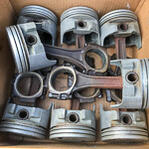
I was still concerned that the oil usage was 1 qt./100 miles and thus decided to pull the pistons and look at the rings and cylinder walls. The engine only has 59K miles on it, but most of the 45K miles by the previous owner was in city driving.
The rod bearings exhibit very minimal wear except for minor dirt scores and are still very serviceable. But, if I install new rings, I will probably install new rod bearings too.
Piston skirts show minimal wear.
The standard pistons are in near factory condition with minimal wear and light scoring on the skirts. The original machining marks are still visible on both sides of the skirts and no scuffing on the top edge of the pistons. Thus, I plan to reuse the original pistons. I don't have a 4 in. micrometer to measure the pistons.
The compression rings on all 8 cylinders exhibit no damage (none broken), thus provide justification for the high compression readings obtained even though the oil consumption was high. However the oil in the cylinders could have been masking bad sealing of the compression rings.
The oil rings and expanders of 3 pistons (#1, #2, & #6) are stuck in the groove and will need to be removed and the groove cleaned. Cylinders #1, #3, & #6 had the most oil carbon on the pistons and valves. I believe the stuck rings contributed significantly to the oil usage although the rings do not exhibit any damage. I will clean the groves of all of the pistons of course.
Metal slivers of unknown source.
I found 3 slivers of metal .023" thick x .065" wide. One piece about 1" long, one about 1-7/8" long, and one about 3/8" long. I believe they were in the ring grove of one piston as they fell to the bench when I picked the piston up. They seem to be similar to ductile iron or steel material, not cast iron, as they do not break when bending.
indication seems to be a cold joint or lamination in the metal when the block was cast
Another lamination - 3 total
I also have 3 cylinders #6, #4, and #1 that have, an indication similar to a crack around the cylinder circumference perpendicular to the piston stroke. The indication is not straight, and I can fell it with my finger nail, but not catch it. These indications seem to be a cold joint or lamination in the metal when the block was cast. These are of a concern should I decide to re-ring with moly filled rings which is what I prefer to use. Also, I don't want to bore the block for fear of opening up a path to the water jacket. The engine currently uses no coolant.
Opinions needed on:
1. any thoughts where the 3 slivers of metal came from?
2. Should I abandon the idea of using new moly filled rings because of the circumferential indications in the 3 cylinders? I don't believe these indications will hone out. Also should I abandon installing moly rings due to these indications and some taper in the bore?
3a. Should I just clean the ring grooves and reinstall the existing rings and bearings? Should I hone the cylinder walls if I reuse the existing rings? - or -
3b. Should I install new moly rings if they will survive in the imperfect cylinders? Of course hone the cylinder walls and install new rod bearings. -or-
3c. Should I install new cast iron rings, I don't like them, but they last for 100K miles on most SBCs and have survived for 50K plus in this engine -or-
3d. Should I install ductile iron rings which are less brittle and may be more suitable for the imperfect bores.
4. Taper of the cylinder walls is yet to be accurately measured due to my MTE is cheap, but I am finding about .002 in.
This is my first re-ring job as I have always previously bored and built engines to last long term. For this re-ring, I am only looking to extend the engine life 20K miles or more with new valves and rings. Thus, I am looking for guidance from the experienced engine technicians.
A lot of the things you've mentioned are not going away with this rebuild...but it CAN improve for sure.
Nearly .003" of valveguide clearance is huge. Need to be in the .0015-...002" max range for something like this. Not a fan of knurling at all. It won't last long. You've effectively removed half of the stem support and concentrated it on the raised edges which will wear away quickly. New inserts are the way to fix them and with a good valve job they'll still be worth selling or using on the later build. Using good positive seals will help also instead of o-rings or umbrellas.
I agree the stuck oil rings are probably one of the biggest issues. Under no circumstances would I reuse old rings in it. Get new ones and new rod bearings also.
The old rings are showing full face wear it appears...so they aren't able to function as designed. They're done.
First thing to mention is cleaning ring grooves MUST be done VERY carefully. 99% of the time the pistons are ruined by someone using a ring groove cleaning tool, or an old ring section. Rings seal to the ring lands...top and bottom faces as much as the cylinder walls. And scratches, grooves, or wear will cause them to not seal and you'll end up with blowby etc.
Yes, I'd hone the cylinders. The odds are the cylinders are a long way from being actually round and straight on any OEM block. You could have a machine shop hone them with a torque plate to see if they can be straightened out, but of course you'll start gaining piston to wall clearance. Not a good thing. So if you're not going that route...a dingleball hone will be the best bet.
Good moly rings bought .005" oversize to allow for setting the gap as best as possible will help. They're forgiving.
Basic plain cheap cast iron "rebuilder" rings will seal up and as mentioned will last for a while, but gaps will likely be larger.
.002" taper is a good bit...but again..it's up to you. Sounds like the best approach is a .030" bore with some good pistons...but I understand wanting to do a quickie cheap rebuild. You can and it will run a good while.
If I went this far I'd be looking at main bearings and rear main seal too..."while I'm at it". If not planning to replace oil pump, I'd throw in a cheap Z-28 high pressure spring to kick things up a little...and maybe pull the end cover and sand the housing to tighten the end play to the below .002" range. I'd also tack weld the pickup to it.
I like that plan...although, I'd use standard size rings, not oversize, and not worry about any extra end gap (but do check it to make sure it has enough gap)
If the bores have less than about .005" taper, then the new cast rings should last forever under typical "today" driving conditions, ie. a few thousand miles per year. If you were using the car for daily transportation, you'd want to bore it...but if you just want to fix the oil consumption issue and drive the car occasionally, the cheap simple rering job is a good way to go.
I would not change bearings unless needed. I'd consider changing the rear main seal, and inspecting the cam bearings, though. To inspect bearings to see if they need replacing, just look for more wear in the center of the insert, or excessive scoring anywhere on the bearing surface, or flaking or whatnot. Pictures will let us see and comment.
btw, the piston skirts do have significant wear, but not enough that I wouldn't try to get another 25k miles out of them. See how the machining marks are worn away at the top center of the skirt? That's the place that gets the most wear. But as you noted, there's no indication of contact with the cylinder wall at the top of the pistons, so they're still doing OK.
I'm a big fan of the $200 overhaul....gaskets and rings, and re use as many of the old parts as possible. Then let the next guy do the full rebuild in 20 years after I'm gone.
Thanks Jim (427 Hotrod),
You and I are on the same page with doing it right. The 355 cu.in. engine I have in the 68RS is .030" over with forged pistons, balanced, steel guides in the heads, etc. I raced it on the strip in a Vega for a couple of years before dropping it in the Camaro and it has 130K miles on it. They will last if you build them right without a restrictive budget.
One of the problems I have are the laminations in the block as boring may open them up to the water jacket which means sleeving it. If it were not a 100% original drive train car, I have three other engines under the bench which could get a full rebuild and installed in the car. It is not a rare car and far from NCRS perfect, but I don't want to devalue it by swapping out the engine.
I have a full set of gaskets (less intake gaskets), oil pump, roller chain, main and cam bearings all in stock and the tools to hone and re-ring the block. The machine shops now want over $500 plus parts to do the heads with steel guides, $350 just for a basic valve job. Cheap valves are $80 plus shipping. I am looking at valves with .015" oversize stems for double that amount. It seems to be ridiculous worrying about $1K or more on a car worth much more.
The car will most likely be sold in the next 2 years along with all of my other toys. We drive it less than 3,000 miles a year. Inflation is destroying the purchasing power of my retirement savings and Social Security increases are a joke, so I am now back in budgeting mode and don't want to waste money my wife will need later. Yea, I am not a man of unlimited funds.
Ron
Continuing saga from my post on the head work on R66:
I rechecked the valve guides in the heads per the GM Service Overhaul Manual Section 6 using a near new valve with .3410 in. stem in lieu of .3413 in. minimum new diameter. The readings were within the allowable clearance for service of .0027 in. Thus, I plan to install new intake and exhaust valves to achieve the GM maximum allowable service clearance and install umbrella seals in addition to the O-ring seals on the valves to control oil usage thru the guides.
I am still considering knurling the guides to bring the clearances down to .001 in. on the intakes and to .0015 in. on the exhausts.
I was still concerned that the oil usage was 1 qt./100 miles and thus decided to pull the pistons and look at the rings and cylinder walls. The engine only has 59K miles on it, but most of the 45K miles by the previous owner was in city driving.
The rod bearings exhibit very minimal wear except for minor dirt scores and are still very serviceable. But, if I install new rings, I will probably install new rod bearings too.
Piston skirts show minimal wear.
The standard pistons are in near factory condition with minimal wear and light scoring on the skirts. The original machining marks are still visible on both sides of the skirts and no scuffing on the top edge of the pistons. Thus, I plan to reuse the original pistons. I don't have a 4 in. micrometer to measure the pistons.
The compression rings on all 8 cylinders exhibit no damage (none broken), thus provide justification for the high compression readings obtained even though the oil consumption was high. However the oil in the cylinders could have been masking bad sealing of the compression rings.
The oil rings and expanders of 3 pistons (#1, #2, & #6) are stuck in the groove and will need to be removed and the groove cleaned. Cylinders #1, #3, & #6 had the most oil carbon on the pistons and valves. I believe the stuck rings contributed significantly to the oil usage although the rings do not exhibit any damage. I will clean the groves of all of the pistons of course.
Metal slivers of unknown source.
I found 3 slivers of metal .023" thick x .065" wide. One piece about 1" long, one about 1-7/8" long, and one about 3/8" long. I believe they were in the ring grove of one piston as they fell to the bench when I picked the piston up. They seem to be similar to ductile iron or steel material, not cast iron, as they do not break when bending.
indication seems to be a cold joint or lamination in the metal when the block was cast
This is my first re-ring job as I have always previously bored and built engines to last long term. For this re-ring, I am only looking to extend the engine life 20K miles or more with new valves and rings. Thus, I am looking for guidance from the experienced engine technicians.
Thank You, your guidance is truly appreciated.
Ron
I am no expert on this but I have certainly been down YOUR road with the same issues so I will offer only 2 bits of advice.
1. Remove each rocker arm stud and check to see if the holes are blind or drilled all the way through----if blind leave them alone. If drilled through add thread sealer and hope for the best. Evidently Aluminum heads are drilled all the way through---DIRECTLY INTO THE INTAKE STREAM. Each time a piston goes down on the intake stroke it sucks oil down those studs into the intake coating everything with oil. THREE rebuilds and countless hours and expense could have been avoided for 1.50's worth of thread sealer and ONE hours worth of work to completely solve the oil burning issue.
2. The rings come in THREE bags.1 Marked TOP 2 Marked SECOND and 3 Marked THIRD easy enough but keep in mind that IF a Ring has the word "TOP" stamped on it IT MAY NOT BE THE TOP RING but actually the Second ring and the word TOP means that the word TOP must face UP But actually be in the second groove. Be VERY CAREFUL about this.
Thanks Jim (jforb),
I am out of my normal mode here with a re-ring. As I stated above, I don't want to sink money into the block with laminations, even though it is original to the car. I am leaning toward the re-ring of the block and oversize stem valves in the heads if I can find them. I am in no hurry to get the project done, April 1st is the target for a first cruise.
If the wife has to sell it, a smoker won't bring much even though it has the original drive train in a base model. Plus, it is embarrassing to drive even just ~3K miles a year.
Still have to refine the measurements on the bore taper with better MTE, but I will not bore this block due to the laminations as I have 3 good engines under the bench and 2 sets of good 300 hp double hump heads on a shelf. It could become a non original drivetrain car for much less.
Ron
Thanks Eddie,
I have built a half dozen engines or so, but learned the only way to do it right is to follow the book - step by step. The dot on the top ring, beveled rings, gap spacing, clearances etc. GM is a lot smarter than I am. I have never encountered the problem with the pressed in rocker studs on cast heads, but will definitely do some looking. The heads appear to have never been off, but had the evidence of a very slight coolant leak around the bolts at the ends. The steel shim head gaskets show no leaks, so it must have been poor sealing of the threads.
My oil usage is definitely primarily valve stems worn up to .002" and the guides up to .002" +. That plus stuck oil rings on the three pistons created huge paths for the oil.
Thanks for your input
Ron
I really wanted to re-ring & re-bearing my 70k mile 427 this summer but upon inspection couldn't get off that easily. I did a lot of study and consideration on how far I wanted/needed to go with getting the engine back up and running with stock performance and characteristics – keeping in mind that it likely won't see but maybe 20k miles in its future with me. I went with standard-quality Clevite bearings and Hastings rings but splurged on the heads with bronze guides and stainless valves – also added forged pistons. Everything else is OEM-Melling. (Hopefully will get to hear it run this week and dyno tested!)
Here's my 1¢ opinion:
The lamination spots appear below the compression ring of the piston at BDC and haven't caused any issue with coolant or other catastrophe in 60 years/60,000 miles, so just let 'em go.
If you feel honing is good, go with the rings most forgiving of taper, fit, and cylinder finish.
Put in new rod and main bearings. The cost is so minimal that it'd be kinda silly not to.
I'd do new valve guides if it were mine. I don't like stop-gap measures for this type of situation, plus it's a selling point later on.
I've no idea where the strips of metal could have come from. If they didn't score the bore, they must have been captured somewhere inside the piston.
Update: I found the source of the metal in the pistons. The second compression ring on each piston appears to have delaminated or GM used a spacer behind the second compression ring. The second ring is narrower depth wise than the top ring. So far, no broken rings nor piston ring lands to indicate detonation.
I think the slithers are malleable iron and thus my guess is a spacer of some type to compensate for the narrow depth ring.
Have any of you engine builders ever seen a cast iron ring with slithers of metal or a spacer behind it
It appears GM put this engine together with reject parts. I have new rings and bearings on the way.
I have two machine shops in the area that will work on the heads, but neither will install .003 in oversize valves. They want to install cast iron sleeves. They also want to install steel seats.
I may try to ream the guides and grind the seats myself. The GM Overhaul Manual shows it can be done without machine shop equipment. Anyone have tips on this DIY valve job?
I have two sets of double humps that need no work and are ready to install, so no way am I taking a chance on a second set of boat anchors with steel seats that leak antifreeze into the cylinders.
Thanks for the guidance.
Ron Slithers of metal I dug out of the ring groove of the second compression ring.
Last edited by R66; Dec 3, 2024 at 09:24 PM.
Reason: pictures
It might have been re-ringed in the past....I think "ring expanders" were a thing for a while...not factory.
Are the rod bearings original? If you can't tell, post a few pictures of the stampings on the backs of them. This might tell you if it's been apart before in the past half century.
The rod bearings are GM and all STD. The head gaskets are the steel shim type which GM used to obtain the 10:1 compression. I don't know how to identify the original head gaskets as GM. All of the cylinders have the same measurement 4.002 in. at the top, 3-1/2" down and at the bottom of the ring travel. I can detect no taper with the snap gauges and caliper I am using as I don't have a dial type bore gauge.
I am convinced the engine is original GM build with 59K miles.
No way I'd install hardened seats. If buying new valves...get some 2.02's if it had 1.94's originally. And 1.6's vs 1.5 exhausts. That will get the valve seats into new metal and raise it back up where it belongs. Blend the new seat into the bowls (read up on doing this if you haven't done it before. You want the have the throat around 90-92% of the valve diameter. Don't make it too big.
Some guide inserts (liners) can make things perfect.
Those marks in the bores don't worry me from what I can see.
I've never seen expanders behind OEM rings either. Check piston groove depth on the pistons against your new rings to make sure of things.
I missed this listing somehow but I always try to follow engine builds.
Jim gave some very good advice with reasons for it early in this post. As he mentioned the Cast Iron faced rings are 100% worn out, you can tell because they are already in full contact with the cylinder. These new are tapered faced or. \ , your rings have zero taper left so they are worn out.
As Jim also pointed out the rings seal on the piston ring land as well as on the cylinder wall so good ring seal would involve new pistons and a professional bore and hone.
I say professional hone because the hone controls the speed the rings will rotate as your engine runs. You can't get good ring seal with a hand held hone. You would leave a lot of good sealing behind by hand honing. If you choose not to get a professional hone I would run the rings on the cylinders as is. Modern Moly rings well well on a smooth surface.
Even GM tells its techs to not hone a factory cylinder unless there is damage to repair.
A home hone can cause more damage than it helps.
I would not consider installing cast iron piston rings unless no other option was available. Moly top rings seal so much better and cause much less cylinder wear. For a $25 increase over the cost of cast rings you can't spend your money better on any part inside that engine.
I have re ringed an engine with almost 200K on it and it ran well afterwards. Brand new, NO but much better than before the re ring job and sometimes it is an option that fits the budget.
The last set of heads I had done, this year in California cost $700 for full rebuild, guides, seats, surfaced, but these were Vortec heads from a 99.
I had a pair of 462 Fuelly heads rebuilt and converted to 2.02 properly for $500 but that was 8 years ago. Everything has gone up since.
You can build it any way you wish. Just offering opinions and trying to help.
I have ordered new Clevite rod bearings even though the existing bearings appear very good. The existing rod bearings are GMM 400 originals with no visual wear other than dirt scratches. The crank appears perfect, however I will check the clearances upon reassembly with new bearings.
I have already ordered the moly rings so am waiting on them to verify clearances in the piston grooves and cylinders. Given the unknown material behind the second ring I want to assure the piston grooves are not beyond specification at which point I may have to order new pistons which changes the whole game for the re-ring.
The second compression rings are about .020" less in width / depth than the top ring which is not normal when compared to other new ring sets I have. Perhaps they were replaced and a spacer added on a service rebuild or other build. Maybe just BUBBA.
Mark, I have read about moly rings not requiring a hone or glaze buster on re-ring jobs, however I can't find this recommendation in the ring manufacturer's literature. All I have read is a preparation hone with 400 grit stones. I would love to avoid honing as I have not removed the block from the car and cleaning will be a pain. It sounds like your experience with "no honing" has always been positive. I have also read the glazed cylinder walls must be honed due to excessive oil retained in the cylinder walls of an engine which was burning oil. I find it hard to believe that this is true, but am not an engineer.
My only remaining concern is the ridge ring, although minimal, at the top of the cylinder, I removed it. I always remove the ridge to get the pistons out without damage to the ring lands. With new bearings and rings I also have always had a concern the top ring might be somewhat higher and clash with the ridge, but of course the reamer does not leave a smooth surface although it should be above the top ring travel if I didn't go too far. Would you recommend a method to smooth this area in lieu of honing the complete cylinder or just leaving it?
The heads exhibit little wear on the intake seats, but more wear on the exhaust seats. A couple of exhaust seats are about currently 3/32" wide and a bit rounded which will require correction. I have new 1.60 exhaust valves should I need to cut the exhaust valve seats larger. Both shops I have talked to are insisting that seats must be replaced although they have not seen the heads which makes me hesitant to let them do the work. They both insist on using cast iron insert guides rather than .003" oversize valves. Both are estimating more than $500 labor plus parts. That does not include magnaflux for cracks and milling which they also insist they must also do.
Thank you gentlemen, I appreciate your time and guidance.
Ron
As stated you DO NOT need hardened valve seats. If the seats are sunk go to 2.02 and 1.6 valves.
I agree, I already have one set of boat anchors with double humps although, I will admit, the defect is in the incorrect machining and not the seats. Unless the thickness of the cast iron is determined prior to machining by ultrasonic testing or other NDT, it can easily happen again. I have two more sets under the bench in good condition which will be used if I can just make up my mind. Let's face it, a set of 300hp heads in good condition might bring $250 to $350 to the right buyer if I could find them. It doesn't make sense to spend > $500 except to keep the original heads with original date code which no one will see. It is too far from a NCRS jewel to be an investment. Being a Redneck,I have always enjoyed trying to DIY everything.
Ron, I worked with the Sealed Power Engineers that developed piston rings and sold them to GM and others. When GM, Ford, Chrysler, Briggs and Stratton had questions they pretty much relied on Sealed Power Engineering to solve it. That was in the 90’s and up to 2000’s before FM sold Sealed Power Ring Plant to Hastings.
Technology has continued to improve over the years and a lot of my information I am sure has gone obsolete by now but I was involved in maybe 100 clinics where Sealed Power was requested to hold a 2 hour clinic helping Engine machine Shops learn proper cylinder boring and honing for good oil control. They also included some Performance enhancing hone information also.
The Engineer brought in to hold these classes did the same class for GM, Ford or any other customer. At that time Sealed Power ran 26 dyno’s full time developing Piston ring information and proving ring packages for OEM use before actual production runs happened. They were the cutting edge experts back then.
I was not an engineer, but got to listen to these guys teach many times over the years so I just share what they knew.
Sealed Power taught to not mess with a good smooth cylinder if doing a re ring. They said you can do more damage than help. This is if using Modern Moly rings.
A rough hone can damage your brand new rings and they will never seal.
If you choose to use the Cast Iron faced tapered rings a smooth hone with a Sunnen 625 stone was recommended to help them seat. As the ring packages kept getting better with less tension and thinner cross sections the honing procedure was updated also. Less tension rings required a new cross hatch angle to work well.
The Ring Engineer, Mike Lynch had a few pearls of wisdom he shared with every class.
One was. “Save your Flex Hones for Mixing Paint”. Says they have no other purpose and should never be used in a cylinder.
When you sell this car in two years you will get your money back if it runs well and does not smoke. Putting $700 into a set of heads gives you the right to tell your buyers you just did a full freshen up with Moly rings new bearings and a complete valve job.
Thanks Mark,
I was unaware of your extensive background and the source of your knowledge. I am old and old school, so I still lean that way until I have confidence in the information I get. I tend to follow practical experience rather than just school education. I had a German engineer assist me on some huge valves. He said he was required to go to school, but before he received a mechanical engineering license, he had to spend 4 years with the craft combining his knowledge with hands-on practical experience.
I am going to give it a shot without boring.
Thanks,
Ron







 Need engine re-ring experts advice