



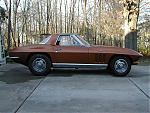


[C2] Found a 427 :)

Thread Starter
Intermediate


Joined: Jun 2006
Posts: 31
Likes: 0
From: Sequim WA
 Found a 427 :)
I think i have had the good fortune of finding a 1966 427. My current C2 194676S106157 was originally a 427. I bought it with a 350 in it and that needs a rebuild so ive been keeping my eye out (ten years) for a year correct motor. Obviously it wont be numbers matching but it will be close. Can anyone share any info or thoughts on this?
Casting number for 427 is 3869942 with a P underneath the casting number
Motor vin is 6110282.... T 1227 IL
Any comments welcome. Also perhaps you might suggest a carburator. Im not trying to win any races just best efficiency.
TIA
Casting number for 427 is 3869942 with a P underneath the casting number
Motor vin is 6110282.... T 1227 IL
Any comments welcome. Also perhaps you might suggest a carburator. Im not trying to win any races just best efficiency.
TIA
Last edited by wpaurich; Dec 2, 2024 at 01:40 AM. Reason: Correction

Team Owner


Joined: Feb 2003
Posts: 54,104
Likes: 9,418
From: Sitting in his Nowhere land Hanover Pa
2024 C2 of the Year Finalist - Unmodified
2015 C2 of Year Finalist
IL is a suffix code for a 427/390 from a Corvette . the Stock carb was a Holley 4160 585 CFM carb. I would be looking for a service dated correct carb
1967 Pedal Car Champion

Joined: Mar 2020
Posts: 9,130
Likes: 4,242
From: US-PNW
I just had my 427/390 rebuilt to factory specs and last week on the dyno the highest CFM recorded (using a 750 CFM Holley) was 514 @5400 rpm. The original oval-port heads and manifold definitely cut the air flow. Folks say the stock carb is too small for the engine, but if it total airflow stays below the rating I don't see how a larger carb is going to perform any better.

Advanced
Joined: Mar 2007
Posts: 86
Likes: 38
I just had my 427/390 rebuilt to factory specs and last week on the dyno the highest CFM recorded (using a 750 CFM Holley) was 514 @5400 rpm. The original oval-port heads and manifold definitely cut the air flow. Folks say the stock carb is too small for the engine, but if it total airflow stays below the rating I don't see how a larger carb is going to perform any better.
Corvette Stories
The Best of Corvette for Corvette Enthusiasts

Top 10 Most Expensive Corvettes Ever Sold on Bring A Trailer
Brett Foote
10 Things Every Corvette Owner Needs (2026 Edition)
Michael S. Palmer
8 Most "Only Corvette Owners Understand" Quirks and Problems
Pouria Savadkouei
10 Reasons the C6 Z06 is Still A Performance Benchmark After 20 Years
Joe Kucinski
How Much Horsepower Every Corvette Engine "LOST" in 1972
Joe Kucinski
Top 10 DOs and DON'Ts for Protecting Your Convertible Top!
Michael S. Palmer
Top 10 Most Explosive Corvettes Ever Made: Power-to-Weight Ratio Ranked!
Joe Kucinski
150 hp to 1,250 hp: Every Corvette Generation Compared by the Specs That Matter
Joe Kucinski
8 Coolest Corvette Pace Cars (and Replicas) of All Time
Verdad Gallardo
Advanced
Joined: Jun 2024
Posts: 78
Likes: 57
From: Houston
Yeah but...
I just had my 427/390 rebuilt to factory specs and last week on the dyno the highest CFM recorded (using a 750 CFM Holley) was 514 @5400 rpm. The original oval-port heads and manifold definitely cut the air flow. Folks say the stock carb is too small for the engine, but if it total airflow stays below the rating I don't see how a larger carb is going to perform any better.
1967 Pedal Car Champion
Joined: Mar 2020
Posts: 9,130
Likes: 4,242
From: US-PNW
Regardless, I'm looking forward to getting it back in the car and seeing if I can notice any difference from before. It was a virgin, untouched engine with ~70k miles, that had great acceleration and power, even with the 6-8 broken rings, one piston with broken ring lands, moderately worn cylinders, a camshaft that had some rounding to the lobes, etc. The old parts showed about 10-15% leak-down with the broken piston showing an 80% loss. I've known the engine had issues for many, many years; the rebuild was definitely in order!
Advanced
Joined: Mar 2007
Posts: 86
Likes: 38
It made 375hp/460 torques. I was a little disappointed that it didn't hit 390, but it's a true restoration rebuild with stock everything -- except 0.030" overbore forged pistons instead of cast, but identical dome height & CCs -- factory-profile hydraulic lifter cam, steel shim head gaskets, stock valve diameters, small port heads & intake, etc.
Regardless, I'm looking forward to getting it back in the car and seeing if I can notice any difference from before. It was a virgin, untouched engine with ~70k miles, that had great acceleration and power, even with the 6-8 broken rings, one piston with broken ring lands, moderately worn cylinders, a camshaft that had some rounding to the lobes, etc. The old parts showed about 10-15% leak-down with the broken piston showing an 80% loss. I've known the engine had issues for many, many years; the rebuild was definitely in order!
Regardless, I'm looking forward to getting it back in the car and seeing if I can notice any difference from before. It was a virgin, untouched engine with ~70k miles, that had great acceleration and power, even with the 6-8 broken rings, one piston with broken ring lands, moderately worn cylinders, a camshaft that had some rounding to the lobes, etc. The old parts showed about 10-15% leak-down with the broken piston showing an 80% loss. I've known the engine had issues for many, many years; the rebuild was definitely in order!

Race Director


Joined: Jan 2003
Posts: 17,681
Likes: 3,678
From: Central Arkansas
It made 375hp/460 torques. I was a little disappointed that it didn't hit 390, but it's a true restoration rebuild with stock everything -- except 0.030" overbore forged pistons instead of cast, but identical dome height & CCs -- factory-profile hydraulic lifter cam, steel shim head gaskets, stock valve diameters, small port heads & intake, etc.
Regardless, I'm looking forward to getting it back in the car and seeing if I can notice any difference from before. It was a virgin, untouched engine with ~70k miles, that had great acceleration and power, even with the 6-8 broken rings, one piston with broken ring lands, moderately worn cylinders, a camshaft that had some rounding to the lobes, etc. The old parts showed about 10-15% leak-down with the broken piston showing an 80% loss. I've known the engine had issues for many, many years; the rebuild was definitely in order!
Regardless, I'm looking forward to getting it back in the car and seeing if I can notice any difference from before. It was a virgin, untouched engine with ~70k miles, that had great acceleration and power, even with the 6-8 broken rings, one piston with broken ring lands, moderately worn cylinders, a camshaft that had some rounding to the lobes, etc. The old parts showed about 10-15% leak-down with the broken piston showing an 80% loss. I've known the engine had issues for many, many years; the rebuild was definitely in order!

Safety Car

Joined: Sep 2007
Posts: 4,458
Likes: 331
From: Indy Indiana
been there, done that....
95% of folks will get by just fine with a stock rebuild. I myself can't tell 375 HP from 425 HP by the seat of my pants. Each 10th of a second in the 1/4 mile will cost you bunches.
installing hop up parts merely raises the HP and torque Curve to a higher RPM range, which decreases longevity of the build.. and decreases streetability.
Its great to have a date correct engine and your investment would probably be somewhat of a lateral move. Maybe dollar for dollar but not a massive increase of marketability or price of the car.
one can find most all the date correct parts but if your are building piecemeal and paying someone to remove/replace/build and pay someone to do all the work it is $15K plus
to convert to BB theres a hundred things to do and buy.. all the way from bellhousing to radiator support to many parts in between. but since your car is originally a BB then some if these hundred might already be there.
a 550 CFM engine doesnt need a 850 CFM carb. it is only bragging rights.
now back to your questions. you said your car is #6157.. makes it a mid to 3rd week october 1965 build.
your 427 is stated as #10282 , makes it around a 1st/2nd week January 66 car, which agrees with a 12 27 build you stated. .
This is almost 3 months too late and would never be construed as possibly original. you would need a engine build early to mid october to match your car build date minus a couple weeks.
this would need to be correct long before any stamping considerations could be factored into the equation.
If you really want to do this, look for a september/ early october 65 block..
There's one that is close on EBAY right now. although every used part has a risk.
IMHO
95% of folks will get by just fine with a stock rebuild. I myself can't tell 375 HP from 425 HP by the seat of my pants. Each 10th of a second in the 1/4 mile will cost you bunches.
installing hop up parts merely raises the HP and torque Curve to a higher RPM range, which decreases longevity of the build.. and decreases streetability.
Its great to have a date correct engine and your investment would probably be somewhat of a lateral move. Maybe dollar for dollar but not a massive increase of marketability or price of the car.
one can find most all the date correct parts but if your are building piecemeal and paying someone to remove/replace/build and pay someone to do all the work it is $15K plus
to convert to BB theres a hundred things to do and buy.. all the way from bellhousing to radiator support to many parts in between. but since your car is originally a BB then some if these hundred might already be there.
a 550 CFM engine doesnt need a 850 CFM carb. it is only bragging rights.
now back to your questions. you said your car is #6157.. makes it a mid to 3rd week october 1965 build.
your 427 is stated as #10282 , makes it around a 1st/2nd week January 66 car, which agrees with a 12 27 build you stated. .
This is almost 3 months too late and would never be construed as possibly original. you would need a engine build early to mid october to match your car build date minus a couple weeks.
this would need to be correct long before any stamping considerations could be factored into the equation.
If you really want to do this, look for a september/ early october 65 block..
There's one that is close on EBAY right now. although every used part has a risk.
IMHO
Thread Starter
Intermediate
Joined: Jun 2006
Posts: 31
Likes: 0
From: Sequim WA
Thanks for the info. My car that I will put this in was orginally a big block car. It has the tach radiator ect. I did find the date stamp on the starter side of the motor to be J 18 5.
Last edited by wpaurich; Dec 4, 2024 at 11:13 AM. Reason: Correction

Pro

Joined: Jun 2009
Posts: 592
Likes: 378
From: MA
In any case, a T1227IL engine assembly date (Dec 27th), seemz too late for your car (even if the assembly date was 'J 18 5')... if you actually care about that aspect.
Le Mans Master


Joined: Dec 2004
Posts: 5,232
Likes: 419
Originally Posted by 67:72;1608385639[b
]It made 375hp/460 torques. I was a little disappointed that it didn't hit 390[/b], but it's a true restoration rebuild with stock everything -- except 0.030" overbore forged pistons instead of cast, but identical dome height & CCs -- factory-profile hydraulic lifter cam, steel shim head gaskets, stock valve diameters, small port heads & intake, etc.
Regardless, I'm looking forward to getting it back in the car and seeing if I can notice any difference from before. It was a virgin, untouched engine with ~70k miles, that had great acceleration and power, even with the 6-8 broken rings, one piston with broken ring lands, moderately worn cylinders, a camshaft that had some rounding to the lobes, etc. The old parts showed about 10-15% leak-down with the broken piston showing an 80% loss. I've known the engine had issues for many, many years; the rebuild was definitely in order!
Regardless, I'm looking forward to getting it back in the car and seeing if I can notice any difference from before. It was a virgin, untouched engine with ~70k miles, that had great acceleration and power, even with the 6-8 broken rings, one piston with broken ring lands, moderately worn cylinders, a camshaft that had some rounding to the lobes, etc. The old parts showed about 10-15% leak-down with the broken piston showing an 80% loss. I've known the engine had issues for many, many years; the rebuild was definitely in order!
Thread Starter
Intermediate
Joined: Jun 2006
Posts: 31
Likes: 0
From: Sequim WA
Wouldn't VIN 194676S106157 equate to an approx November 18, 1965 build... and wouldn't an engine casting date of 'J 18 6' be for a 1967 model vehicle?
In any case, a T1227IL engine assembly date (Dec 27th), seemz too late for your car (even if the assembly date was 'J 18 5')... if you actually care about that aspect.
In any case, a T1227IL engine assembly date (Dec 27th), seemz too late for your car (even if the assembly date was 'J 18 5')... if you actually care about that aspect.
my date stamp actually is J 18 5. Hard to read upside down lol