When you click on links to various merchants on this site and make a purchase, this can result in this site earning a commission. Affiliate programs and affiliations include, but are not limited to, the eBay Partner Network.
On the original winter manifold I cant seem to find the right size tool to torque the center bolts. The torque wrench and socket are to big to fit on the bolts.
Those of us who are real car guys only place we use a torque wrench : head bolts and rotating assembly nuts & bolts
We have been doing it long enough - we know how much to tighten things by feel !
Long box end wrench. Pull on a bolt you just torqued with a torque wrench with the box end to get a feel for the correct torque and duplicate that on the bolts you can’t reach.
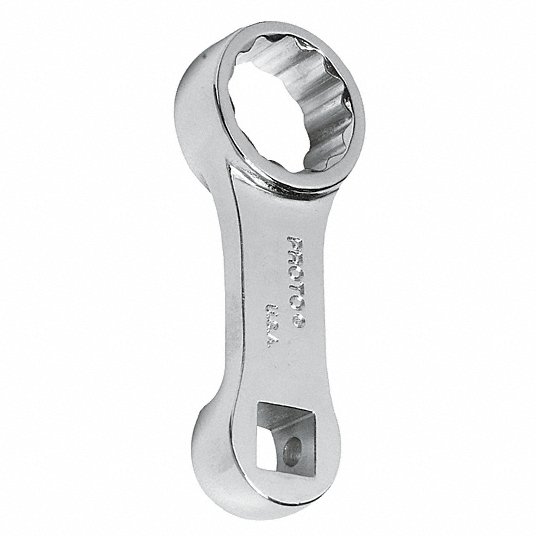
or you can buy a torque wrench box end offset adapter. See Amazon.
Do you have a 1/2 or 3/4 universal and a 6" extension? Also, there have been millions of the bolts tightened over the years by the arm wrench in the correct sequence, no mechanical issues have occurred including myself. Dennis
For those of us that prefer to use a torque wrench on these bolts, we MAKE our own adapter tool. Very easy to do with a box end wrench and a drive adapter/socket.....and a hacksaw and a welder.
On the original winter manifold I cant seem to find the right size tool to torque the center bolts. The torque wrench and socket are to big to fit on the bolts.
Any help would be appreciated
I just use a stubby box wrench along with a hex drive socket on the torque wrench. Works very well. You just need to calculate the appropriate torque value based on the length of the box wrench. There are plenty of calculators/charts on-line. Also, most torque wrenches come with documents explaining the calculations.
For some applications, I’ve turned down outer diameter of the socket. Generally, sockets are designed to take a lot more torque than you need for automotive applications, so you can take off the extra metal. If you grind it down too far, worst case is that the socket splits and you try again
Those of us who are real car guys only place we use a torque wrench : head bolts and rotating assembly nuts & bolts
We have been doing it long enough - we know how much to tighten things by feel !
Torque on the intake manifold bolts is 30 lb ft. When using the box wrench adapter to torque the four intake manifold bolts located under the carburetor (or, anywhere else the torque wrench won't fit), set the torque wrench to 26 lb ft to compensate...otherwise, you'll be over torqueing the bolts
It’s my impression that published torque specs for Chevy intakes are for cast iron intakes. At least on big blocks you don’t want to torque that high for aluminum intakes as it often cracks the bolt hole ears. I don’t know for sure if SB aluminum intakes suffer from the same issues.
Also, aluminum sealing surfaces on used aluminum manifolds often are distorted at the bolt holes. It’s a good idea to straightedge them and if not flat, block them flat with sandpaper so they seal up tight. On my L72 manifold that was pretty severely distorted, I used a new aluminum level base that checked out flat with a straightedge to block with and SA sandpaper to dress the faces down and the manifold fit 100% better. I had 3 used BB aluminum intakes and there wasn’t a flat sealing surface on any of them.
Those of us who are real car guys only place we use a torque wrench : head bolts and rotating assembly nuts & bolts
We have been doing it long enough - we know how much to tighten things by feel !
In sixty years of tinkering with these cars, I have never used a torque wrench on an intake manifold and have never had a problem—ditto for spark plugs. However, I do sequence the torquing process for the intake.
Good point Dan. On small block aluminum intakes, I do torque the intake bolts to GM specs, 30 ft. lbs., using the specified sequence in the Chevrolet Chassis Service Manual, pages 6-26 & 6-39. But after aligning the intake, first bringing the bolts to a snug tight torque of about 1/2 of the final torque or less using the sequence. Then bringing them to the final torque using the sequence. But the torque of the center bolts seem to relax as you torque the bolts to each side, thus a repeat of final torque assures the intake is evenly clamped to the heads.
Lubricated bolts, using pipe sealant or other sealants, generally require less torque to achieve the clamping force and thus one may want to use less torque, say 25 ft. lbs., on aluminum intakes. It is all about obtaining even gasket compression to obtain sealing. The torque is the clamping force to obtain the optimum compression. Over torque can also be bad.
Some guys don't torque intake or carburetor bolting, but a large percentage of the Holleys I have have warped throttle plates due to over torquing.
Torque wrenches are cheaper than aluminum intakes and carburetors.
On the original winter manifold I cant seem to find the right size tool to torque the center bolts. The torque wrench and socket are to big to fit on the bolts.
Any help would be appreciated
Did you try the sockets on the bolt head without the carburetor on the intake manifold? It makes the job much easier.







 Manifold Torque problem





 Dennis