When you click on links to various merchants on this site and make a purchase, this can result in this site earning a commission. Affiliate programs and affiliations include, but are not limited to, the eBay Partner Network.
So I'm going to have my 66 coupe towed later this week, I cannot get it to start. Turns over fine, battery seems like it will crank forever but it will not catch, not even a hint. I tried starting fluid but nothing. Car ran perfectly before I put it away last October, went to start it Friday and nothing. I've been storeing cars for winter for many years and have never had one fail to start in the spring. Anyhow, my question is what should I look for or ask for when they are getting ready to tow. I requested a flat bed but what should they hook the tow straps to on the car as they pull it up onto the bed. What has been anyone's experience having their car towed and what should I look out for. The goal obviously is to keep any potential damage to zero. Thanks in advance.
Are you unable to troubleshoot it and work on it yourself? You can probably get some help here. I assume you have a restored chassis and want to protect the finishes. If flat-bedding you can wrap towels around the front of the lower control arms and secure with tape and ask him to place his hooks over the toweled areas. The sway bar is another area they could hook to but they may feel it’s not stout enough for the task. I’ve had luck asking the tow operator if he has T-hooks that are made to slip into the slots in the underside of the frame crossmember between the frame kickups to tie the rear down. I believe that’s why those are there. See below. After that I’m not sure on the rear as anchoring to any suspension point except maybe the control arms (again wrapped with towels), doesn’t look like a good idea to me. Possibly some operators have tire straps for the rear. Maybe some others have some ideas.
Thank you for the suggestions. Not really mechanically inclined. Yes, the car is totally restored and has a NCRS national Top-Flight award from 10 years ago with only about 3,000 miles since. You'd think flat bedding would be a safe way to tow a car but I've seen the damage it can do to the suspension parts. I'm going to call the tow company tomorrow to see what they have based on your suggestions. Car is not being towed until Wednesday when it was due to go in for it's annual check-up. And it doesn't need to go in then, I can have it looked at anytime. Thank you.
Before towing, I'd look at all of the distributor wiring to make sure nothing is disconnected. (You or someone else didn't by chance pull the coil wire as a theft deterrent during storage?)
You definitely want to flat-bed it. Watch that the pull or tie straps don't touch either the front fiberglass panel between the parking lights or the rear exhaust filler panel. Not only will the paint be abraded, but the panels may crack.
Before towing, I'd look at all of the distributor wiring to make sure nothing is disconnected. (You or someone else didn't by chance pull the coil wire as a theft deterrent during storage?)
You definitely want to flat-bed it. Watch that the pull or tie straps don't touch either the front fiberglass panel between the parking lights or the rear exhaust filler panel. Not only will the paint be abraded, but the panels may crack.
No, before storing I don't touch anything except add Stabil to the gas and hook it up to a battery maintainer. What you mentioned about the fiberglass panel by the parking lights and the rear filler panel is exactly what I'm afraid of.
Many real professional tow company operators use straps over all 4 tires. It does not infringe on any parts of the suspension, doesn't hurt the tires and the car is totally secure. Dennis
If you have classic car insurance like NCM, they send out flat beds for classics with experienced operators. NCM also paid the freight for the one time I needed it.
Many real professional tow company operators use straps over all 4 tires. It does not infringe on any parts of the suspension, doesn't hurt the tires and the car is totally secure. Dennis
This is what most of the new car haulers are using these days also. My concern is what kind of an attitude is your flatbed driver going to have? Hopefully he's sensitive to your concern of avoiding any damage. How is your Corvette getting up on the flatbed? Where are the tow hooks going? Does he have a way to keep the hooks and winch from contacting the lower valance? I think you need to be prepared to deal with any or all of these possibilities. If it's going to be loaded up by grabbing the lower control arms (a good possibility) you want to protect the hooks from causing any damage (some old carpet pieces or maybe some hose to slide over the hooks). Make sure the tie rods are clear. Also you may want to have a 4X4 available in case you need to put it between the frame and the winch to space the cable below the front of your car. Best to be ready to deal with any and all possibilities. If he knows what he's doing and he understands the value of your car as well as your anxiety all should go well.
Good luck.
Since it is a NCRS car surely there is a Corvette guy around there somewhere that would come look at it. I strongly suspect if it gets a spark it will run.
Hauling it is not a problem, getting on the flat bed is a problem. I'm not sure if there is anywhere you can hook on the rear and not run the risk of damaging the rear valance. The rear valance is easily removed on a side pipe car.
Even though you are not mechanically inclined you can do simple things like removing the air filter and pull the throttle rod while watching for fuel delivery in the carburetor. You may have to hold the choke plate open while stroking the throttle. If there is excessive fuel in the throttle body, you may have flooded the engine and need to hold the accelerator to the floor while cranking the engine. If the choke is closed on cold engine and you see fuel, then you can move on to the ignition. If you have no fuel squirt, then you may want to use a small squirt bottle to put a couple of squirts into the carburetor and see if it fires.
If you want to check for spark, remove the coil wire to the distributor at the coil and hold it about 1/4" or less above the coil or any metal surface on the engine and have someone crank the engine while watching for a spark. No spark will require someone with a bit of old car knowledge to troubleshoot further. As polo91 recommends, you can reach out to any classic car owner from this era for assistance as the ignition system is basically generic among all manufacturers.
Ron
This is what most of the new car haulers are using these days also. My concern is what kind of an attitude is your flatbed driver going to have? Hopefully he's sensitive to your concern of avoiding any damage. How is your Corvette getting up on the flatbed? Where are the tow hooks going? Does he have a way to keep the hooks and winch from contacting the lower valance? I think you need to be prepared to deal with any or all of these possibilities. If it's going to be loaded up by grabbing the lower control arms (a good possibility) you want to protect the hooks from causing any damage (some old carpet pieces or maybe some hose to slide over the hooks). Make sure the tie rods are clear. Also you may want to have a 4X4 available in case you need to put it between the frame and the winch to space the cable below the front of your car. Best to be ready to deal with any and all possibilities. If he knows what he's doing and he understands the value of your car as well as your anxiety all should go well.
Good luck.
Thanks for the good wishes. Had the car towed today instead of Wednesday. Everything went perfectly, the tow ropes never got close to the lower valance (towed from the rear) and he used straps on each tire as was recommended here once it was on the flatbed. I talked to the driver before he started and he was extremely sympathetic to how I felt. You were right, it all went well. Should have the car back for the first show of the season this Sunday.
Sometimes a carburetor float will stick. Just tap on the float bowl on the carb. With the handle of a screwdriver!
Thanks, tried that, but when it wouldn't catch even with starting fluid I knew it had to be something else. Turns out it was a burnt coil wire. Took care of that and we're back on the road.



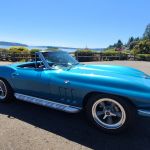



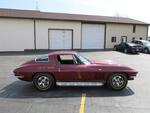


 Towing a C2






 Dennis









 This is what most of the new car haulers are using these days also. My concern is what kind of an attitude is your flatbed driver going to have? Hopefully he's sensitive to your concern of avoiding any damage. How is your Corvette getting up on the flatbed? Where are the tow hooks going? Does he have a way to keep the hooks and winch from contacting the lower valance? I think you need to be prepared to deal with any or all of these possibilities. If it's going to be loaded up by grabbing the lower control arms (a good possibility) you want to protect the hooks from causing any damage (some old carpet pieces or maybe some hose to slide over the hooks). Make sure the tie rods are clear. Also you may want to have a 4X4 available in case you need to put it between the frame and the winch to space the cable below the front of your car. Best to be ready to deal with any and all possibilities. If he knows what he's doing and he understands the value of your car as well as your anxiety all should go well.