When you click on links to various merchants on this site and make a purchase, this can result in this site earning a commission. Affiliate programs and affiliations include, but are not limited to, the eBay Partner Network.
As I slowly develop wrench turning skills, the health of my ball joints came to mind. No driving symptoms and she runs tight through autocross but I am not clear, as part of preventive maintenance, how one checks them. Online search has you trying to lift the control arms vertically while looking for movement so before I start looking for pry bars I just wanted to ask all of you. How do you check for ware in those joints.
Thanks in advance.
A good question and prying on the connection to look for movement from wear is pretty much what I’ve seen too. But I’ve never actually bothered with it so maybe who has can fill us in. I know the lower ones are the ones that get the most wear. The uppers will usually last a long time.
Were on the same page Dan. Although my 66 327 is asymptomatic, I am aware that should a ball joint fail, the wheel may wish to go horizontal which is a tad too much camber for me, especially at speed! Hoping someone can shed some light on it. Thanks.
Unless in a collision or way-way rusty control arms, I don't think ball joints fail catastrophically, they just wear and wear and get sloppy. With a worn ball joint, front wheel raised, you should be able to see vertical movement (and hear clunking) when prying the tire/wheel up and down. You can feel it if you do it by hand but make sure you're feeling the ball joints and not play in the hub bearings.
Other replies below pointed out that this is incorrect.
Last edited by barkingrats; Aug 5, 2025 at 11:32 AM.
Jack the front end up and rest (one ball joint at a time) the lower control arm on a jack stand all the way out, preferably, under that lower ball joint (takes spring pressure off it). Then get a pry bar under the tire to pry upward and see if there is any movement (best to have a second person do that while you look underneath the car. Then pull in and out on the top of the tire to look for any movement in the upper ball. Side to side on the tire to check tie rod ends. 20 years in the front end business.
Oh, and yes...I have seen catastrophic failure of ball joints numerous times but not the ones where the car hits a tree, etc (those usually are not repairable).
I like to jack it up on the frame so the tire is hanging couple of inches off the floor. And use a bar under the tire to lift the wheel up and down a bit while someone else watches the ball joints / wheel bearings for any movement.
What he said above!
I like to jack it up on the frame so the tire is hanging couple of inches off the floor. And use a bar under the tire to lift the wheel up and down a bit while someone else watches the ball joints / wheel bearings for any movement.
What he said above!
This rarely tells you anything because the suspension spring pressure will hold a loose ball joint tight making you think everything is OK. Like I said; 20 years experience doing this.
Jack the front end up and rest (one ball joint at a time) the lower control arm on a jack stand all the way out, preferably, under that lower ball joint (takes spring pressure off it). Then get a pry bar under the tire to pry upward and see if there is any movement (best to have a second person do that while you look underneath the car. Then pull in and out on the top of the tire to look for any movement in the upper ball. Side to side on the tire to check tie rod ends. 20 years in the front end business.
Oh, and yes...I have seen catastrophic failure of ball joints numerous times but not the ones where the car hits a tree, etc (those usually are not repairable).
^^^^^^^^^^^^^^^^^^^^^^^^^^^^^^^^^^^^^^^^ ^^^^^^^^^^^^^^^^^^^^^^^^^^^^^^^^^^^^^^^^ ^^^^^^^^^^^^^^^^^^^^^^^^^^^^^^^^^^^^^^^^ ^^
This is how to check them. Once the spring load is off you will see the play. The top last a long time, the lowers are what wear out.
From: Middle TN by way of KY, OH, VA, IL, CA, FL, NY, SC, HI
Originally Posted by barkingrats
Unless in a collision or way-way rusty control arms, I don't think ball joints fail catastrophically, they just wear and wear and get sloppy. With a worn ball joint, front wheel raised, you should be able to see vertical movement (and hear clunking) when prying the tire/wheel up and down. You can feel it if you do it by hand but make sure you're feeling the ball joints and not play in the hub bearings.
I have. I had a 1975 Opel Sportwagon back in the early 80s with a front end squeak I was never able to locate the source. One day just moments after getting off the San Diego freeway in Orange County, CA, the left front lower ball joint catastrophically failed - came apart - in a parking lot, dropping the entire left front suspension and of course disabling the car. The source of the squeak was finally found. Oddly, the car did not exhibit poor handling on account of it - until it came apart. Weird, I now.
I have. I had a 1975 Opel Sportwagon back in the early 80s with a front end squeak I was never able to locate the source. One day just moments after getting off the San Diego freeway in Orange County, CA, the left front lower ball joint catastrophically failed - came apart - in a parking lot, dropping the entire left front suspension and of course disabling the car. The source of the squeak was finally found. Oddly, the car did not exhibit poor handling on account of it - until it came apart. Weird, I now.
Yup. There was a guy that worked in the same place I did except in the tire section (not suspension section). Driving to work one morning I saw his car on the side of the road about 100yds from our work place. Left lower ball joint failed (Cadillac IIRC) leaving the tire sticking out sideways. Fortunately a very slow section of road.
From: Middle TN by way of KY, OH, VA, IL, CA, FL, NY, SC, HI
Originally Posted by JF in MI
Yup. There was a guy that worked in the same place I did except in the tire section (not suspension section). Driving to work one morning I saw his car on the side of the road about 100yds from our work place. Left lower ball joint failed (Cadillac IIRC) leaving the tire sticking out sideways. Fortunately a very slow section of road.
All of this is not to say that they OP should be worried about their ball joints; however, since the car is presumably a C2 (he didn't say), if the ball joints are original it's not the worst idea to check on their health, as not everyone is good to grease them as frequently as was specified in the owners manual.
Jack the control arm up under the balljoint using a piece of 2x lumber so as not to damage the control arm and to unload the spring. Hands north and south (top and bottom) rock the tire back and forth. Then do the same east and west (left and right):
1. A tiny amount of equal movement is acceptable (wheel bearing)
2. More movement N-S vs E-W, possible BJ wear.
3. More movement E-W vs N-S, possible steering wear (tie rods or relay rod)
4. Too much movement N-S and E-W, possible wheel bearing wear or adjustment needed or entire front end needs replacing!
If 2, 3, or 4, have a friend do the same while you observe the suspected component(s).
When I see a ball joint failure on the road, it is almost always a Toyota or Lexus. On a hunch one day i rolled down my window as I passed a wrecker retrieving a 10 year old Lexus sedan with its right front folded under. Its forlorn owner looked on as I asked "how many miles on that Lexus?" She said 235,000.
I remember when my lower ball joints on my 64 Plymouth I owned in the 60s were shot, the steering suddenly started catching and releasing when turning. A new set of lower ball joints fixed it right up. Not sure if that’s a typical failure mode in other makes or not.
Yes, I am referring to my C2 with a L79. Thanks to all, I have a clear vision now as to how and proceed and will get on it now. Have autocross this Saturday and plan to spend quality time with her doing a nut and bolt inspection. This will be part of my check.
Yes, I am referring to my C2 with a L79. Thanks to all, I have a clear vision now as to how and proceed and will get on it now. Have autocross this Saturday and plan to spend quality time with her doing a nut and bolt inspection. This will be part of my check.
Just remember that on a C2 the steering knuckle (nut for ball joint) attaches below the control arm so have the jack/stand just inside of it on the control arm, not on the nut attaching it to the knuckle.
Passenger side up on a jack stand. LCA raised with 2nd jack to unload lower ball joint. At 12:00/6:00 no respectable movement at upper ball joint. Prying bottom of tire, no notable movement. So far, so good.
Rocking at 9:00/3:00 definite rocking noted. Tie rods and ends have 2,000 miles on them. I rock the wheel while looking behind the wheel and I am seeing movement of the steering knuckle where it bolts up to the (hub?). Put a wrench on both the front and aft nut and I can rotate the bolt with the nut easily. See video and pix. Have to believe they need to be tight but need confirmation. Both drivers side and passengers side are like this. rear bolt/nut drivers side This is the nut/bolt at the front
Designer Imagines A Corvette That Looks More Like a Corvette Than the Corvette
Slideshow: A Jaguar designer's personal project imagines what a modern front-engined Corvette might look like if Chevrolet revisited the golden age of the Stingray.




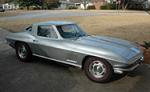


 Checking Ball Joints