When you click on links to various merchants on this site and make a purchase, this can result in this site earning a commission. Affiliate programs and affiliations include, but are not limited to, the eBay Partner Network.
This is from my SBC. For my general knowledge. I asked this question on the www and got NO answer as to where the rotor is in relation to the #1 plug tower. "Should point at" is the best I got, but that didn't help. Can someone comment on the pic I've included as to why my rotor is approx 15° past the #1 plug contact when my initial timing mark is at 12° BTDC.
This looks to me like the spark contact already occured and is over. If I want detonation at 12° before TDC I would think that the rotor should be on the incoming side of the #1 contact, not the outgoing side. What am I wrong about?
Craig
Last edited by 64DreamMachine; Aug 13, 2025 at 04:13 PM.
Reason: More info
When engine is running the added vacuum advance and (later) centrifugal advance will fire the plug earlier..........and rotor will be closer to plug tower.
Vacuum advance is 8 distributer degrees by itself for your B28 can (16 crank degrees). At about 2000 RPM centrifugal advance will add another 16 crank or 8 distributor degrees.
Everything with these older engines is a compromise.
When engine is running the added vacuum advance and (later) centrifugal advance will fire the plug earlier..........and rotor will be closer to plug tower.
Vacuum advance is 8 distributer degrees by itself for your B28 can (16 crank degrees). At about 2000 RPM centrifugal advance will add another 16 crank or 8 distributor degrees.
Everything with these older engines is a compromise.
Larry
Thanks Larry. I've restricted my B28 to 10 crank degrees measured with timng light on the balancer mark and my Mighty Vac. I've got initial set at 12°. I did verify my balancer mark was right on target with tape on balancer and a piston stop tool. At 2400RPM I have 36° timing with no VAC, so I'm seeing 24 crank degrees from my mechanical/centrifugal with the given springs/weights. Doesn't that mean I am only getting 12° on the distributor mechanical advance? I'm trying VERY hard to understand how and when "Crank" versus "Distributor" degrees are quoted and used because when anyone talks timing, they do not preface it with "Crank" or "Dist". Answer one more question and I think I'll get it; My distributor is stamped "530". That tells me it offers 30° of advance. Does that mean 30° Crank advance or 30° distributor advance?
Thanks for all your help and input.
Craig
It's a four-cycle engine. The crankshaft rotates twice for each single rotation of the camshaft and distributor. That's the difference between crank and cam (or distributor) degrees. With the vac disconnected, if you're seeing timing move from 12* BTC to 36* BTC, you're seeing 24* of centrifugal advance at the crankshaft.
The "530" number means series 5 cam/base plate with MAX of 30 crank (engine) degrees allowed. This is determined by the length of the machined slot..........and the diameter of the bushing that is on the steel pin that rides in this slot. Some distributors do not have a bushing on the pin, but others do. Bushing can be plastic/rubber or metal. My OEM 1967 distributor used a plastic/rubber bushing.
SJW explained crank vs distributor degrees. Some books/manuals use one set of numbers and other books/manuals use the other. Just depends on the writer. Many of us talk distributer degrees when dealing with SUN Distributor Machine. Obviously that machine did everything in "distributor" degrees and RPM.
It's a four-cycle engine. The crankshaft rotates twice for each single rotation of the camshaft and distributor. That's the difference between crank and cam (or distributor) degrees. With the vac disconnected, if you're seeing timing move from 12* BTC to 36* BTC, you're seeing 24* of centrifugal advance at the crankshaft.
Live well,
SJW
Thanks, that's the kind of detail I needed to learn and understand.
Craig
The "530" number means series 5 cam/base plate with MAX of 30 crank (engine) degrees allowed. This is determined by the length of the machined slot..........and the diameter of the bushing that is on the steel pin that rides in this slot. Some distributors do not have a bushing on the pin, but others do. Bushing can be plastic/rubber or metal. My OEM 1967 distributor used a plastic/rubber bushing.
SJW explained crank vs distributor degrees. Some books/manuals use one set of numbers and other books/manuals use the other. Just depends on the writer. Many of us talk distributer degrees when dealing with SUN Distributor Machine. Obviously that machine did everything in "distributor" degrees and RPM.
Larry
Good explanation and thanks for the help with this. I now understand that I was trying to equate the distributor movement to crank and was off by 2X.
Craig
The only time the rotor firing tab is in complete alignment with the #1 cap tower is when the distributor is set to 0* BTDC, the VAC is unplugged and no mechanical advance is happening. So, never.
When I pull a distributor I set the timing I want, say 10*. I line up the balancer line and the 10* BTDC mark on the timing tab. This is my "zero". I then pull the cap and mark the side of the distributor cap base right below the rotor timing tab. Use a straight edge if you like.
When I put the distributor in, I just move the base of the distributor to align my mark directly under the center of the rotor firing tab. My timing is now set about 10*, or within a degree or two. Good enough to fire right up and run.
This is a good method for the corvette, as there isn't much "swing area" available between the intake and coil bracket. Installing the distributor with this method, and setting 10* and "centering" the distributor in the available arc area gives you ample room for increase and decrease in timing adjustments.
To anyone waiting on a reply or comment about further conclusion to my engine problem, I will be for about 4 weeks. I'm left handed and just had surgery yesterday on my left arm to repair a partially torn bicep tendon from/to my radius bone. So stay tuned, I'll be back, I hope.
I am thankful for the above knowledge you all have offered. It made me understand that I could have saved 6 months and over 50 distibutor removals if I had just asked earlier. My problem turned out to be the carb, not the dizzy at all. But what a learning experience. After 10+ months, the engine problem of bucking and trailer-hitching at low RPM, low speed seems to be solved. Everyone can stop holding their breath. For those of you who thought and communicated "Must be a Vacuum Leak", congratulations you are the winners. There will be ample celebration but no prizes. Sorry.
I know for a fact that I tried very poorly four times to find a vacuum leak around the carb, hoses, intake manifold, etc. Finally when I got the car back from the garage that did nothing for two months I noticed gas pooling up on the intake manifold on the right side under the shaft extension of the secondary plates. Why did I find that now and not sooner? That is a very good question. Apparently I was way overwhelmed by the fact that I was looking at an $80,000 boat anchor and I don't have a boat. Blah, blah, blah, to the end of the story already.
I ordered a new Base Plate and throttle assembly for a Holley 2818. Little hard to find, but Allstate Carburetor had one. After very thorough setting and adjustment, I got it on and the boat anchor started right up and ran smooth AND around the block! I've had several trips around the block in the last week and a half and I am waiting for a rain free day to go further. Wish me luck and "You got this!"
BTW, my arm surgery went well thanks for asking. Should be able to drive a non-power steering C2 without my knees very soon.
At this point I have New 18gm weights installed in the Distributor with Medium (Silver) springs and I am seeing 28° Timing at idle (1000RPM) with the Vac Advance connected and 48-50° Timing at WOT.
Timing withOUT VAC connected: 20° at idle (1000RPM) 36° at WOT (2500+RPM)
So far, so good. Thanks to everyone who tuned in and offered ample advice. It's ALWAYS a pleasure hearing from everyone who enjoys these classic beasts.
Craig
I am thankful for the above knowledge you all have offered. It made me understand that I could have saved 6 months and over 50 distibutor removals if I had just asked earlier. My problem turned out to be the carb, not the dizzy at all. But what a learning experience. After 10+ months, the engine problem of bucking and trailer-hitching at low RPM, low speed seems to be solved. Everyone can stop holding their breath. For those of you who thought and communicated "Must be a Vacuum Leak", congratulations you are the winners. There will be ample celebration but no prizes. Sorry.
I know for a fact that I tried very poorly four times to find a vacuum leak around the carb, hoses, intake manifold, etc. Finally when I got the car back from the garage that did nothing for two months I noticed gas pooling up on the intake manifold on the right side under the shaft extension of the secondary plates. Why did I find that now and not sooner? That is a very good question. Apparently I was way overwhelmed by the fact that I was looking at an $80,000 boat anchor and I don't have a boat. Blah, blah, blah, to the end of the story already.
I ordered a new Base Plate and throttle assembly for a Holley 2818. Little hard to find, but Allstate Carburetor had one. After very thorough setting and adjustment, I got it on and the boat anchor started right up and ran smooth AND around the block! I've had several trips around the block in the last week and a half and I am waiting for a rain free day to go further. Wish me luck and "You got this!"
BTW, my arm surgery went well thanks for asking. Should be able to drive a non-power steering C2 without my knees very soon.
At this point I have New 18gm weights installed in the Distributor with Medium (Silver) springs and I am seeing 28° Timing at idle (1000RPM) with the Vac Advance connected and 48-50° Timing at WOT.
Timing withOUT VAC connected: 20° at idle (1000RPM) 36° at WOT (2500+RPM)
So far, so good. Thanks to everyone who tuned in and offered ample advice. It's ALWAYS a pleasure hearing from everyone who enjoys these classic beasts.
Craig
You shouldn’t be seeing this much advance at WOT with vacuum advance hooked up (in bold above) as vacuum advance will go to zero when the throttle is opened. Maybe you mis-spoke. You probably see that much advance at a high speed, steady cruise with the engine above 2500 rpm.
Good luck with the surgery recovery and PT and I hope they did a good job of fixing you up.
Designer Imagines A Corvette That Looks More Like a Corvette Than the Corvette
Slideshow: A Jaguar designer's personal project imagines what a modern front-engined Corvette might look like if Chevrolet revisited the golden age of the Stingray.






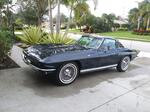


 Relation between rotor & #1 plug tower?