When you click on links to various merchants on this site and make a purchase, this can result in this site earning a commission. Affiliate programs and affiliations include, but are not limited to, the eBay Partner Network.
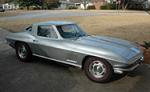
I am running a 66 vert L-79 that came to me with a 7 leaf rear spring and the corresponding F41 front springs. Handling at the time was pretty unstable. Working to freshen her up (Gary rebuilt the posi and steering box, I replaced the remaining steering components between the horn button and the spindles, The new tie rods are in the quick steer locations, manual steering, Bair's rebuilt the trailing arms, Vredestein tires on 15" aluminum wheels, road/track alignment specs, C3 camber rod inner pivot point bracket, 13/16" front sway bar (from Duke's threads) with poly down link bushings, NOS rubber bushings on the IRS and differential nose. The limiting factor during auto crossing is the pilot, the C2 willingly does whatever I ask of her. So now the question.
She is at her best of smooth roads as well as the runway I race her on. On less than smooth roads that may have the occasional 1" deep pot hole, she bangs through it, rattling whatever rattles I have not yet fixed. Growing up it was common to run a stiff suspension on sport cars to limit body roll and the effects of weight transfer. One of the things I had read was that an advantage of softer springs was that it was more compliant and helped the tire patch remain planted on the road when encountering a bump.
My 7 leaf spring has no real camber left in it and it was on the Winter agenda to pick up a new one from Eaton. But perhaps this in an opportunity to make an improvement to her ride and perhaps her handling. Reading the work of Herb Adams, his philosophy was to use softer springs and then to use stiffer shocks (adjustable units these days) and sway bar diameters to dial in the handling characteristics desired. I could pick up the progressive front coils and a 9 leaf rear from Eaton and test how that feels on the track next season. If need be I could install rebound adjustable shocks and a different diameter sway bar as dictated by any encountered under/over steer tendencies.
For those whom have knowledge and experience in this area, such as Jim Lockwood, I would be very much interested in your thoughts. Is my thinking reasonable here?
From: I tend to be leery of any guy who doesn't own a chainsaw or a handgun.
Just my two cents. Forget the steel leaf spring, It's heavy, rides like hell, and the stiction between the leaves gives you a non-linear response to bumps. Get a modest rate composite spring (330-360 #/inch) and a decent set of shocks.
Regarding the light springs and big bar concept, I tried that years ago after reading his book. Personally, I never liked it. Under hard braking or acceleration the car would dive/squat excessively, and the suspension would throw in camber in the process. Camber gain in a straight line is rarely productive. And in corners, I never noticed an improvement over modest springs and modest bars. I prefer decent rate (not heavy!) springs to keep the car from feeling mushy, and then using the bars to tune the amount of understeer/neutralness I feel comfortable with.
Just my experience and handling preferences.
Either way, post what you end up doing, and give your reactions to your car's handling.
I am running a 66 vert L-79 that came to me with a 7 leaf rear spring and the corresponding F41 front springs. Handling at the time was pretty unstable. Working to freshen her up (Gary rebuilt the posi and steering box, I replaced the remaining steering components between the horn button and the spindles, The new tie rods are in the quick steer locations, manual steering, Bair's rebuilt the trailing arms, Vredestein tires on 15" aluminum wheels, road/track alignment specs, C3 camber rod inner pivot point bracket, 13/16" front sway bar (from Duke's threads) with poly down link bushings, NOS rubber bushings on the IRS and differential nose. The limiting factor during auto crossing is the pilot, the C2 willingly does whatever I ask of her. So now the question.
She is at her best of smooth roads as well as the runway I race her on. On less than smooth roads that may have the occasional 1" deep pot hole, she bangs through it, rattling whatever rattles I have not yet fixed. Growing up it was common to run a stiff suspension on sport cars to limit body roll and the effects of weight transfer. One of the things I had read was that an advantage of softer springs was that it was more compliant and helped the tire patch remain planted on the road when encountering a bump.
My 7 leaf spring has no real camber left in it and it was on the Winter agenda to pick up a new one from Eaton. But perhaps this in an opportunity to make an improvement to her ride and perhaps her handling. Reading the work of Herb Adams, his philosophy was to use softer springs and then to use stiffer shocks (adjustable units these days) and sway bar diameters to dial in the handling characteristics desired. I could pick up the progressive front coils and a 9 leaf rear from Eaton and test how that feels on the track next season. If need be I could install rebound adjustable shocks and a different diameter sway bar as dictated by any encountered under/over steer tendencies.
For those whom have knowledge and experience in this area, such as Jim Lockwood, I would be very much interested in your thoughts. Is my thinking reasonable here?
I think if you intend to Autocross the car regularly, your current set up sounds very appropriate. If just cruising around town and Cars and Coffee are more your interest then the standard suspension would ride more comfortably (and rattle less). My BB has the standard suspension and it’s pretty soft. Ideally I would like something in between standard and F41 which would have to be aftermarket stuff. But, I mostly just tool around boulevards and country roads so I will stick with what I have.
It seems you're happy with the handling on smooth roads and autocross. How often do you drive on pour pavement? Besides try to avoid those pot holes. IMCO even new cars will occasionally "bang" over a pot hole (don't you hate that). Spend your time not your money fixing the rattles. Then as suggested already you might want to make a change with the rear spring and shocks to compliment the new rear spring.
All good points. I had not considered the increased tenancy for squat and dive so there may be a tradeoff that just leaves me with a new gripe. Another consideration is that I have not found anyone selling faithful reproductions of the original front progressive coils. Eaton lists a 9 leaf progressive rear but only F41 front coils. One of the aftermarket companies does show a progressive front coil but does not list specs such as spring rate range. I can try and call around if I decide to try this route but if not then I'll get the Eaton 7-leaf, pick up some Quanta liners and some high zinc paint.
One of the aftermarket companies does show a progressive front coil but does not list specs such as spring rate range. .
I found this
The Ridetech dual-rate C2 Corvette front spring rate is 480/700 lbs/in. This design consists of a softer "soft" rate of 480 lbs/in for small road imperfections and a firmer "stiff" rate of 700 lbs/in that engages during larger bumps or cornering for better handling and roll control.
The springs that Coil Springs Specialties in KS built me are progressively wound. They are a copy of the standard BB springs except wound shorter due to my aluminum heads, intake, water pump, etc. I think they can build you anything you want. The closer coil spacing is on the top in the pictures.
Yes Jack, Ridetech was the company I spoke of that sold a progressive spring. The thing is, from my research, OE spring rates shake down like this:
F-41 Standard
Front: 550 lbs/in 207-380 lbs/in
Rear 305 lbs/in 140-168 lbs/in
So the rates quoted from Ridetech are considerably higher than those the GM engineers came up with. My working theory is that those guys were pretty qualified to calculate such things (way more than I am) so that if I were to go forward with this experiment, I would want to use components that matched their calculations so as not to create new undesirable handling characteristics.
Thanks for the recommendation Dan, I will talk with them if I go forward with this
Some time ago, IIRC, a member posted a pix of them measuring the camber of their rear spring at the center while weight bearing. My 7-leaf has just about 1" of curvature with no spare tire in the carrier. Does anyone with this spring happen to know what their spring measures out as?
Some time ago, IIRC, a member posted a pix of them measuring the camber of their rear spring at the center while weight bearing. My 7-leaf has just about 1" of curvature with no spare tire in the carrier. Does anyone with this spring happen to know what their spring measures out as?
I measured my 7 leaf VB&P spring, full spare and less than a 1/4 tank of gas.
Outboard end: 6 5/8" off the floor
Inboard end, next to the plate, shouldn't have much arch after this point: 7 9/16"
So, also about an inch in my case.
So that sounds as if my spring is essentially normal. Thinking I may then refocus by pulling/disassembling the one I have, paint it with a high zinc product and replacing the liners. See then what I have. Good info guys, thank you.
My impression is at normal suspension height, your half shafts will be angled up slightly towards the differential - maybe 4-5 degrees. The 7 leaf spring may be just slightly closer to level for the lower suspension height it provides. But if your half shafts sit level or slope up towards the trailing arm something is probably wrong or worn out. If longer than stock link bolts have been installed that would tend to cause them to sit flat or angle up towards the outside.
Thats my observation someone else may validate it or rule it out t.
My impression is at normal suspension height, your half shafts will be angled up slightly towards the differential - maybe 4-5 degrees. The 7 leaf spring may be just slightly closer to level for the lower suspension height it provides. But if your half shafts sit level or slope up towards the trailing arm something is probably wrong or worn out. If longer than stock link bolts have been installed that would tend to cause them to sit flat or angle up towards the outside.
Thats my observation someone else may validate it or rule it out t.
At normal suspension height, your half shafts will be angled up slightly towards the differential with a stock C2.
GM (Duntov) recognized the geometry as less than ideal with wide tires & radials due to the high rear roll center and resulting camber change that can promote unstable rear traction and snap oversteer. The partial fix was the lower C3 camber rod bracket.
Competition use also improved the rear roll center and handling with a lower rear ride height.
Designer Imagines A Corvette That Looks More Like a Corvette Than the Corvette
Slideshow: A Jaguar designer's personal project imagines what a modern front-engined Corvette might look like if Chevrolet revisited the golden age of the Stingray.





 Suspension Function Question







 IMCO even new cars will occasionally "bang" over a pot hole (don't you hate that). Spend your time not your money fixing the rattles. Then as suggested already you might want to make a change with the rear spring and shocks to compliment the new rear spring.