



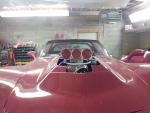


guide coat technique

Instructor


Joined: Apr 2005
Posts: 226
Likes: 0
From: lakewood (tacoma/seattle) washington

TOMB1, there are many different ways to paint a corvette.I agree with ahoover,prime using ppg dplf reduced. then address all your small problems with polyester putties I prefer evercoat rage extreme,and for pinholes rage metal glaze. be very carefull with pinholes make shure they are filled (not coverd over) this is an area that can trap solvent and cause paint poping on a hot day ,my best advise is get data sheets on the primers and follow the dry and cure times to the letter. polyester high build primers will be your (gell coat) . some times I dont use the dplf and just do all my filling directly to the fiber glass and then use the polyester primer and then do more filling then use the dplf as a final sealer. there are many other ways and other products. just follow the directions on the data sheet it even tells you the grit sand scratches to go over, dont second guess the mfg. good luck with youe project.

Pro


Joined: Jun 2005
Posts: 540
Likes: 4
St. Jude Donor '09, '24
Originally Posted by gator79
I know on metal you usually grind the surface so the filler can get a good grip. is this necessary with fiberglass. I mainly need to smooth out the seams from the bonding strips.
Are your bonding strips starting to seperate, if they are you will need to do other things to repair the strips once they start to seperate. I usually make a V shape groove in the strip and then tape off glass next to the groove and fill in with epoxy resin. Making the groove is a real PITA and I use 7" angle grinder and some 36 grit paper to make groove, Good Luck, houstonvett

Le Mans Master

Joined: Jul 2005
Posts: 5,752
Likes: 4
From: Austin Texas
Originally Posted by gator79
only the very early vettes had gel coat C 3's never did. gel coat is for boats 


Thread Starter
Safety Car

Joined: May 2005
Posts: 4,176
Likes: 7
From: Jennings LA
Originally Posted by houstonvett
Are your bonding strips starting to seperate, if they are you will need to do other things to repair the strips once they start to seperate. I usually make a V shape groove in the strip and then tape off glass next to the groove and fill in with epoxy resin. Making the groove is a real PITA and I use 7" angle grinder and some 36 grit paper to make groove, Good Luck, houstonvett
Le Mans Master
Joined: Jul 2005
Posts: 5,752
Likes: 4
From: Austin Texas
The factory resin is grey. Either someone has gel-coated it or that is a white primer. If the pin-holes are small and few, block them out. There shouldn't be any pinholes in primer after you sand it.

Race Director


Joined: Jul 2004
Posts: 12,710
Likes: 329
From: Scottsdale Arizona
Originally Posted by big_G

Corvette Stories
The Best of Corvette for Corvette Enthusiasts

Every 2027 Corvette Engine Explained
Joe Kucinski
Designer Imagines A Corvette That Looks More Like a Corvette Than the Corvette
Verdad Gallardo
10 Ugly Corvettes That We Still Kinda Love
Joe Kucinski
Top 10 Most Expensive Corvettes Ever Sold on Bring A Trailer
Brett Foote
10 Things Every Corvette Owner Needs (2026 Edition)
Michael S. Palmer
8 Most "Only Corvette Owners Understand" Quirks and Problems
Pouria Savadkouei
10 Reasons the C6 Z06 is Still A Performance Benchmark After 20 Years
Joe Kucinski
How Much Horsepower Every Corvette Engine "LOST" in 1972
Joe Kucinski
Top 10 DOs and DON'Ts for Protecting Your Convertible Top!
Michael S. Palmer
Melting Slicks

Joined: May 2001
Posts: 2,131
Likes: 4
From: May help you? You can sure as hell try!
Originally Posted by TOM B1
no gel coat on my 69??? then what was that thick white stuff under the primer. Will this ppg dplf stick to bare fiberglass and should I fill the pin holes befor or after the dplf.
I ended up using PPG DPLF epoxy primer as a seal coat on the bare glass (The DPLF will stick to bare glass very well) and did my block sanding work with Evercoat's Slick-Sand. . It's about $60 for a gallon. Much less expensive than PPG's urethane primers or Dupont's URO primers and most of it will end up on your garage floor after blocking anyway. I then did my final blocking and sealing with Dupont URO and the top coat in Dupont's BC/CC chroma system. You can use polyester spot putty and a rubber squeegee for the small pin holes. Don't use the solvent based stuff. It shrinks and you'll see it later when your paint is finished.
As Big G said, you should buy an assortment of sanding blocks as he's listed. Use a firm block for block sanding and you'll find the low spots.
Patience makes perfect!
