




Speaker and amp suggestions?

Thread Starter
Instructor

Joined: Jan 2007
Posts: 152
Likes: 0
 Speaker and amp suggestions?
I have a newer Sony Explod head unit with an Ipod adapter, a Dual 600 watt amplifier and 10" speakers rated at 600 watts in the box shown below. I also have the small speakers in the dash (pioneer). My problem is I can't hear the bass over the flowmaster dual exhaust when traveling at speed.
Any suggetsions?
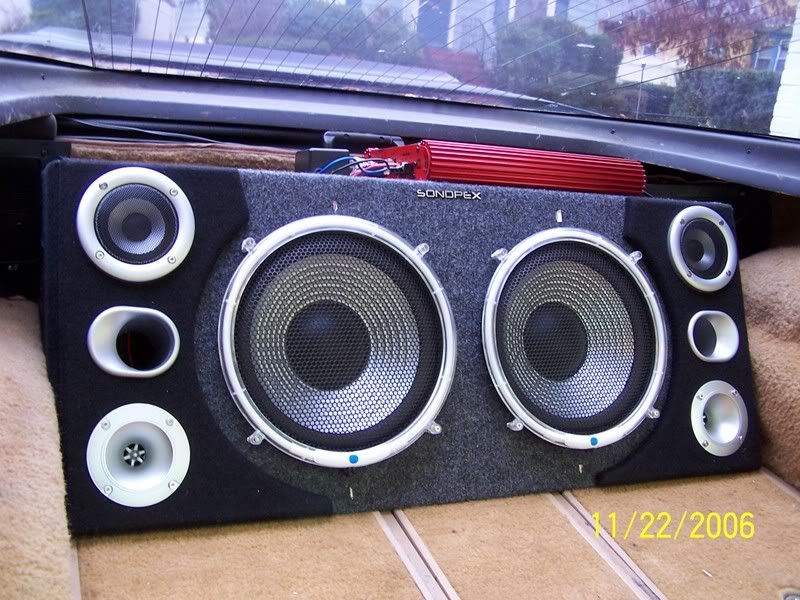
Any suggetsions?

Team Owner

Joined: Aug 2006
Posts: 24,125
Likes: 15
From: Columbia Missouri
First of all...you don't really hear bass, you feel it. The only thing you should hear is the music performed by your front or rear stage. The highs and mids will be what you listen to. You can get low frequencies from your subs and you hear those, but the bass you speak of...that thump, is felt more than it's heard.
The way we feel that bass, is by proper imaging. The subs the way you have them are not going to be very effective. Turn the box around or aim it so there is a surface in front of the cones. The sound waves bouncing off of a surface will increase what you feel and or hear.
Also, the subs look cheap and probably have a low Xmax value.
The way we feel that bass, is by proper imaging. The subs the way you have them are not going to be very effective. Turn the box around or aim it so there is a surface in front of the cones. The sound waves bouncing off of a surface will increase what you feel and or hear.
Also, the subs look cheap and probably have a low Xmax value.
Melting Slicks


Joined: May 2003
Posts: 2,387
Likes: 2
From: Meriden CT
Team Owner
Joined: Aug 2006
Posts: 24,125
Likes: 15
From: Columbia Missouri
It's a shame all that stuff is paid for. The amp looks like a Pyle or Legacy or Pyrimid, and if it says 600 W then it's probably closer to 150 RMS.
I'm not ragging on anyone for their equipment, but it's clear why you cannot hear or feel what you want to hear and feel.
I'm not ragging on anyone for their equipment, but it's clear why you cannot hear or feel what you want to hear and feel.

Le Mans Master


Joined: Dec 2006
Posts: 8,837
Likes: 1,028
It's a shame all that stuff is paid for. The amp looks like a Pyle or Legacy or Pyrimid, and if it says 600 W then it's probably closer to 150 RMS.
I'm not ragging on anyone for their equipment, but it's clear why you cannot hear or feel what you want to hear and feel.
I'm not ragging on anyone for their equipment, but it's clear why you cannot hear or feel what you want to hear and feel.

Le Mans Master

Joined: Jan 2006
Posts: 9,192
Likes: 27
From: Boca Raton Florida
yea ya really need to know what your buying in that business. For years I kept an amp laying around that advertised as a 100 wattx2 PIP
It was about 6" square and 3/4" thick. Would not have even been big enough for a heat sink on a 50 watt amp.
I figured the PIP meant Peak Imaginary Power
It was about 6" square and 3/4" thick. Would not have even been big enough for a heat sink on a 50 watt amp.
I figured the PIP meant Peak Imaginary Power
Corvette Stories
The Best of Corvette for Corvette Enthusiasts

Top 10 Most Expensive Corvettes Ever Sold on Bring A Trailer
Brett Foote
10 Things Every Corvette Owner Needs (2026 Edition)
Michael S. Palmer
8 Most "Only Corvette Owners Understand" Quirks and Problems
Pouria Savadkouei
10 Reasons the C6 Z06 is Still A Performance Benchmark After 20 Years
Joe Kucinski
How Much Horsepower Every Corvette Engine "LOST" in 1972
Joe Kucinski
Top 10 DOs and DON'Ts for Protecting Your Convertible Top!
Michael S. Palmer
Top 10 Most Explosive Corvettes Ever Made: Power-to-Weight Ratio Ranked!
Joe Kucinski
150 hp to 1,250 hp: Every Corvette Generation Compared by the Specs That Matter
Joe Kucinski
8 Coolest Corvette Pace Cars (and Replicas) of All Time
Verdad Gallardo
Le Mans Master
Joined: Jan 2006
Posts: 9,192
Likes: 27
From: Boca Raton Florida
Team Owner
Joined: Aug 2006
Posts: 24,125
Likes: 15
From: Columbia Missouri
Honest Power Ratings:
The most honest way to rate a speaker is to give the rating as continuous RMS watts (ex: 150 watts continuous RMS power). You may hear speakers advertised as "150 watt 6 x 9s" or "100 watt 6 x 9s" and you may instantly think that the "150 watt 6 x 9s" are better and will play louder than the speakers rated at 100 watts. The first thing you should realize is that speaker ratings are OFTEN exaggerated. Then you should ask if the rating is in RMS or peak watts and are the speaker ratings for instantaneous or continuous power. Most car audio speakers (with the exception of some subwoofers) are rated in peak power or music power. Only a few speakers (generally the higher quality speakers) are rated in RMS watts. While peak power is a legitimate way to rate speakers (as long as the manufacturer tells you that the power rating is in peak watts), it can be deceptive.
Peak vs RMS:
You know that peak power is 2 times the RMS power. If a speaker is actually capable of handling 150 watts of peak power it would only be rated to handle 75 watts RMS. If a speaker is rated to handle 150 watts 'music power', it may mean that the speaker will take only very short bursts of power approaching 150 watts RMS. Even if there are two speakers from different manufacturers which have the same power ratings, one of the manufacturers may be more conservative in their ratings than the other manufacturer. The more conservatively rated speaker would be more likely to handle its rated power. Bottom line, beware of power ratings on speakers. Knowing that some manufacturers are less than honest in their power ratings, will likely help you to make better decisions when buying speakers.
Amplifiers and Speakers:
Many people ask the question... Can my speakers handle this amplifier or will this amplifier blow my speakers. Well, the truth is that any speaker can be driven by any amplifier. The only time that there will be a problem is when the person operating the system becomes abusive. Most people (and I do mean most) drive their amplifiers well into clipping. I know what your thinking... I never drive my amp into clipping. Well, you must be one of the very few. Generally speaking, if you have friends who are impressed by high volume, you drive your system into clipping.
The most honest way to rate a speaker is to give the rating as continuous RMS watts (ex: 150 watts continuous RMS power). You may hear speakers advertised as "150 watt 6 x 9s" or "100 watt 6 x 9s" and you may instantly think that the "150 watt 6 x 9s" are better and will play louder than the speakers rated at 100 watts. The first thing you should realize is that speaker ratings are OFTEN exaggerated. Then you should ask if the rating is in RMS or peak watts and are the speaker ratings for instantaneous or continuous power. Most car audio speakers (with the exception of some subwoofers) are rated in peak power or music power. Only a few speakers (generally the higher quality speakers) are rated in RMS watts. While peak power is a legitimate way to rate speakers (as long as the manufacturer tells you that the power rating is in peak watts), it can be deceptive.
Peak vs RMS:
You know that peak power is 2 times the RMS power. If a speaker is actually capable of handling 150 watts of peak power it would only be rated to handle 75 watts RMS. If a speaker is rated to handle 150 watts 'music power', it may mean that the speaker will take only very short bursts of power approaching 150 watts RMS. Even if there are two speakers from different manufacturers which have the same power ratings, one of the manufacturers may be more conservative in their ratings than the other manufacturer. The more conservatively rated speaker would be more likely to handle its rated power. Bottom line, beware of power ratings on speakers. Knowing that some manufacturers are less than honest in their power ratings, will likely help you to make better decisions when buying speakers.
Amplifiers and Speakers:
Many people ask the question... Can my speakers handle this amplifier or will this amplifier blow my speakers. Well, the truth is that any speaker can be driven by any amplifier. The only time that there will be a problem is when the person operating the system becomes abusive. Most people (and I do mean most) drive their amplifiers well into clipping. I know what your thinking... I never drive my amp into clipping. Well, you must be one of the very few. Generally speaking, if you have friends who are impressed by high volume, you drive your system into clipping.


Racer
Joined: Jul 2006
Posts: 270
Likes: 3
From: Montana
Clipping equals audio distortion of the media being listened to. The media is not faithfully reproduced as it was originally recorded. Clipping occurs when the final output stage in the power amplifier is overdriven by turning the volume control way too high.
Pete .
.
Pete
.
Thread Starter
Instructor
Joined: Jan 2007
Posts: 152
Likes: 0
First of all...you don't really hear bass, you feel it. The only thing you should hear is the music performed by your front or rear stage. The highs and mids will be what you listen to. You can get low frequencies from your subs and you hear those, but the bass you speak of...that thump, is felt more than it's heard.
The way we feel that bass, is by proper imaging. The subs the way you have them are not going to be very effective. Turn the box around or aim it so there is a surface in front of the cones. The sound waves bouncing off of a surface will increase what you feel and or hear.
Also, the subs look cheap and probably have a low Xmax value.
The way we feel that bass, is by proper imaging. The subs the way you have them are not going to be very effective. Turn the box around or aim it so there is a surface in front of the cones. The sound waves bouncing off of a surface will increase what you feel and or hear.
Also, the subs look cheap and probably have a low Xmax value.
And yes - I do not deny it. It IS a cheap set of speakers. I paid $60.00 at Pep Boys for the box with the speakers. I liked the fact that they fit in the rear cargo area without any modifications. They sound surprisingly good for the money as long as they are not competing with the exhaust system. The amp is made by DUAL and as I stated earlier, is mated to a Sony head unit. I have felt the hair on my head and arms move at certain low frequencies with these speakers, so they can deliver some....


Le Mans Master
Joined: Dec 2006
Posts: 8,837
Likes: 1,028
I would imagine that would cause a great deal of harmonic distortian.
Racer
Joined: Jul 2006
Posts: 270
Likes: 3
From: Montana
Here a few other considerations to think about when selecting speaker's for a Corvette audio playback system:
1. 6" x 9" speakers will faithfully replicate frequencies within the 2kHz to 8kHz range ... this range varies depending upon the speaker cone material composition.
2. 'Tweeter's' reproduce audio frequencies at the upper levels of the human hearing range which may be on the order of 7kHz up to 20kHz.
3. 'Woofer's' reproduce frequencies at the lower end of the human hearing range ... down around 30Hz up to 3kHz.
Remember that the human hearing range is measured to be between 20Hz and 20KHz. Also remember that we humans 'hear' frequencies at different amplitudes across the range of 20Hz to 20kHz.
What the heck does this mean? Well, we 'hear' frequencies or sounds on a non-linear scale.
To illustrate, imagine for a moment a sad face icon, just the opposite of this happy face , look at the curve of the mouth on the sad face ... both ends are turned down with respect to the middle portion.
Okay, you got it, that curve approximates the curve we humans have in hearing sound. At lower frequencies (the left-side of the down-turned mouth), our hearing is diminished. During mid-range frequencies (the middle of the mouth) we hear much better, and at higher frequencies (the right-side of the mouth), the sound amplitude we hear becomes diminished again.
Well, sheesh! How do we compensate our hearing to clearly hear all the sounds at the same level or volume we wish to in an audio playback system??
Glad you asked! The answer is to boost the amplitude of the frequencies at the lower and upper ends of our hearing spectrum.
Well, how is that accomplished?? By separating the human hearing range into individual frequency components.
Granted, most music when recorded is already compensated to boost low and upper frequencies through the use of RIAA equalization techniques. This is good, but not sufficient to overcome all the various noise sources in our old 'Vettes.
The lower and upper frequency sounds must be further boosted again. This is where an audio equalizer will help restore the full frequency range to meet your individual hearing requirements.
If one is looking to get a bass boost to 'feel' those low frequencies, then one must obtain a 'woofer' that is capable of producing those low frequencies without distortion. Specifically look for a speaker with performance specs that allow the speaker cone to travel in excess of an inch or more.
Why?? Simply because the speaker must get a large volume (bolus) of air moving so that same impacts upon on our body ... we do not hear this mass of air ... we only feel it.
So, I'm 'gabbing' a lot here ... sorry for the long post.
Hope this helps ... if more questions follow, let me know.
Best Regards,
Pete
1. 6" x 9" speakers will faithfully replicate frequencies within the 2kHz to 8kHz range ... this range varies depending upon the speaker cone material composition.
2. 'Tweeter's' reproduce audio frequencies at the upper levels of the human hearing range which may be on the order of 7kHz up to 20kHz.
3. 'Woofer's' reproduce frequencies at the lower end of the human hearing range ... down around 30Hz up to 3kHz.
Remember that the human hearing range is measured to be between 20Hz and 20KHz. Also remember that we humans 'hear' frequencies at different amplitudes across the range of 20Hz to 20kHz.
What the heck does this mean? Well, we 'hear' frequencies or sounds on a non-linear scale.
To illustrate, imagine for a moment a sad face icon, just the opposite of this happy face
, look at the curve of the mouth on the sad face ... both ends are turned down with respect to the middle portion.Okay, you got it, that curve approximates the curve we humans have in hearing sound. At lower frequencies (the left-side of the down-turned mouth), our hearing is diminished. During mid-range frequencies (the middle of the mouth) we hear much better, and at higher frequencies (the right-side of the mouth), the sound amplitude we hear becomes diminished again.
Well, sheesh! How do we compensate our hearing to clearly hear all the sounds at the same level or volume we wish to in an audio playback system??
Glad you asked! The answer is to boost the amplitude of the frequencies at the lower and upper ends of our hearing spectrum.
Well, how is that accomplished?? By separating the human hearing range into individual frequency components.
Granted, most music when recorded is already compensated to boost low and upper frequencies through the use of RIAA equalization techniques. This is good, but not sufficient to overcome all the various noise sources in our old 'Vettes.
The lower and upper frequency sounds must be further boosted again. This is where an audio equalizer will help restore the full frequency range to meet your individual hearing requirements.
If one is looking to get a bass boost to 'feel' those low frequencies, then one must obtain a 'woofer' that is capable of producing those low frequencies without distortion. Specifically look for a speaker with performance specs that allow the speaker cone to travel in excess of an inch or more.
Why?? Simply because the speaker must get a large volume (bolus) of air moving so that same impacts upon on our body ... we do not hear this mass of air ... we only feel it.
So, I'm 'gabbing' a lot here ... sorry for the long post.
Hope this helps ... if more questions follow, let me know.
Best Regards,
Pete
Racer
Joined: Jul 2006
Posts: 270
Likes: 3
From: Montana
