




Interior Dye Application Question
Thread Starter
Racer


Joined: May 2003
Posts: 432
Likes: 0
From: Manchvegas NH
 Interior Dye Application Question
I bought some spray can dye from Corvette America to spray some new hard plastic parts I just bought, plus spray some older soft and hard interior parts.
Here is my game plan:
New Parts: Clean with rubbing alcohol, apply paint in thin coats every 10 - 15 minutes.
Old Parts: Clean/Degrease, wipe down with rubbing alcohol, apply paint in thin coats every 10 - 15 minutes.
Here is the question: I also bought a can of Interior Dye Primer, and I have not seen any mention of anyone using this while searching the forum. Is it even necessary? I thought it might be because I am going from the black that the new parts are molded in to Light Saddle. Am I correct, or should I just return it?
By the way: Corvette America dye is a re-wrapped can of Omni Pak MasterBlend, made by Krylon. This must mean that Corvette America custom blends and fills their own cans.
Here is my game plan:
New Parts: Clean with rubbing alcohol, apply paint in thin coats every 10 - 15 minutes.
Old Parts: Clean/Degrease, wipe down with rubbing alcohol, apply paint in thin coats every 10 - 15 minutes.
Here is the question: I also bought a can of Interior Dye Primer, and I have not seen any mention of anyone using this while searching the forum. Is it even necessary? I thought it might be because I am going from the black that the new parts are molded in to Light Saddle. Am I correct, or should I just return it?
By the way: Corvette America dye is a re-wrapped can of Omni Pak MasterBlend, made by Krylon. This must mean that Corvette America custom blends and fills their own cans.

Le Mans Master

Joined: Jun 2005
Posts: 5,447
Likes: 3
From: Syracuse NY
I think the primer would be a good idea as you are going from black to a much lighter color, I've never dyed parts but it seems like cheap insurance IMHO.
Mike,
Who makes this Bulldog product?
Rick
Mike,
Who makes this Bulldog product?
Rick

Burning Brakes


Joined: Sep 2004
Posts: 1,167
Likes: 2
From: Ft.Worth Texas
Absolutely use this first....after cleaning. You won't need primer but prime if you wish. I cleaned with Comet and a fingernail brush.
Drifting

Joined: May 2004
Posts: 1,442
Likes: 2
From: Flanders NJ
I did mine exactly the way you mentioned, without primer, and it came out perfect. Went from dark blue to charcoal, and also some new pieces. Use very thin coats and as many as needed to get the results you want. An easy job. Good luck. Check out My Corvette Photos to see the interior.
Dave
Dave
Burning Brakes
Joined: Jan 2006
Posts: 1,154
Likes: 1
From: St Augustine FL
I have only dyed one part in my car and that is the power seat switch bezel. Dark Blue. It was a new bezel. I cleaned it first then put 4 coats on it. A year later the dye is fading on the top edge. I assume it is fading from the bezel being rubbed when getting in and out of the car.

Instructor
Joined: Aug 2006
Posts: 134
Likes: 0
From: Apple Valley MN
I redyed (silver) most of the window and t-top trim this winter. I follow the same procedure you mentioned - except i cleaned the parts with Laquer thinner first to get off all grease and then cleaned with rubbing alcohol. most of my parts were being dyed the same color but i did dye a few new black parts. I also bought the primer and used it on one black but not the other. I saw no differance. I did use the clear coat protectant on the power seat switch bezel which was orginally black. it darkened it a bit but i hope it will last longer.
I also used the dye on the steering column and related parts - worked great!
I also used the dye on the steering column and related parts - worked great!
Corvette Stories
The Best of Corvette for Corvette Enthusiasts

8 Coolest Corvette Pace Cars (and Replicas) of All Time
Verdad Gallardo
Top 10 Corvette Engines RANKED by Peak Torque (70+ Years of Muscle!)
Joe Kucinski
Corvette ZR1X Will Be Pacing the Indy 500, And Could Probably Race, Too!
Verdad Gallardo
Top 10 Corvettes Coming to Mecum Indy 2026!
Brett Foote
Top 10 C9 Corvette MUST-HAVES to Fix These C8 Generation Flaws!
Michael S. Palmer
10 Revolutionary 'Corvette Firsts' Most People Don't Know
Joe Kucinski
5 Reasons to Upgrade to an LS6-Powered Corvette; 5 Reasons to Stay LT2
Michael S. Palmer
2027 Corvette vs The World: Every C8 vs Its Closest Competitor
Joe Kucinski
10 Most Common Corvette Problems of the Last 20 Years!
Joe Kucinski
Intermediate
Joined: Jan 2007
Posts: 29
Likes: 0
From: Rhinebeck ny
Interior Dye
I used the corvette Amercia spray cans ,ordered primer and used one can,then did the rest without. Came out Great went from doe skin to firethorn. If i had it to do again would buy it by the quart, took about eight cans! Just clean the parts good lacyuer thinner works great.

Le Mans Master
Joined: Nov 2004
Posts: 6,434
Likes: 0
St. Jude Donor '07
I just cleaned mine with acetone and sprayed them with one coat. I used the crap from discount auto parts. Duplicolor I think. I was only putting a coat of the same color(black) to cover some crap and make it look better. Did it about 2 minutes ago lol. ran out of paint though 
Thread Starter
Racer
Joined: May 2003
Posts: 432
Likes: 0
From: Manchvegas NH
Thanks for all the useful info.!
I think I'll use the primer on the black parts, and knowing me, I'll want to dye the whole interior soon enough. In that case, I'll just order a quart of dye and forget about the primer.
I think I'll use the primer on the black parts, and knowing me, I'll want to dye the whole interior soon enough. In that case, I'll just order a quart of dye and forget about the primer.

Intermediate
Joined: Mar 2007
Posts: 30
Likes: 0
From: Coastside California
I also picked up some dye (Silver Pace) from Corvette America along with one can of their primer. The instructions for the primer says to spray it on the part first, then wait a few minutes and spray the color on top (while the primer is still wet). Then continue to spray light coats of the colored dye every 10 - 15 minutes after that.
I think spraying the color onto the damp primer is so that the first coat of dye "bonds" with the primer on the part. I'm sure that's what the "bulldog" does as well - but without the slightly higher price of the CA primer...
In any case, it worked well for me. Good luck!
I think spraying the color onto the damp primer is so that the first coat of dye "bonds" with the primer on the part. I'm sure that's what the "bulldog" does as well - but without the slightly higher price of the CA primer...
In any case, it worked well for me. Good luck!

Intermediate
Joined: Apr 2007
Posts: 36
Likes: 0
Dye job looks great, but ..........
Just finished dyeing the interior parts. The leather and soft rubber pieces are really great. I am using Corvette America dye (1980 Red). I am also dyeing the hard plastic pieces such as around windshield, hinge covers on seats, etc. These also turned out great.
Each part was scrubbed with Comet, rinsed throughly, allowed to dry for two days. Before starting to spray, I washed my hands thoroughly, sprayed each with SEM Sand Free, and sprayed each while the SF was still wet. I had each hanging by some stiff wire through an available screw hole.
THE PROBLEM: When I removed the wire from some of the hard plastic pieces (specifically the seat hinge covers), some of the color scratched off. This may not be a problem with the pieces around the windshield that are rarely touched, but the hinge covers (and the seat frames that I haven't done yet) will get a lot of wear.
WHAT CAN I DO TO BETTER PREP THE HARD PLASTIC PIECES ???
AM I USING THE CORRECT DYE/PAINT FOR HARD PLASTIC ???
Thank you. I appreciate your input before I mess up the seat frames.
Bob
Each part was scrubbed with Comet, rinsed throughly, allowed to dry for two days. Before starting to spray, I washed my hands thoroughly, sprayed each with SEM Sand Free, and sprayed each while the SF was still wet. I had each hanging by some stiff wire through an available screw hole.
THE PROBLEM: When I removed the wire from some of the hard plastic pieces (specifically the seat hinge covers), some of the color scratched off. This may not be a problem with the pieces around the windshield that are rarely touched, but the hinge covers (and the seat frames that I haven't done yet) will get a lot of wear.
WHAT CAN I DO TO BETTER PREP THE HARD PLASTIC PIECES ???
AM I USING THE CORRECT DYE/PAINT FOR HARD PLASTIC ???
Thank you. I appreciate your input before I mess up the seat frames.
Bob

Drifting


Joined: Nov 2004
Posts: 1,627
Likes: 293
2020 C3 of the Year Finalist - Modified
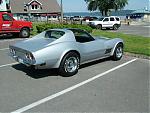
i've just finished dyeing all of my interior pieces from tan/red to black......here's a picture of my new dash from ecklers....the glove box is original and I used the dupli color interior paint/dye.....i think it came out pretty darn well......matches great too! i put it in the sun so ya'll can see the color better..

as for the hard pieces use a primer...and a decent amount of coats....
as for the hard pieces use a primer...and a decent amount of coats....



Instructor

Joined: Apr 2003
Posts: 216
Likes: 13
From: Camas WA
I was about to say the same thing. I have always put 2 clear coats on top of the new dye color coat. That seems to make everything more durable. I have used polyurethane rather than spray lacquer.

Le Mans Master


Joined: Oct 2000
Posts: 8,897
Likes: 1,353
From: Santa Ana CA
You're going from black to light saddle??? 
Recognize that the threads in the various pieces (e.g., the center console) are a different color than the actual vinyl piece and you will never get the thread color exactly right (regardless of what color you go from and to).
Also, the dye will "glop" these threads together and they will never be the same.
I had a green/green '70 so any replacement pieces always had to be dyed and this was my experience.
Recognize that the threads in the various pieces (e.g., the center console) are a different color than the actual vinyl piece and you will never get the thread color exactly right (regardless of what color you go from and to).
Also, the dye will "glop" these threads together and they will never be the same.
I had a green/green '70 so any replacement pieces always had to be dyed and this was my experience.
