







California Plates
Thread Starter
Melting Slicks


Joined: Aug 2005
Posts: 2,821
Likes: 204
From: Lincoln CA
 California Plates
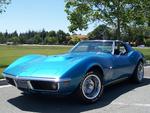
I have a late 69 coupe. The California legislature is presently considering a bill to allow owners of 63 - 69 cars to participate in the "Year of Manufacture" license plate program available to 62 and earlier vehicles. I've already got CA yellow on black plates for my 69 Mustang convertible (built in Oct. 68 and probably first licensed in Nov. 68), but I've got my doubts about my Vette. The Vette is a late 69, built in mid-October 69. It was probably first registered in November 69. Since CA began issuing the yellow on blue plates for the 70 model year, is it possible that my 69, being registered two months into the 70 model year, would have gotten yellow on blue plates instead of yellow on black? Anyone out there know?
Burning Brakes


Joined: Mar 2006
Posts: 915
Likes: 2
From: Lima, OH -- 69 L71 427/435hp
How does the "Year of Manufacturer" program work?
A friend was telling me something related to this just last week and I didn't quite understand it. Is it like historical plates?
He was saying something to the effect that you can use an old registered plate, from that year, and use it to get custom plates, if a name you want is already used. Which seems odd, because I wouldn't think two different people could have the same plate name/number.
I guess I am not understanding where and how you would get plates from that long ago and how you could register them or what the advantage of this really is.

Thanks
A friend was telling me something related to this just last week and I didn't quite understand it. Is it like historical plates?
He was saying something to the effect that you can use an old registered plate, from that year, and use it to get custom plates, if a name you want is already used. Which seems odd, because I wouldn't think two different people could have the same plate name/number.
I guess I am not understanding where and how you would get plates from that long ago and how you could register them or what the advantage of this really is.
Thanks
Thread Starter
Melting Slicks
Joined: Aug 2005
Posts: 2,821
Likes: 204
From: Lincoln CA
Here in CA the DMV wouldn't be able to help. They destroy their records after three years. No history on what they did four years ago let alone forty.
The Year of Manufacture program here in CA allows owners of vintage cars (up through 62 as of now) to re-register the cars with correct vintage plates on them. They have to be actual CA plates (not reproductions), they have to be clean and legible, and they have to be certified as "clear" meaning that number is not associated with any other vehicle on their records presently. The advantage is simply authenticity of appearance. There is also some desirability associated with the old CA plates here in CA since the yellow on black plates (63-69) are still in service on cars that have not been resold by a dealer since they were first registered. They retain the black plates and that attests to the fact that they are original CA cars. Less rust and all that. Dealers would usually remove plates and re-register the car with current version plates when they were re-sold. That's how my 69 Mustang convertible got it's present 1982 vintage yellow on blue plates and how my 69 Vette got the modern blue on reflective white plates. As far as your question regarding custom or "vanity" plates, CA didn't start a "vanity" plate program until the advent of the yellow on blue plates in 1970, so I don't know how that would work in your state. I doubt the state would look kindly on issuing the same vanity plate to two different cars, however, regardless of color.
The Year of Manufacture program here in CA allows owners of vintage cars (up through 62 as of now) to re-register the cars with correct vintage plates on them. They have to be actual CA plates (not reproductions), they have to be clean and legible, and they have to be certified as "clear" meaning that number is not associated with any other vehicle on their records presently. The advantage is simply authenticity of appearance. There is also some desirability associated with the old CA plates here in CA since the yellow on black plates (63-69) are still in service on cars that have not been resold by a dealer since they were first registered. They retain the black plates and that attests to the fact that they are original CA cars. Less rust and all that. Dealers would usually remove plates and re-register the car with current version plates when they were re-sold. That's how my 69 Mustang convertible got it's present 1982 vintage yellow on blue plates and how my 69 Vette got the modern blue on reflective white plates. As far as your question regarding custom or "vanity" plates, CA didn't start a "vanity" plate program until the advent of the yellow on blue plates in 1970, so I don't know how that would work in your state. I doubt the state would look kindly on issuing the same vanity plate to two different cars, however, regardless of color.
Last edited by RagTop69; May 9, 2007 at 02:55 PM.
Pro

Joined: Sep 2006
Posts: 551
Likes: 2
From: Clovis CA
I bought a set of clean YOM title plates for my 39 Plymouth last year, it was easy to re-register, but you have to go to DMV and take the plates, thay have to approve everything including appearance. I have the name/number of a old guy that has a garage of plates, they are not cheap though....John Serio 559-226-4972 or 559-269-9274
Every state is different,some call for historic plates,we are lucky here..
Every state is different,some call for historic plates,we are lucky here..
Thread Starter
Melting Slicks
Joined: Aug 2005
Posts: 2,821
Likes: 204
From: Lincoln CA
I bought a set of clean YOM title plates for my 39 Plymouth last year, it was easy to re-register, but you have to go to DMV and take the plates, thay have to approve everything including appearance. I have the name/number of a old guy that has a garage of plates, they are not cheap though....John Serio 559-226-4972 or 559-269-9274
Every state is different,some call for historic plates,we are lucky here..
Every state is different,some call for historic plates,we are lucky here..
Corvette Stories
The Best of Corvette for Corvette Enthusiasts

Top 10 Most Expensive Corvettes Ever Sold on Bring A Trailer
Brett Foote
10 Things Every Corvette Owner Needs (2026 Edition)
Michael S. Palmer
8 Most "Only Corvette Owners Understand" Quirks and Problems
Pouria Savadkouei
10 Reasons the C6 Z06 is Still A Performance Benchmark After 20 Years
Joe Kucinski
How Much Horsepower Every Corvette Engine "LOST" in 1972
Joe Kucinski
Top 10 DOs and DON'Ts for Protecting Your Convertible Top!
Michael S. Palmer
Top 10 Most Explosive Corvettes Ever Made: Power-to-Weight Ratio Ranked!
Joe Kucinski
150 hp to 1,250 hp: Every Corvette Generation Compared by the Specs That Matter
Joe Kucinski
8 Coolest Corvette Pace Cars (and Replicas) of All Time
Verdad Gallardo
Burning Brakes

Joined: Jul 2006
Posts: 1,047
Likes: 12
From: SoCal
Not quite true - IIRC, CA began issuing the yellow on blue plates in late 1969 (don't know the exact date), which coincided with the 1970 model year introductions. Any car, regardless of model year, that was issued a new CA license plate after then would have gotten yellow on blue.

Burning Brakes
Joined: May 2005
Posts: 803
Likes: 7
From: Johnstown Pa
Some, if not all states, which allow YOM, not all do, require you to have a current type plate in the vehicle.
About half of the states have the program. Pa has none. I believe SCar just initiated one.
Pa old yello blue plates with a standard issue number could be issued as a vanity plate. I'm not aware that any state would issue the same number/letter combo no matter the year. At least one state will issue the same number for a car, a truck and a motorcycle.
About half of the states have the program. Pa has none. I believe SCar just initiated one.
Pa old yello blue plates with a standard issue number could be issued as a vanity plate. I'm not aware that any state would issue the same number/letter combo no matter the year. At least one state will issue the same number for a car, a truck and a motorcycle.
Thread Starter
Melting Slicks
Joined: Aug 2005
Posts: 2,821
Likes: 204
From: Lincoln CA
Not quite true - IIRC, CA began issuing the yellow on blue plates in late 1969 (don't know the exact date), which coincided with the 1970 model year introductions. Any car, regardless of model year, that was issued a new CA license plate after then would have gotten yellow on blue.
Pro
Joined: Sep 2006
Posts: 551
Likes: 2
From: Clovis CA
A few of our friends have taken the white reflective w/raised California and powder coated them semi gloss black, then painted the off yellow. NONE have had a problem, some have run them for many years, all old cars though...or theres no reason you cant put a clean title black plate on your car,does not have to be YOM's...
Last edited by 68RATVT; May 9, 2007 at 08:51 PM.

Instructor

Joined: Jul 2004
Posts: 183
Likes: 1
From: San Clemente CA
I met a guy at the Pomona Car show who had Black plates on a 68 he just bought in TX. He bought a set of Black plates and got a new vanity plate from DMV with those numbers on it. If a cop pulls you over and runs the plate he the numbers are correct. They don't ask what color it is.



Racer
Joined: Jan 2004
Posts: 303
Likes: 28
From: los angeles ca
My 69 came with black and yellow plates.
The black and yellow plates have 6 digits.
The blue and yellow plates on up have 7 digits.
Changing the color would be an invitation to get pulled over and the number of digits would be a dead give away.
The black and yellow plates have 6 digits.
The blue and yellow plates on up have 7 digits.
Changing the color would be an invitation to get pulled over and the number of digits would be a dead give away.

Pro

Joined: Aug 2004
Posts: 505
Likes: 19
From: Ca
I met a guy at the Pomona Car show who had Black plates on a 68 he just bought in TX. He bought a set of Black plates and got a new vanity plate from DMV with those numbers on it. If a cop pulls you over and runs the plate he the numbers are correct. They don't ask what color it is.
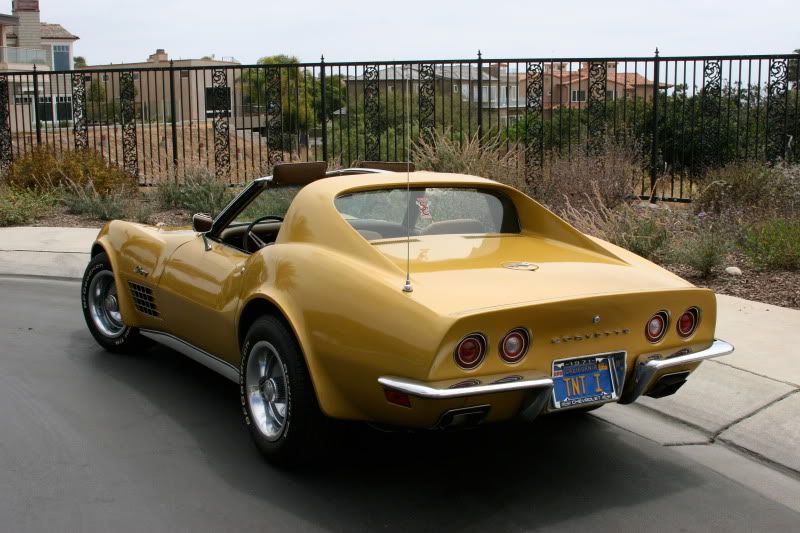
Sometimes I will see cars with old blue plates that are painted black to make them look authentic. These are pretty easy to spot. With ylw on blk plates the letters are placed prior to the numbers. Vice versa on the blue plates.
Some 1970 models have original blk plates. There are not many but they are out there. If you really want to get **** there are actually 2 sets of the early style ylw on blue as well (both with 3 numbers then 3 letters). On the first style the word "California is approximately 3/4 inch shorter than the later style which was issued later.

Instructor
Joined: Jul 2004
Posts: 183
Likes: 1
From: San Clemente CA
[QUOTE=pchmotoho;1560201473]I would check to the paperwork of that car very closely. The guy is probably lying. The DMV is not supposed to do that (we all know that they couldnt make a mistake!). I tired doing that same thing twice and got shot down both times.
Yea, he was selling and we all know people who sell at Pomona NEVER lie.
I have a orginal blue plate on my 71 so I never followed up with DMV. Thanks.
Yea, he was selling and we all know people who sell at Pomona NEVER lie.
I have a orginal blue plate on my 71 so I never followed up with DMV. Thanks.

Intermediate
Joined: Oct 2006
Posts: 35
Likes: 0
From: Martinez California