


I'm finally getting my car back on the road and took it for a drive in the mountains yesterday. Nearing the destination traffic came to a quick stop (construction) and when I hit the brakes they were VERY soft and while they stopped me they are certainly not as good as normal. I looked at the dash and noticed my brake light was also on. No, I was not driving with the parking brake on. Before heading back I stopped and checked the brake fluid and the rear reservoir (front brakes?) was basically empty. I filled it up and headed back. The brakes seemed better, but still soft some times, almost back to normal others. After getting home I checked the fluid and it's still full. The car has basically sat for 2 years and leaks from just about everything, so I'm guessing it's a very slow leak. I'm sure I sucked air into the lines and since I plan to have every fluid in the car drained and filled this will resolve it.
What concerns me is the brake warning light on the dash did not go off. If the brake fluid is topped off, and the parking brake is off, what else could make the brake light stay on?
What concerns me is the brake warning light on the dash did not go off. If the brake fluid is topped off, and the parking brake is off, what else could make the brake light stay on?

Fix the brakes.Draining the fluid and putting in new will not fix the problem.You need to repair what is worn out. These cars often leak from the piston seals in the brake caliper,also from just about every where else.Find your brake leak (or leaks) make the repairs,look over the lines,both rubber and metal,look for leaks at the master cylneder as well. then bleed them and your brake light will turn off.
Quote:
Yes, well, finding the leak and looking for old/worn out parts is planned, but why is the light on after topping off the brake fluid?Originally Posted by Kyle69-71 BBs
Fix the brakes.Draining the fluid and putting in new will not fix the problem.You need to repair what is worn out. These cars often leak from the piston seals in the brake caliper,also from just about every where else.Find your brake leak (or leaks) make the repairs,look over the lines,both rubber and metal,look for leaks at the master cylneder as well. then bleed them and your brake light will turn off.

I would be willing to bet that it is detecting air in the system. Even if there was a little fluid in there, it may have still picked up some air.
Brake light is going to remain on until the "proportioning valve" is re-centered internally. When the valve sensed a lower pressure on one side of the valve an internal piston slides to one side, as opposed to the normal center position, which is what powers up the light circuit.
The proportioning valve or brake warning switch is mounted on the drivers frame rail. Follow your brake lines from the master cylinder, they lead to the proportioning valve.
To re-center internally you need a solid brake application which puts high pressure on both sides of the valve and should re-center the valve. I would give the brake pedal a rapid jolt. (like a right jab!!) If unsuccessful, you have to replace the proportioning valve.
The proportioning valve or brake warning switch is mounted on the drivers frame rail. Follow your brake lines from the master cylinder, they lead to the proportioning valve.
To re-center internally you need a solid brake application which puts high pressure on both sides of the valve and should re-center the valve. I would give the brake pedal a rapid jolt. (like a right jab!!) If unsuccessful, you have to replace the proportioning valve.
Quote:
In order to reset the light, you need equal pressue front and rear. Pump the pedal a few times then push fairly hard. If it doesn't go out, then either:Originally Posted by skeptic
Yes, well, finding the leak and looking for old/worn out parts is planned, but why is the light on after topping off the brake fluid?
1) you still have air in the system.
2) the PB is partly on.
3) the switch is stuck in the on position.
dannyman
Thats a very clear way of describing it.
But I would not replace the valve unless the repairs are made to the system first and the light still stays on..
I think the air in the system is the cause of the problem. (as far as the light staying on goes).
Thats a very clear way of describing it.
But I would not replace the valve unless the repairs are made to the system first and the light still stays on..
I think the air in the system is the cause of the problem. (as far as the light staying on goes).
Kyle
You're right. I am assuming that the system has been checked for leaks, fixed and full brake pressure is available( ie: no air = no sponginess ).
My point was that the system can be fully functional and yet the light will remain on until proportioning valve has been re-centered. The purpose of the light is to tell you that there is a problem in the braking system, but unless reset it is now able to give a false indication.
You're right. I am assuming that the system has been checked for leaks, fixed and full brake pressure is available( ie: no air = no sponginess ).
My point was that the system can be fully functional and yet the light will remain on until proportioning valve has been re-centered. The purpose of the light is to tell you that there is a problem in the braking system, but unless reset it is now able to give a false indication.
Corvette Stories
The Best of Corvette for Corvette Enthusiasts
Explore

Corvette ZR1X Will Be Pacing the Indy 500, And Could Probably Race, Too!
Verdad Gallardo
Top 10 Corvettes Coming to Mecum Indy 2026!
Brett Foote
Top 10 C9 Corvette MUST-HAVES to Fix These C8 Generation Flaws!
Michael S. Palmer
10 Revolutionary 'Corvette Firsts' Most People Don't Know
Joe Kucinski
5 Reasons to Upgrade to an LS6-Powered Corvette; 5 Reasons to Stay LT2
Michael S. Palmer
2027 Corvette vs The World: Every C8 vs Its Closest Competitor
Joe Kucinski
10 Most Common Corvette Problems of the Last 20 Years!
Joe Kucinski
5 MOST and 5 LEAST Popular Corvette Model Years in History!
Joe Kucinski
2027 Corvette Buyer's Guide: Everything You Need to Know!
Joe Kucinski


Quote:
Originally Posted by Bruthish
I would be willing to bet that it is detecting air in the system. Even if there was a little fluid in there, it may have still picked up some air.

The brake light comes on when there is a significant pressure difference between the front and rear systems (as well as when the parking brake is on). If one resevoir was very low it quite likely sucked in some air. Just adding fluid without bleeding the air out would still result in a pressure difference and the light coming on. If the car sits for a long time the lip seal type piston seals may start to leak some fluid. This happened to my car after sitting for 5 years but the leaking stopped after bleeding out all the old brake fluid and using the brakes again.
I have a '73 with the similar problem. I've had to bleed my brakes all too often. Recently I spoke to someone who used to work on the older Vettes and he said this is a common problem. If the rotors haven't been turned in awhile, the constant vibration from the floating style calipers allows air to sneak in past the pistons. I'm about to have all of the rotors turns and see if that helps.
Thanks for explaining how a pressure difference will cause the light to come one, and not go off until the proportioning valve is re-centered. Makes perfect sense (now that I know that is where the sensor is), and matches my symptoms perfectly.
Now I just need to find/fix the leak and bleed the brakes.
Now I just need to find/fix the leak and bleed the brakes.


Quote:
Your caliper seals could also simply be worn out.Originally Posted by Ran-D
I have a '73 with the similar problem. I've had to bleed my brakes all too often. Recently I spoke to someone who used to work on the older Vettes and he said this is a common problem. If the rotors haven't been turned in awhile, the constant vibration from the floating style calipers allows air to sneak in past the pistons. I'm about to have all of the rotors turns and see if that helps.
Quote:
Originally Posted by Ran-D
I have a '73 with the similar problem. I've had to bleed my brakes all too often. Recently I spoke to someone who used to work on the older Vettes and he said this is a common problem. If the rotors haven't been turned in awhile, the constant vibration from the floating style calipers allows air to sneak in past the pistons. I'm about to have all of the rotors turns and see if that helps.
Quote:
I replaced the original calipers with ones with stainless steel sleeves. I suppose seals are a posibility, but I'm not leaking any fluid. I'll try the seal replacement if the rotor turning doesn't help. Thanks for the idea.Originally Posted by I'm Batman
Your caliper seals could also simply be worn out.

I also had this problem.Me and a friend of mine bleed the brakes the correct way and I still had air.A guy that I know who has worked on a lot of vettes in his life told me to take a wrench and tap on the upper part of the caliper.Tap a few times.Air gets trapped up there and the tapping will untrap the air.You will have to do all of them.Some might have air and some might not.Of course you need to do this while bleeding the brakes.It worked on mine.No problem after 6 months!!
Quote:
There is one more possibility that's slightly off-the-wall - if a caliper support is bent, your rotors could be dead-on on runout and still have problems...Originally Posted by Ran-D
I replaced the original calipers with ones with stainless steel sleeves. I suppose seals are a posibility, but I'm not leaking any fluid. I'll try the seal replacement if the rotor turning doesn't help. Thanks for the idea.
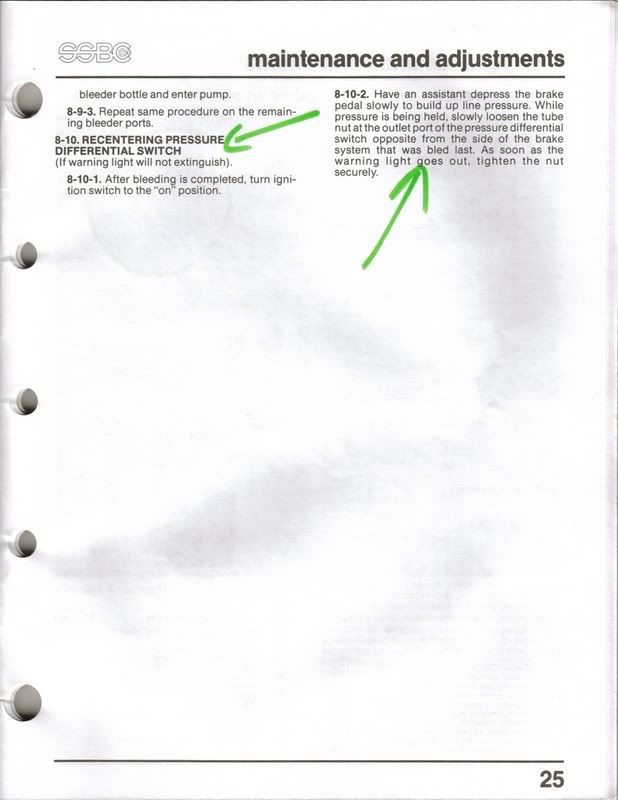
The way to get the light to turn off is to open the output brake line on the pressure switch on the side that did not experience the low pressure, ie, if the problem was in the front brakes, then open the output line to the rear brakes into a rag at the switch. With the ignition on, not running, e-brake off, watching the light, have a friend step on the brakes. Lossen the line into a rag untill the light goes out-- tighten it.. Your centering the piston in the failure switch. That is just a switch, not the proprotioning valve. After this you should bleed the entire system, but it looks like your going to have to do this anyway.


Only $23.00 for a new master cylinder at autozone...I just replaced mine this weekend; thought it was my caliper leaking but turned out to be the cylinder. I had the same type of symptoms w/ my brakes and my brake warning light, which works, did not turn on...