




Help with '68 Convertible please

Thread Starter
Instructor


Joined: Sep 2009
Posts: 114
Likes: 16
From: NE Ohio
 Help with '68 Convertible please
Hello everyone,
I am considering purchasing a '68 Corvette Convertible "driver." I had a brief conversation with the owner and only know the following about the car so far:
convertible (black soft top)
silver exterior
black interior
original 327cid 4bbl and 4 speed manual
manual 4 wheel disc brakes
power steering
The motor runs strong and the top is in good condition. It has not been in any collisions and is in good overall mechanical condition. The owner drives it often. The front nose cover is sagging in the "typical areas" (so he says). The nose also has a crack where the headlight cover caught it. Cosmetically it is good, but not a show queen by any stretch. (I know that's not much to go on)
Now, I've been working on muscle cars for decades but never laid my hands on a Vette or any fiberglass car for that matter. I'd like some ideas of what to look for in the '68 Vette.
What are common problem areas?
What are the difficult or horriobly expensive things to fix?
Are there any areas I should pay particular attention to when looking it over?
Are aftermarket parts readily available? What major parts aren't available?
Of course, any information, opinions, and stories are welcomed. I've always liked the looks of the early C3 convertibles and this one sounds promising so far. I'll be meeting with the owner in a week or so and wanted to have an idea just what I'm looking at.
Thank you all very much.
Mitch
NE Ohio
I am considering purchasing a '68 Corvette Convertible "driver." I had a brief conversation with the owner and only know the following about the car so far:
convertible (black soft top)
silver exterior
black interior
original 327cid 4bbl and 4 speed manual
manual 4 wheel disc brakes
power steering
The motor runs strong and the top is in good condition. It has not been in any collisions and is in good overall mechanical condition. The owner drives it often. The front nose cover is sagging in the "typical areas" (so he says). The nose also has a crack where the headlight cover caught it. Cosmetically it is good, but not a show queen by any stretch. (I know that's not much to go on)
Now, I've been working on muscle cars for decades but never laid my hands on a Vette or any fiberglass car for that matter. I'd like some ideas of what to look for in the '68 Vette.
What are common problem areas?
What are the difficult or horriobly expensive things to fix?
Are there any areas I should pay particular attention to when looking it over?
Are aftermarket parts readily available? What major parts aren't available?
Of course, any information, opinions, and stories are welcomed. I've always liked the looks of the early C3 convertibles and this one sounds promising so far. I'll be meeting with the owner in a week or so and wanted to have an idea just what I'm looking at.
Thank you all very much.
Mitch
NE Ohio

Race Director


Joined: Oct 2000
Posts: 12,682
Likes: 3,135
From: Shamong, NJ
68 can be a tough year. As a first year model there are many one year only parts on a 68. Though most are repro-ed, many are much more expensive than similar parts for a 69 up and the parts that aren't, can be expensive and hard to find.
Beyond that, believe it or not, rust is a big problem in plastic Corvettes. Common areas for rust are the windshield frame, windshield pillar posts and the birdcage in the area where the pillars meet the cowl. Rust in the frame, mainly in the area of the frame kick-ups where the trailing arms bolt to the frame, and the trailing arm boxes themselves.
As you've seen, 68's are prone to having the forward section of the nose sagging. In 69 Chevrolet added some triangle shaped supports to the nose between the top front of the inner skirts and the underside of the fender top surround. If there is noticable cracking, I would suspect repair work, no matter what the seller is claiming.
Leaking brake calipers are a common problem with all 65-82 Corvettes and leaking power steering components (slave cylinder and control valves) are common to all 63-82's with power steering.
If possible, post some pictures here along with all the important numbers from the car (trim tag, engine stamping, block casting number, etc.) you can find and the forum will provide you with just about all you need to know about that car! Also, please concider having someone who knows Corvettes (especially 68's, or at least 68-72's) look at the car for or with you.
Good luck.
Beyond that, believe it or not, rust is a big problem in plastic Corvettes. Common areas for rust are the windshield frame, windshield pillar posts and the birdcage in the area where the pillars meet the cowl. Rust in the frame, mainly in the area of the frame kick-ups where the trailing arms bolt to the frame, and the trailing arm boxes themselves.
As you've seen, 68's are prone to having the forward section of the nose sagging. In 69 Chevrolet added some triangle shaped supports to the nose between the top front of the inner skirts and the underside of the fender top surround. If there is noticable cracking, I would suspect repair work, no matter what the seller is claiming.
Leaking brake calipers are a common problem with all 65-82 Corvettes and leaking power steering components (slave cylinder and control valves) are common to all 63-82's with power steering.
If possible, post some pictures here along with all the important numbers from the car (trim tag, engine stamping, block casting number, etc.) you can find and the forum will provide you with just about all you need to know about that car! Also, please concider having someone who knows Corvettes (especially 68's, or at least 68-72's) look at the car for or with you.
Good luck.
Last edited by gbvette62; Sep 14, 2009 at 09:24 PM.

Melting Slicks

Joined: Jul 2007
Posts: 3,352
Likes: 1
From: Westminster Maryland
Good advice above. Ask to remove a kick panel ( next to your feet in front of the hinge pillar), and look at the condition of the steel. That is a good indicator of how the car has survived 42 years of use. I have a very similar car to what you are looking at. I have had very little trouble finding parts for it. Thanks to e bay and so many vendors, aftermarket parts are easy to find, and original parts are plentiful. One thing to keep in mind, nearly any 69 part will work for a 68, depending on how correct you plan to keep it. Door hardware, taillights /reverse lights, are the obvious differences, so don't be too scared of a "one only" year. I do love the 327; it has it's own characteristics that I find to be very appealing. I say if the frame is good, pull the trigger and get started!

Team Owner


Joined: Jul 1999
Posts: 26,545
Likes: 46
From: Huntersville NC
"original 327cid 4bbl and 4 speed manual"
There were 2 smallblock engines available, the base engine (300 hp) and a 350 hp option, which should be more desireable. Check numbers to see if the car is still wearing its original Rochester carburetor.
There were 2 smallblock engines available, the base engine (300 hp) and a 350 hp option, which should be more desireable. Check numbers to see if the car is still wearing its original Rochester carburetor.
Race Director
Joined: Oct 2000
Posts: 12,682
Likes: 3,135
From: Shamong, NJ
Good advice above. Ask to remove a kick panel ( next to your feet in front of the hinge pillar), and look at the condition of the steel. That is a good indicator of how the car has survived 42 years of use. I have a very similar car to what you are looking at. I have had very little trouble finding parts for it. Thanks to e bay and so many vendors, aftermarket parts are easy to find, and original parts are plentiful. One thing to keep in mind, nearly any 69 part will work for a 68, depending on how correct you plan to keep it. Door hardware, taillights /reverse lights, are the obvious differences, so don't be too scared of a "one only" year. I do love the 327; it has it's own characteristics that I find to be very appealing. I say if the frame is good, pull the trigger and get started!
Melting Slicks
Joined: Jul 2007
Posts: 3,352
Likes: 1
From: Westminster Maryland
Hey, I don't want you to think I'm maligning 68's. It's just that I've been involved in the Corvette hobby as both a hobby and/or a business for over 35 years and I've seen many people buy a 68 as their first Corvette, only to become frustrated or disillusioned. Many think they're going to be super valuable because they're a first year model, like a split window. Others just didn't do their homework to find out what they were getting into. Some just can't understand that a one year part costs more than one that fits 2 or 6 or 14 years, because the cost of producing the part can be recovered quicker if there is more sales volumn for a part.

Drifting

Joined: Jun 2006
Posts: 1,912
Likes: 12
From: Schaumburg (Chicago) Illinois
68 can be a tough year. As a first year model there are many one year only parts on a 68. Though most are repro-ed, many are much more expensive than similar parts for a 69 up and the parts that aren't, can be expensive and hard to find.
Beyond that, believe it or not, rust is a big problem in plastic Corvettes. Common areas for rust are the windshield frame, windshield pillar posts and the birdcage in the area where the pillars meet the cowl. Rust in the frame, mainly in the area of the frame kick-ups where the trailing arms bolt to the frame, and the trailing arm boxes themselves.
As you've seen, 68's are prone to having the forward section of the nose sagging. In 69 Chevrolet added some triangle shaped supports to the nose between the top front of the inner skirts and the underside of the fender top surround. If there is noticable cracking, I would suspect repair work, no matter what the seller is claiming.
Leaking brake calipers are a common problem with all 65-82 Corvettes and leaking power steering components (slave cylinder and control valves) are common to all 63-82's with power steering.
If possible, post some pictures here along with all the important numbers from the car (trim tag, engine stamping, block casting number, etc.) you can find and the forum will provide you with just about all you need to know about that car! Also, please concider having someone who knows Corvettes (especially 68's, or at least 68-72's) look at the car for or with you.
Good luck.
Beyond that, believe it or not, rust is a big problem in plastic Corvettes. Common areas for rust are the windshield frame, windshield pillar posts and the birdcage in the area where the pillars meet the cowl. Rust in the frame, mainly in the area of the frame kick-ups where the trailing arms bolt to the frame, and the trailing arm boxes themselves.
As you've seen, 68's are prone to having the forward section of the nose sagging. In 69 Chevrolet added some triangle shaped supports to the nose between the top front of the inner skirts and the underside of the fender top surround. If there is noticable cracking, I would suspect repair work, no matter what the seller is claiming.
Leaking brake calipers are a common problem with all 65-82 Corvettes and leaking power steering components (slave cylinder and control valves) are common to all 63-82's with power steering.
If possible, post some pictures here along with all the important numbers from the car (trim tag, engine stamping, block casting number, etc.) you can find and the forum will provide you with just about all you need to know about that car! Also, please concider having someone who knows Corvettes (especially 68's, or at least 68-72's) look at the car for or with you.
Good luck.
Thread Starter
Instructor
Joined: Sep 2009
Posts: 114
Likes: 16
From: NE Ohio
All good advice. I'm definitely going to have someone (a Corvette specialist) go over it for me before making any decision. I haven't even seen it yet but I will definitely check the numbers once I see it.
The owner told me it isn't optioned very heavily and just has the basics. I just want a solid roadster with the kind of (minor) problems I can address in my garage. Rust and serious engine issues aren't something I'm going to deal with. I'd rather not buy a car in need of serious fiberglass repair, either. If there is serious nose sagging problems, can they be easily repaired? Can the '69 supports be retrofitted?
Could someone post pictures of the rust areas I should pay particular attention to? The kick-panels are easy, but the "birdcage" isn't something I'm familiar with. I'll insist on having it inspected on a rack by a professional but I'd like to have an idea where to look for myself.
Thanks again everyone.
The owner told me it isn't optioned very heavily and just has the basics. I just want a solid roadster with the kind of (minor) problems I can address in my garage. Rust and serious engine issues aren't something I'm going to deal with. I'd rather not buy a car in need of serious fiberglass repair, either. If there is serious nose sagging problems, can they be easily repaired? Can the '69 supports be retrofitted?
Could someone post pictures of the rust areas I should pay particular attention to? The kick-panels are easy, but the "birdcage" isn't something I'm familiar with. I'll insist on having it inspected on a rack by a professional but I'd like to have an idea where to look for myself.
Thanks again everyone.
Corvette Stories
The Best of Corvette for Corvette Enthusiasts

Top 10 Most Expensive Corvettes Ever Sold on Bring A Trailer
Brett Foote
10 Things Every Corvette Owner Needs (2026 Edition)
Michael S. Palmer
8 Most "Only Corvette Owners Understand" Quirks and Problems
Pouria Savadkouei
10 Reasons the C6 Z06 is Still A Performance Benchmark After 20 Years
Joe Kucinski
How Much Horsepower Every Corvette Engine "LOST" in 1972
Joe Kucinski
Top 10 DOs and DON'Ts for Protecting Your Convertible Top!
Michael S. Palmer
Top 10 Most Explosive Corvettes Ever Made: Power-to-Weight Ratio Ranked!
Joe Kucinski
150 hp to 1,250 hp: Every Corvette Generation Compared by the Specs That Matter
Joe Kucinski
8 Coolest Corvette Pace Cars (and Replicas) of All Time
Verdad Gallardo
Race Director
Joined: Oct 2000
Posts: 12,682
Likes: 3,135
From: Shamong, NJ
The "birdgage" refers to the steel structure that the fiberglass is attached too. With the fiberglass removed, what's underneath has the appearence of a birdgage.
If the pillar posts have rust, you can usually see it by looking through the windshield at the pillars. The interior pillar post moldings don't come up flush to the glass so you can see some of the pillar material through the windshield beside/behind the interior molding. If some surface rust is visable, I wouldn't be overly concerned, but if holes or rust bubbling is seen, beware! The cost to repair or replace the windshield frame properly is about $1,800 to $2,000. Sometimes you can see rust damage in the door jam, up front above the hinges, in the area under the top rear fender corners, where the pillars meet the cowl. Unfortunetly, if there is rust in the windshield header, you'll never know without buying the car, since most owners would frown upon removing the stainless moldings.
Frame rust can usually be seen or found by looking in the rear wheel wells and feeling around the frame in the area under the door lock pillar (the rear door jam). If you look at the frame in the area in the front of the rear wheel wells, this is the most common area to find frame rust. The frame has a boxed end in front of the rear tire. If your going to find rust, this boxed end and the area of the frame just forward of it are usually where it will be. Also, the section of frame that is attached here that goes up and over the rear (the kick up) can also rust out where it meets the frame. While looking in the rear wheel wells, take a look at the body mounts behind the rear wheels, both the frame one and the one riveted to the body. These are easy to fix, but worth noting before buying a car.
And yes, the 69 up supports can be retrofitted. They are being repro-ed and others have added them to their 68's. All my parts catalogs are in my shop, but I think they may only be about $20.00 each. A look at a 69 or newer assembly manual would show how and where they mount.
If the pillar posts have rust, you can usually see it by looking through the windshield at the pillars. The interior pillar post moldings don't come up flush to the glass so you can see some of the pillar material through the windshield beside/behind the interior molding. If some surface rust is visable, I wouldn't be overly concerned, but if holes or rust bubbling is seen, beware! The cost to repair or replace the windshield frame properly is about $1,800 to $2,000. Sometimes you can see rust damage in the door jam, up front above the hinges, in the area under the top rear fender corners, where the pillars meet the cowl. Unfortunetly, if there is rust in the windshield header, you'll never know without buying the car, since most owners would frown upon removing the stainless moldings.
Frame rust can usually be seen or found by looking in the rear wheel wells and feeling around the frame in the area under the door lock pillar (the rear door jam). If you look at the frame in the area in the front of the rear wheel wells, this is the most common area to find frame rust. The frame has a boxed end in front of the rear tire. If your going to find rust, this boxed end and the area of the frame just forward of it are usually where it will be. Also, the section of frame that is attached here that goes up and over the rear (the kick up) can also rust out where it meets the frame. While looking in the rear wheel wells, take a look at the body mounts behind the rear wheels, both the frame one and the one riveted to the body. These are easy to fix, but worth noting before buying a car.
And yes, the 69 up supports can be retrofitted. They are being repro-ed and others have added them to their 68's. All my parts catalogs are in my shop, but I think they may only be about $20.00 each. A look at a 69 or newer assembly manual would show how and where they mount.
Last edited by gbvette62; Sep 15, 2009 at 12:14 AM.
Race Director
Joined: Oct 2000
Posts: 12,682
Likes: 3,135
From: Shamong, NJ
A good friend, whose also a customer of mine, has been doing a body off on a 68 roadster for 3 or 4 years now. This car is one of the first 200 68's built and you wouldn't believe some of strange and unique parts on this car. He's owned many Vettes and is an NCRS judge, but this car has frustrated him! About 2 years ago, he stopped keeping track of how much he's spent on the car!


Melting Slicks
Joined: Jun 2009
Posts: 2,343
Likes: 4
From: Anderson SC
While looking in the rear wheel wells, take a look at the body mounts behind the rear wheels, both the frame one and the one riveted to the body. These are easy to fix, but worth noting before buying a car.
And yes, the 69 up supports can be retrofitted. They are being repro-ed and others have added them to their 68's. All my parts catalogs are in my shop, but I think they may only be about $20.00 each. A look at a 69 or newer assembly manual would show how and where they mount.
And yes, the 69 up supports can be retrofitted. They are being repro-ed and others have added them to their 68's. All my parts catalogs are in my shop, but I think they may only be about $20.00 each. A look at a 69 or newer assembly manual would show how and where they mount.
Also... did the front supports make it into the late '68's ??
-W
-W
Race Director
Joined: Oct 2000
Posts: 12,682
Likes: 3,135
From: Shamong, NJ
I'm curious as to the "easy" method for fixing the one riveted to the body. My left rear one is "so-so" and I don't see an easy way to replace it without lifting the body. I don't see lifting the body as "easy".
Also... did the front supports make it into the late '68's ??
-W
-W
Also... did the front supports make it into the late '68's ??
-W
-W
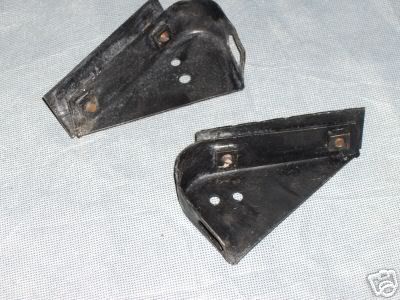
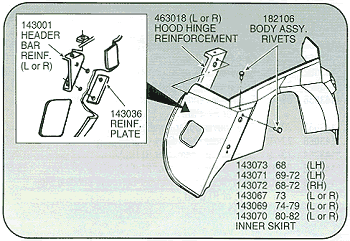
I don't know that the supports were ever used in 68, but with all the running changes made through out 68, I'm not going to say they weren't. My 1972 Corvette parts book lists them as 69-72 and later books I have show them starting in 69, also. The current 68-82 Paragon catalog lists them as "68-82" on page 100 (part # 2020K, $30.00pr and $6.00ea for the 2 reinforcements that go with them on the underside of the inner skirt). Bair's also repros them and they list them as 69-82, not 68. Bair's sells them for $10.00ea and $2.50ea for the reinforcements. I tend to think that their first usage was 1969, but I'm not supid enough (but some would say close though!
) to say that they couldn't have showed up in 68.

Le Mans Master


Joined: Jun 2005
Posts: 5,447
Likes: 3
From: Syracuse NY
I guess "easy" is a relative term. Yes, you do have to lift (but not remove) the body to replace the #4 upper body mounts. Though it is a lot of work, to me, raising a body a little to replace a body mount, doesn't compare to what is needed to properly repair rust in the frame or windshield/cowl/birdgage area. The lower #4 mount (the one welded to the frame) can be replaced without lifting the body, that is if the body mount bolt comes out of the upper without breaking off. I just wanted to point out that needing to replace a #4 mount, was not something that would scare me away from an otherwise nice car. The cost for the parts ($40ea for the upper mount and cage nut vs. $650.00 for a repro windshield frame) and labor are far less than that of replacing a frame or repairing the windshield frame, too.
I don't know that the supports were ever used in 68, but with all the running changes made through out 68, I'm not going to say they weren't. My 1972 Corvette parts book lists them as 69-72 and later books I have show them starting in 69, also. The current 68-82 Paragon catalog lists them as "68-82" on page 100 (part # 2020K, $30.00pr and $6.00ea for the 2 reinforcements that go with them on the underside of the inner skirt). Bair's also repros them and they list them as 69-82, not 68. Bair's sells them for $10.00ea and $2.50ea for the reinforcements. I tend to think that their first usage was 1969, but I'm not supid enough (but some would say close though!) to say that they couldn't have showed up in 68.
I don't know that the supports were ever used in 68, but with all the running changes made through out 68, I'm not going to say they weren't. My 1972 Corvette parts book lists them as 69-72 and later books I have show them starting in 69, also. The current 68-82 Paragon catalog lists them as "68-82" on page 100 (part # 2020K, $30.00pr and $6.00ea for the 2 reinforcements that go with them on the underside of the inner skirt). Bair's also repros them and they list them as 69-82, not 68. Bair's sells them for $10.00ea and $2.50ea for the reinforcements. I tend to think that their first usage was 1969, but I'm not supid enough (but some would say close though!
) to say that they couldn't have showed up in 68.

Team Owner

Joined: Jun 2000
Posts: 38,923
Likes: 1,482
From: Southbound
Cruise-In II Veteran

Thread Starter
Instructor
Joined: Sep 2009
Posts: 114
Likes: 16
From: NE Ohio
Thanks again everyone for the advice.
I had not actually set out looking for a '68 roadster. I always liked the C3 body style and wanted a convertible. This opportunity came up after the owner saw my "restified" 1980 Z/28 (350, 4sp, loaded, beautiful) in a parking lot and struck up a conversation. He asked if I was interested in selling it or trading it. I told him that the only car I was really interested in was a Corvette convertible. I guess it was just a matter of good timing that he was a Corvette owner looking for a late model 2nd gen F-body.
My '80 Z/28 is super clean and absolutely solid. I have in the neighborhood of $15K invested in it. I know that these cars ("drivers" anyway) do not normally fetch these prices (in today's market) so when the opportunity for a trade came up I became interested.
I'm looking for something I can drive in fair weather and enjoy. I like going to the local shows and the occasional recreational drive, but I'm not looking for a full-on restoration (not yet, anyway). I definitely want a solid car, though. I wouldn't trade away a solid car for a headache. I don't have the time, money, or desire to throw a ton of effort into fixing serious rust issues. I have a good contact at a local hot-rod restoration shop (Excallibur in Eastlake) and he told me he'd be happy to go over it with a fine-tooth comb if I like. If the initial look is promising I'm take the car to the shop and let a professional examine it.
Just waiting on a phone call at this point.
Thanks again.
I had not actually set out looking for a '68 roadster. I always liked the C3 body style and wanted a convertible. This opportunity came up after the owner saw my "restified" 1980 Z/28 (350, 4sp, loaded, beautiful) in a parking lot and struck up a conversation. He asked if I was interested in selling it or trading it. I told him that the only car I was really interested in was a Corvette convertible. I guess it was just a matter of good timing that he was a Corvette owner looking for a late model 2nd gen F-body.
My '80 Z/28 is super clean and absolutely solid. I have in the neighborhood of $15K invested in it. I know that these cars ("drivers" anyway) do not normally fetch these prices (in today's market) so when the opportunity for a trade came up I became interested.
I'm looking for something I can drive in fair weather and enjoy. I like going to the local shows and the occasional recreational drive, but I'm not looking for a full-on restoration (not yet, anyway). I definitely want a solid car, though. I wouldn't trade away a solid car for a headache. I don't have the time, money, or desire to throw a ton of effort into fixing serious rust issues. I have a good contact at a local hot-rod restoration shop (Excallibur in Eastlake) and he told me he'd be happy to go over it with a fine-tooth comb if I like. If the initial look is promising I'm take the car to the shop and let a professional examine it.
Just waiting on a phone call at this point.
Thanks again.
