



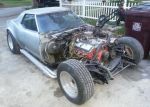




Big Block or small block

Burning Brakes


Joined: Jan 2010
Posts: 967
Likes: 109
From: Europe, Germany

Just check this page and you will know ;-)
http://www.corvetteactioncenter.com/...70/70prod.html
Regards
Roma
http://www.corvetteactioncenter.com/...70/70prod.html
Regards
Roma

Race Director


Joined: Oct 2000
Posts: 12,698
Likes: 3,153
From: Shamong, NJ
You can't tell from the VIN on a 70, 72 was the first year the VIN included a designation to indicate the engine.
Most of the features unique to big blocks were bolt on (rear sway bar, 7 leaf rear spring, etc.) so they're easily changed. If it's an automatic (and still has the original trans), the indicator code on the trans would be an "S" with a 454 and a "K" for a small block automatic. Original rears have a 3 letter identification code stamped on the rear, and the codes are different for big block and small block rears. Unfortunetly, the machined pad it's stamped on is pretty hard to see with the rear in the car. Big block rears also used cast retainer caps on the half shaft universals at the side yokes. Small block universals use a strap type u-bolt. Big blocks used a copper radiator (26" wide) with tanks and a fill cap. AC and automatic small blocks use a slightly smaller copper radiator (25" wide), manual trans 70s use an aluminum radiator (18" wide) with an expansion tank.
Most of the features unique to big blocks were bolt on (rear sway bar, 7 leaf rear spring, etc.) so they're easily changed. If it's an automatic (and still has the original trans), the indicator code on the trans would be an "S" with a 454 and a "K" for a small block automatic. Original rears have a 3 letter identification code stamped on the rear, and the codes are different for big block and small block rears. Unfortunetly, the machined pad it's stamped on is pretty hard to see with the rear in the car. Big block rears also used cast retainer caps on the half shaft universals at the side yokes. Small block universals use a strap type u-bolt. Big blocks used a copper radiator (26" wide) with tanks and a fill cap. AC and automatic small blocks use a slightly smaller copper radiator (25" wide), manual trans 70s use an aluminum radiator (18" wide) with an expansion tank.
Last edited by gbvette62; Mar 31, 2010 at 05:53 PM.

Team Owner


Joined: Jun 2000
Posts: 38,923
Likes: 1,482
From: Southbound
Cruise-In II Veteran

Burning Brakes


Joined: Feb 2004
Posts: 924
Likes: 2
From: Kearneysville West Virginia
You can't tell from the VIN on a 70, 72 was the first year the VIN included a designation to indicate the engine.
Big blocks used a copper radiator (26" wide) with tanks and a fill cap. AC and automatic small blocks use a slightly smaller copper radiator (25" wide), manual trans 70s use an aluminum radiator (18" wide) with an expansion tank.
Big blocks used a copper radiator (26" wide) with tanks and a fill cap. AC and automatic small blocks use a slightly smaller copper radiator (25" wide), manual trans 70s use an aluminum radiator (18" wide) with an expansion tank.
Le Mans Master

Joined: Jan 2007
Posts: 5,485
Likes: 7
From: Peekskill NY
Corvette Stories
The Best of Corvette for Corvette Enthusiasts

5 Best & 5 Worst Corvette Daily Drivers
Joe Kucinski
The Headlights of Every Corvette Generation Explained
Joe Kucinski
5 Best & 5 Most Overrated Corvette Track Packages of All Time!
Joe Kucinski
Every 2027 Corvette Engine Explained
Joe Kucinski
Designer Imagines A Corvette That Looks More Like a Corvette Than the Corvette
Verdad Gallardo
10 Ugly Corvettes That We Still Kinda Love
Joe Kucinski
Top 10 Most Expensive Corvettes Ever Sold on Bring A Trailer
Brett Foote
10 Things Every Corvette Owner Needs (2026 Edition)
Michael S. Palmer