




why the pop rivets?
Le Mans Master


Joined: Mar 2008
Posts: 5,948
Likes: 72
From: Oxford MA-----You just lost the game!!!!

If your rotors are pop riveted on, it didn't come that way from the factory. Do you know how to measure the runout of the rotors? If you don't have exessive runout on the rotors, the pop rivets won't hurt anything, I guess, they came riveted from the factory. Not with pop rivets, tho! Disk brakes were pretty new back in 1965, and that was how they made 'em back then; they riveted the rotor on, and then machined it to be true, because the design uses a fixed caliper. Never bothered to change the design on 'vettes until '84
Scott
Scott
Last edited by scottyp99; Oct 22, 2011 at 05:19 PM.
Le Mans Master
Joined: Mar 2008
Posts: 5,948
Likes: 72
From: Oxford MA-----You just lost the game!!!!

Race Director


Joined: Jul 2001
Posts: 15,892
Likes: 42
The rotors and hubs/spindles were mated together and held with rivets, then finish machined to minimize runout. This made them a matched set that was not intended to be disturbed afterwards. GM never sold rotors separate from hubs/spindles for that reason.
This is unique to C2/C3 Corvettes, unfortunately Bubba and his many friends come along and unknowingly replace just the rotors only to wonder where the runout and low brake pedal came from..............
This is unique to C2/C3 Corvettes, unfortunately Bubba and his many friends come along and unknowingly replace just the rotors only to wonder where the runout and low brake pedal came from..............

Thread Starter
Intermediate

Joined: Sep 2011
Posts: 28
Likes: 0
This is unique to C2/C3 Corvettes, unfortunately Bubba and his many friends come along and unknowingly replace just the rotors only to wonder where the runout and low brake pedal came from..............[/QUOTE]
so if i were planning on replaceing my rotors and calipers and brake hoses, what should i be looking for in buying rotors?
so if i were planning on replaceing my rotors and calipers and brake hoses, what should i be looking for in buying rotors?
Corvette Stories
The Best of Corvette for Corvette Enthusiasts

Top 10 Most Expensive Corvettes Ever Sold on Bring A Trailer
Brett Foote
10 Things Every Corvette Owner Needs (2026 Edition)
Michael S. Palmer
8 Most "Only Corvette Owners Understand" Quirks and Problems
Pouria Savadkouei
10 Reasons the C6 Z06 is Still A Performance Benchmark After 20 Years
Joe Kucinski
How Much Horsepower Every Corvette Engine "LOST" in 1972
Joe Kucinski
Top 10 DOs and DON'Ts for Protecting Your Convertible Top!
Michael S. Palmer
Top 10 Most Explosive Corvettes Ever Made: Power-to-Weight Ratio Ranked!
Joe Kucinski
150 hp to 1,250 hp: Every Corvette Generation Compared by the Specs That Matter
Joe Kucinski
8 Coolest Corvette Pace Cars (and Replicas) of All Time
Verdad Gallardo
Race Director
Joined: Jul 2001
Posts: 15,892
Likes: 42
Why are you replacing the rotors- most originals outlast the rest of the car.
If you feel the need to change them 'just cause', there's a thousand and one posts here on the different methods of achieving acceptable final runout. Replicating the factory method of machining them as a matched set is by far the best method, but it's usually very expensive and difficult to find a shop capable of doing this.
If you feel the need to change them 'just cause', there's a thousand and one posts here on the different methods of achieving acceptable final runout. Replicating the factory method of machining them as a matched set is by far the best method, but it's usually very expensive and difficult to find a shop capable of doing this.
Thread Starter
Intermediate
Joined: Sep 2011
Posts: 28
Likes: 0
im changeing the calipers cus they leak , the hoses cus there old and figured while i have the calipers off i could do the hoses also, and since the calipers were off i could do the rotors too and i was trying to do some research and see the best way of going about it and then seen different posts with different opinions on ways of doing the rotors. now im a little confused on whats the best option and trying to get some opinions
Thread Starter
Intermediate
Joined: Sep 2011
Posts: 28
Likes: 0

Pro


Joined: Sep 2006
Posts: 547
Likes: 13
From: Carlstadt NJ
The rivits were put there to hold the rotors on as the frame when down the assembly line. You could put them back if you want, but if the run out is good the wheel will hold them on. Some guys drill and tap the spindle but as I said the wheel will hold it in place.
Thread Starter
Intermediate
Joined: Sep 2011
Posts: 28
Likes: 0
i understand that but if i were to buy new rotors and put them on would i have a runout prolem?

Racer
Joined: Oct 2006
Posts: 255
Likes: 3
If you are going to buy new rotors you should bolt the rotor to the hub and check for runout before using it. If the run out is acceptable mark the rotor to the hub so it always is located in that location. If it is not you can rotate it on the hub and recheck. If you find that its not within tolerance take the hub and rotor to the machine shop to have it turned as one unit. Again make sure that once its machined the rotor stays in the location on the hub that it was in when machined.
Rodney
Rodney



Burning Brakes

Joined: Sep 2008
Posts: 805
Likes: 5
From: Naperville Illinois
My car has 80k miles. All four rotors had been drilled, but they were still on the car (or else had been replaced with drilled rotors taken off of another Corvette) and they were barely worn. I recently inherited some '66 trailing arms from a car with about the same mileage and those rotors are also barely worn

Melting Slicks


Joined: May 2005
Posts: 2,209
Likes: 12
From: Montgomery Alabama
Cruise-In VII Veteran
St. Jude Donor '06
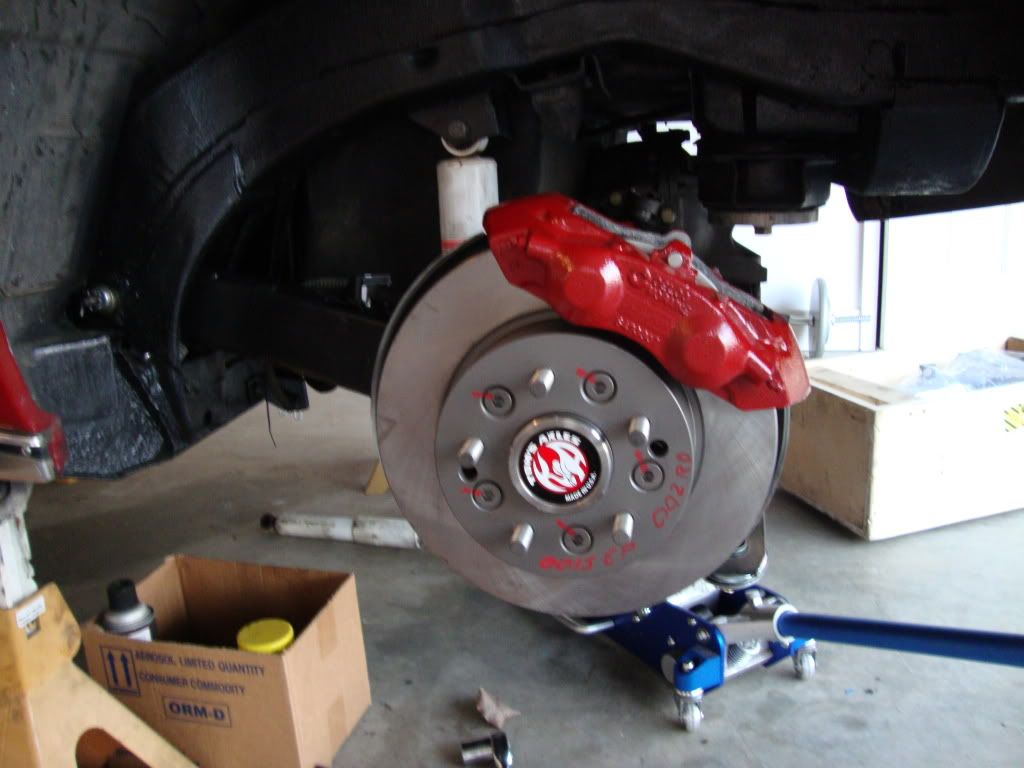
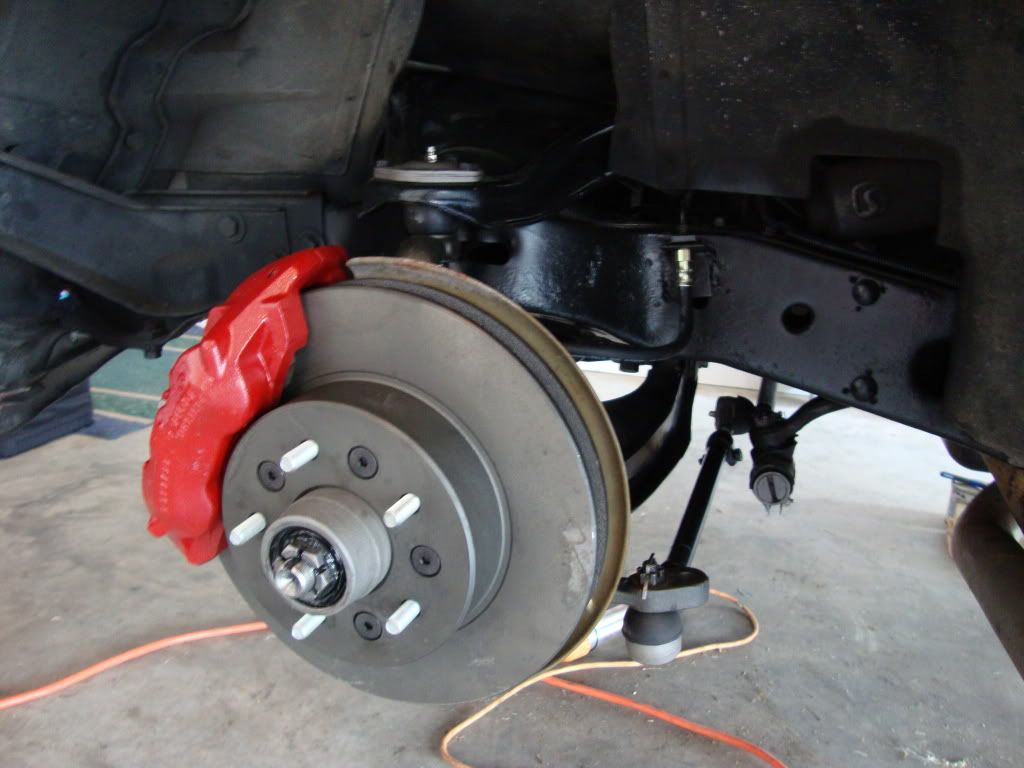
Unfortunately, the rotors on my 72 were below spec, and had to be replaced. They were the originals and still had the rivets in them.
I drilled and taped the hubs and used tapered bolts to hold them on. I had to shim the rotors to get thr runout to 0.002 It was 0.009 and 0.01 right out of the box.
Gary Ramadei did the back ones:
I did the front ones:
I drilled and taped the hubs and used tapered bolts to hold them on. I had to shim the rotors to get thr runout to 0.002 It was 0.009 and 0.01 right out of the box.
Gary Ramadei did the back ones:
I did the front ones:
Last edited by Curby; Oct 24, 2011 at 02:24 PM.