







Starting paint stripping, going razor method first

Thread Starter
Instructor


Joined: Jan 2007
Posts: 135
Likes: 0
From: Western Loudoun County VA
 Starting paint stripping, going razor method first
When I first saw the threads saying how easy stripping by hand via razor was, I must say I was pretty dubious. Well after my first night, I am glad to report back that I was very pleased with the results. There are a couple spots that are proving tough where there seems to have been some extra layers put on over some work, but in general, it is amazing how smoothly the old paint peels off, with no heat even applied. I'm getting down to the primer, but then the razor is definitely is not going to be the means to get the primer off from what I can tell.
So I'm basically just trying to do as much of the prep labor before turning over to a paint shop. What is the benefit of stripping off the primer as well or is stopping with just taking off paint OK? I don't mind putting in the extra labor to use stripper to get the primer off, but want to be as educated about the decision before talking with any paintshops as I can be.
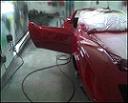
Here is last night's progress, about three hours with swapping out the engine harness taking some of that time.


So I'm basically just trying to do as much of the prep labor before turning over to a paint shop. What is the benefit of stripping off the primer as well or is stopping with just taking off paint OK? I don't mind putting in the extra labor to use stripper to get the primer off, but want to be as educated about the decision before talking with any paintshops as I can be.
Here is last night's progress, about three hours with swapping out the engine harness taking some of that time.

Instructor
Joined: Feb 2011
Posts: 241
Likes: 1
From: Axton va
i stripped my 79 the exact same way.just be careful,i had some gouges i had to fill from the razors getting dull and digging in on the corners.the bumpers i stripped with a pressure washer because the paint was pealing on them anyways.
Race Director

Joined: Mar 2008
Posts: 15,161
Likes: 17
From: coffee
On the areas that were not repainted, the process was much easier and the paint came up with little drama.

Race Director

Joined: Aug 2007
Posts: 10,977
Likes: 19
From: Canboro Ontario
True fact, is to always use a fresh sharp blade, the moment you feel it getting tougher, get a new blade. Removing the primer will save you money at the paint shop for sure. It will also reveal any hidden issues you might have to deal with. I used Capt Lees spray spa. It works great, use lots of water to neutrilize the chemical, it works fast and you do not want it to go too deep. Read and follow the instructions to the "T".
Thread Starter
Instructor
Joined: Jan 2007
Posts: 135
Likes: 0
From: Western Loudoun County VA
So just to clarify, as long as the razor does not go into the fiberglass, it is not a gouge? As I make the runs, sometimes one corner or the other of the razor will go a bit deeper and leave a white colored line and very rarely will catch and reach a darker shade below the white. So red paint on top, then light gray primer, then something white and I assume the dark material is the fiberglass that you can see I reached in one spot in this picture. What's the white stuff? and as long as I don't cut into the bottom dark I'm not making gouges the body shop will need to spend time on?

Melting Slicks

Joined: Mar 2007
Posts: 2,520
Likes: 11
From: Hinckley OH
Found these on youtube
http://www.youtube.com/watch?v=g7kr6F8mXsM
This looks like a metal panel but the techniqe is the same.
http://www.youtube.com/watch?v=dR9faQRZEqg
http://www.youtube.com/watch?v=g7kr6F8mXsM
This looks like a metal panel but the techniqe is the same.
http://www.youtube.com/watch?v=dR9faQRZEqg
Corvette Stories
The Best of Corvette for Corvette Enthusiasts

Top 10 Most Expensive Corvettes Ever Sold on Bring A Trailer
Brett Foote
10 Things Every Corvette Owner Needs (2026 Edition)
Michael S. Palmer
8 Most "Only Corvette Owners Understand" Quirks and Problems
Pouria Savadkouei
10 Reasons the C6 Z06 is Still A Performance Benchmark After 20 Years
Joe Kucinski
How Much Horsepower Every Corvette Engine "LOST" in 1972
Joe Kucinski
Top 10 DOs and DON'Ts for Protecting Your Convertible Top!
Michael S. Palmer
Top 10 Most Explosive Corvettes Ever Made: Power-to-Weight Ratio Ranked!
Joe Kucinski
150 hp to 1,250 hp: Every Corvette Generation Compared by the Specs That Matter
Joe Kucinski
8 Coolest Corvette Pace Cars (and Replicas) of All Time
Verdad Gallardo
Melting Slicks
Joined: Aug 2008
Posts: 2,200
Likes: 3
From: Lehigh county Pennsylvania
Thread Starter
Instructor
Joined: Jan 2007
Posts: 135
Likes: 0
From: Western Loudoun County VA
So went around to some of the paint shops today to start getting a feel for who knows what they are talking about and is even open to doing this kind of work. One shop that a forum thread recommended said they don't do anything but collision work anymore, second one said that they don't like to do it but he talked with me a long time about the process and I showed him some of the pictures so far. He said the light grey and white layers should be able to come right off and back in the days that he used to do a lot of old vette work that a scotch brite pad and lacquer thinner was a pretty common way to handle the original primer in his shop. Since working on this car is as much about learning new things as actually finishing any particular project, I decided to take a deeper look. Taking a more conservative stance I took scotch brite pad and mineral spirits to see what things looked like under the grey/white and here is the result. I've jumped on a thread over in the paint section and it sounds like I've made it down to the fiberglass. Just wanted to pop up the latest picture here too in case anyone is interested. Since it is either sit in the house and grow my butt in front of the tv or play with the car in the evenings, I will probably give the primer a go once all the paint is off to see how bad the effort would really be. So from the paint forum, we are thinking the dark stuff that came out after making it through grey/white/red layers is the bare glass.

Instructor
Joined: Feb 2011
Posts: 241
Likes: 1
From: Axton va
that dark layer with the strand showing is the resin glass layer, there is a product i used called slicksand it is a spray-able polyester filler that takes MEKP hardner
http://www.evercoat.com/productDetail.aspx?pID=28
covers raw glass great,i have laid up raw glass,smooth it out with 36 grit paper and spay this on several coats,when it cures break it with 80 grit and start in with the 220,320 and so on
http://www.evercoat.com/productDetail.aspx?pID=28
covers raw glass great,i have laid up raw glass,smooth it out with 36 grit paper and spay this on several coats,when it cures break it with 80 grit and start in with the 220,320 and so on
Last edited by junkman123; Jul 26, 2012 at 06:39 PM.


Racer
Joined: Oct 2004
Posts: 281
Likes: 9
From: New England
Started using a razor blade and did more damage than good, ended up having mine media blasted with glass beads and really came out nice, but a bit costly. Just added it to the total overall paint cost and sucked it up. Didn't plan on doing this job again in my time so it was worth it to have it one this way. Also redid my panel
Bond seams. Finished paint job is in my album.
Bond seams. Finished paint job is in my album.
Thread Starter
Instructor
Joined: Jan 2007
Posts: 135
Likes: 0
From: Western Loudoun County VA
Whatever the white layer is, it is pretty thick and dense and has for the most part kept us from slipping and getting even to the original primer. After doing most of the front surround and half the drivers door, have yet to get deep enough to hit fiberglass.
Tried using the mineral spirits and scotch brite pad last night to clear out a larger area than the test spot in the picture and I'm going to need to get something stronger on it. The grey comes off almost instantly, but there is so much of the white it takes a very long time to get through it. I'm driving over to Maryland for work today and will swing by West Marine and see what they have in stock. Need to get something to put the header bar back in anyway, just went through the Wilcox process to remove the aluminum rivets from the nose. Much easier than I expected, but I also went to the trouble of taking the headlight housings out so everything was very easy to access with the dremel.
Tried using the mineral spirits and scotch brite pad last night to clear out a larger area than the test spot in the picture and I'm going to need to get something stronger on it. The grey comes off almost instantly, but there is so much of the white it takes a very long time to get through it. I'm driving over to Maryland for work today and will swing by West Marine and see what they have in stock. Need to get something to put the header bar back in anyway, just went through the Wilcox process to remove the aluminum rivets from the nose. Much easier than I expected, but I also went to the trouble of taking the headlight housings out so everything was very easy to access with the dremel.
Advanced
Joined: Apr 2005
Posts: 89
Likes: 5
From: Madison WI
Started using a razor blade and did more damage than good, ended up having mine media blasted with glass beads and really came out nice, but a bit costly. Just added it to the total overall paint cost and sucked it up. Didn't plan on doing this job again in my time so it was worth it to have it one this way. Also redid my panel
Bond seams. Finished paint job is in my album.
Bond seams. Finished paint job is in my album.
Dale

Melting Slicks
Joined: Mar 2007
Posts: 2,520
Likes: 11
From: Hinckley OH
I don't know what that white layer is but there are two things I think it could be. Original paint that was baked on at the factory or gel coat. If it's gel coat then I don't think you should be removing it. I would ask on the paint forum if anybody knows what it is.
Racer
Joined: Oct 2009
Posts: 279
Likes: 0
From: Virginia Beach VA
The white is the original paint and you're right, it is thick and globby when you try to get it off. The red is the original primer. You can take it off if you want to. I used Citristrip paint remover to take it all off down to the fiberglass. Follow the instructions and wipe it down with mineral spirits after. You can see some pics in my garage.
Racer
Joined: Nov 2006
Posts: 435
Likes: 7
From: Wake Forest NC
Here is some info on these various colors/primers/etc; this is from my specification pamphlet I received from GM (on a '75 vette). It's on the Exterior Paint Process page (I'll paraphrase to same words).
Dry sand all surfaces of body, vacuum, solvent clean w/thinner applied w/clean cloth.
Dry sand all surfaces of body, vacuum, solvent clean w/thinner applied w/clean cloth.
Racer
Joined: Nov 2006
Posts: 435
Likes: 7
From: Wake Forest NC
Here is some info on these various colors/primers/etc; this is from my specification pamphlet I received from GM (on a '75 vette). It's on the Exterior Paint Process page (I'll paraphrase to same words).
Dry sand all surfaces of body, vacuum, solvent clean w/thinner applied w/clean cloth.
Dry sand all surfaces of body, vacuum, solvent clean w/thinner applied w/clean cloth.
Next is wipe on red rubbing putty on all exterior surfaces w/substantial pressure, working into pits of fiberglass.
Vacuum all surfaces to remove excess putty.
Spray primer-surfacer on all external surfaces.
Bake at 275*F
Putty glaze where necessary with gray putty.
Wet sand; blow off to remove excess moisture.
Putty glaze where necessary with gray putty.
Remember, this is from 1975.... I found my car had all these layers like yours. The layers came off easy w/heat gun and razor blade. The "red rubbing putty" came off with lacquer thinner, scrubbing with 7447 3M pads. Hope this helps...