



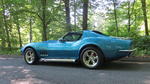

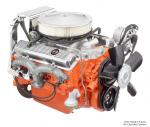


71 454 4spd

Team Owner


Joined: Jun 2000
Posts: 38,923
Likes: 1,481
From: Southbound
Cruise-In II Veteran

No. Factory big block cars had certain items installed which small block cars usually did not get, but since any of these items were part of an options package, any and all of them could have been installed by a previous owner.
Nothing in the 71 VIN identifies the original engine.
Do you have any original GM paperwork with the car?
Have you checked for the tank sticker?

Nothing in the 71 VIN identifies the original engine.
Do you have any original GM paperwork with the car?
Have you checked for the tank sticker?
Thread Starter
Advanced

Joined: Aug 2012
Posts: 52
Likes: 0
From: Chino Hills Ca
Easy Mike, I have not checked for the tank sticker. Where exactly would it be if still on the car. The only thing I know about the car is the previous owner purchased it 5 years ago from a Corvette dealer in Arizona and I tried to contact the dealer but is no longer in business.
Team Owner
Joined: Jun 2000
Posts: 38,923
Likes: 1,481
From: Southbound
Cruise-In II Veteran
Top left corner of the fuel tank. These pics have been posted here:

The one above is a teaser; it is still there and legibile.
This is more common:

I do not advocate going to all the trouble of dropping the tank just to see if something may or may not be there. Get a good flashlight and try peering around the fuel collar. You might be able to see enough to determine whether something might still be there.
The one above is a teaser; it is still there and legibile.
This is more common:
I do not advocate going to all the trouble of dropping the tank just to see if something may or may not be there. Get a good flashlight and try peering around the fuel collar. You might be able to see enough to determine whether something might still be there.
Thread Starter
Advanced
Joined: Aug 2012
Posts: 52
Likes: 0
From: Chino Hills Ca
Don't think I will pull the tank just to be disappointed on what I find.
The plate on the console says 425hp 475tq and the air cleaner says 425hp but stickers and plates are cheap to replace. I know the current engine is a 454 truck block with 353049 heads, looks like stock intake and exhaust manifolds and a quadrajet.
The plate on the console says 425hp 475tq and the air cleaner says 425hp but stickers and plates are cheap to replace. I know the current engine is a 454 truck block with 353049 heads, looks like stock intake and exhaust manifolds and a quadrajet.

Drifting


Joined: May 2008
Posts: 1,647
Likes: 5
From: Roseville CA
Don't think I will pull the tank just to be disappointed on what I find.
The plate on the console says 425hp 475tq and the air cleaner says 425hp but stickers and plates are cheap to replace. I know the current engine is a 454 truck block with 353049 heads, looks like stock intake and exhaust manifolds and a quadrajet.
The plate on the console says 425hp 475tq and the air cleaner says 425hp but stickers and plates are cheap to replace. I know the current engine is a 454 truck block with 353049 heads, looks like stock intake and exhaust manifolds and a quadrajet.
425!!?? Original LS6 car? That would be something.
Corvette Stories
The Best of Corvette for Corvette Enthusiasts

Corvette ZR1X Will Be Pacing the Indy 500, And Could Probably Race, Too!
Verdad Gallardo
Top 10 Corvettes Coming to Mecum Indy 2026!
Brett Foote
Top 10 C9 Corvette MUST-HAVES to Fix These C8 Generation Flaws!
Michael S. Palmer
10 Revolutionary 'Corvette Firsts' Most People Don't Know
Joe Kucinski
5 Reasons to Upgrade to an LS6-Powered Corvette; 5 Reasons to Stay LT2
Michael S. Palmer
2027 Corvette vs The World: Every C8 vs Its Closest Competitor
Joe Kucinski
10 Most Common Corvette Problems of the Last 20 Years!
Joe Kucinski
5 MOST and 5 LEAST Popular Corvette Model Years in History!
Joe Kucinski
2027 Corvette Buyer's Guide: Everything You Need to Know!
Joe Kucinski
Safety Car


Joined: Jun 2004
Posts: 4,652
Likes: 80
From: Lakeland Florida
I thought there was a difference in the tachometer redline between big blocks and small blocks. I did a quick check and found the BB may redline at 5600 and the small blocks at 6500.
Tachometers are also easy to change out so this may not be a good indicator, but its another item to check.
kdf
Tachometers are also easy to change out so this may not be a good indicator, but its another item to check.
kdf

Team Owner
Joined: Jun 2000
Posts: 38,923
Likes: 1,481
From: Southbound
Cruise-In II Veteran



Safety Car

Joined: Sep 2007
Posts: 4,451
Likes: 326
From: Indy Indiana
does the console tag look old, like 41 years old? I seriously doubt it is a 1 of 188 LS6 car..
an original 4 speed car has welded tranny crossmember both SB and BB cars
certain codes on the emission sticker behind the master cylinder probably unreadable after 41 years
certain codes on the tank sheet on the tank, probably unreadable after 41 years if it exists at all
5600 red line tach... ( 6500 if LS6 )
big block/LT1 hood
rear stabilizer bar
thicker front stabilizer bar
caps instead of straps on the half shaft u-joints..
27.5 inch copper radiator/support.
several other characteristics related to the engine and emissions, but you already said it was NOM.
as said above, any or all can be bought and installed in the aftermarket.
the hardest to fake is the tach redline ( hard to find a rare working 5600 red line, then install it.. and the radiator/support.. major effort.
failure of any of the points above would result in me losing faith that it is an original BB car.
even though you may trust the previous owner, who knows what was done 6 owners ago.
an original 4 speed car has welded tranny crossmember both SB and BB cars
certain codes on the emission sticker behind the master cylinder probably unreadable after 41 years
certain codes on the tank sheet on the tank, probably unreadable after 41 years if it exists at all
5600 red line tach... ( 6500 if LS6 )
big block/LT1 hood
rear stabilizer bar
thicker front stabilizer bar
caps instead of straps on the half shaft u-joints..
27.5 inch copper radiator/support.
several other characteristics related to the engine and emissions, but you already said it was NOM.
as said above, any or all can be bought and installed in the aftermarket.
the hardest to fake is the tach redline ( hard to find a rare working 5600 red line, then install it.. and the radiator/support.. major effort.
failure of any of the points above would result in me losing faith that it is an original BB car.
even though you may trust the previous owner, who knows what was done 6 owners ago.
Thread Starter
Advanced
Joined: Aug 2012
Posts: 52
Likes: 0
From: Chino Hills Ca
Pretty sure it is not an LS6. The guy I bought it from, he bought it from CnV Corvette Sales in Arizona and was advertised as an LS5 not an LS6. You would think that they would know what they were selling and it sold for an LS5 price.
Looked at a few things
It has a BB hood
5600 rpm redline and tack works
sticker behind brake cylinder says 454 but sticker looks like a repro
console tag looks as old as the rest of the interior
I think no rear sway bar
half shafts have bolt on straps to hold bearing caps and has a retainer clip
Looked at a few things
It has a BB hood
5600 rpm redline and tack works
sticker behind brake cylinder says 454 but sticker looks like a repro
console tag looks as old as the rest of the interior
I think no rear sway bar
half shafts have bolt on straps to hold bearing caps and has a retainer clip

Melting Slicks

Joined: Apr 2007
Posts: 3,189
Likes: 111
From: Tolland CT
It may be interesting to know if the car was configured with the LS5 or LS6 option package when it left St Louis but without the original block doesn't mean much so far as value goes. The tach sounds right, 5600 redline? Sounds like somebody may have changed out parts in the rear if the sway bar is missing.. Did you confirm the UJoints are fastened to the rear end with caps?
I suspect many LS5s and maybe some LS6s met this fate years ago.
I suspect many LS5s and maybe some LS6s met this fate years ago.


Safety Car
Joined: Sep 2007
Posts: 4,451
Likes: 326
From: Indy Indiana
I have a different opinion...
very high faith type of proof that a car left the factory as a LS6 ( lots of DOC), but without its original engine, would be very valuable. I would easilly pay 25K extra for a POP or tank sheet and other validating doc that said LS6, or L88 , ZR1, or L89.. if the doc was valid. people don't realize what pedigree proof does to the value of the car..
that is one extreme, now LS5 is another.. not so much difference, but if the doc is valid, there is a difference.
a documented LS5 car, is worth more than a documented base engine car, if both are NOM.. especially a convertible with A/C.
many of you won't do it and won't play the numbers game.. but many others will.
Melting Slicks
Joined: Apr 2007
Posts: 3,189
Likes: 111
From: Tolland CT
I have a different opinion...
very high faith type of proof that a car left the factory as a LS6 ( lots of DOC), but without its original engine, would be very valuable. I would easilly pay 25K extra for a POP or tank sheet and other validating doc that said LS6, or L88 , ZR1, or L89.. if the doc was valid. people don't realize what pedigree proof does to the value of the car..
that is one extreme, now LS5 is another.. not so much difference, but if the doc is valid, there is a difference.
a documented LS5 car, is worth more than a documented base engine car, if both are NOM.. especially a convertible with A/C.
many of you won't do it and won't play the numbers game.. but many others will.
very high faith type of proof that a car left the factory as a LS6 ( lots of DOC), but without its original engine, would be very valuable. I would easilly pay 25K extra for a POP or tank sheet and other validating doc that said LS6, or L88 , ZR1, or L89.. if the doc was valid. people don't realize what pedigree proof does to the value of the car..
that is one extreme, now LS5 is another.. not so much difference, but if the doc is valid, there is a difference.
a documented LS5 car, is worth more than a documented base engine car, if both are NOM.. especially a convertible with A/C.
many of you won't do it and won't play the numbers game.. but many others will.

Pro


Joined: Oct 2006
Posts: 542
Likes: 3
From: Vilnius, Lithuania
It is not necessary to pull the tank immediately. You could start by removing the rubber boot from the gas filler neck and looking around with the flashlight. If you see build sheet, then it takes some patience and manipulation with a set of tools to remove it. I took off build sheets from my 1968 and 1973 exactly this way.
Melting Slicks
Joined: Apr 2007
Posts: 3,189
Likes: 111
From: Tolland CT
http://www.parts123.com/parts123/yb....Z5Z5Z50000050G
Big blocks have caps which look something like these...
http://www.parts123.com/parts123/yb....Z5Z5Z50000050G
Hope this helps..
Last edited by BBCorv70; Sep 17, 2012 at 09:38 PM.