




Molded in bumper problem.

Thread Starter
Race Director


Joined: Jan 2002
Posts: 11,614
Likes: 350
From: No Where USA
 Molded in bumper problem.
Well my car is all painted, I have another thread on that that I will post some more pictures on.
I wetsanded the rear portion of the car, block sanded from 1000 to 2500 the paint job came out great with very little orange peal or junk in it.
Buffed out the rear bumper on the passenger side, and there was a line where the bumper was molded in, not a crack but I could see where the seam was. Like a ghost line. When I did the body work I blocked it and checked it 100 times. I sprayed epoxy over it and there was no sign of it. Epoxy goes on glossy so you would be able to see any ripples in the panels. If you run your hand over it it is perfectly flat. It isn´t wavy. Then on the drivers side there is a little dimple that you can see move when the bumper flexes, yes these are flex fiberglass bumpers. The top part along the spoiler is perfect. You can´t see the seem. The dimple is very small and the ghost line can only be seen if you are looking for it. I know it is because I used a flex bumper. I have molded in a few real glass ones and never had this problem. And yes I used the correct mat and resin for the panels.
This really has me pizzed off, I don´t know if I should finish buffing the back and the rest of the car and wait to do it over or just do it now. This would pretty well finish any use this summer as there was some other things I was going to do on it after the paint was rubbed out.
I wetsanded the rear portion of the car, block sanded from 1000 to 2500 the paint job came out great with very little orange peal or junk in it.
Buffed out the rear bumper on the passenger side, and there was a line where the bumper was molded in, not a crack but I could see where the seam was. Like a ghost line. When I did the body work I blocked it and checked it 100 times. I sprayed epoxy over it and there was no sign of it. Epoxy goes on glossy so you would be able to see any ripples in the panels. If you run your hand over it it is perfectly flat. It isn´t wavy. Then on the drivers side there is a little dimple that you can see move when the bumper flexes, yes these are flex fiberglass bumpers. The top part along the spoiler is perfect. You can´t see the seem. The dimple is very small and the ghost line can only be seen if you are looking for it. I know it is because I used a flex bumper. I have molded in a few real glass ones and never had this problem. And yes I used the correct mat and resin for the panels.
This really has me pizzed off, I don´t know if I should finish buffing the back and the rest of the car and wait to do it over or just do it now. This would pretty well finish any use this summer as there was some other things I was going to do on it after the paint was rubbed out.

Le Mans Master

Joined: Dec 2003
Posts: 5,381
Likes: 416
From: N J
That really stinks, sorry to hear that.
I can only think its going to get worse at time goes by. I think I would deal with it now and get it over with. I dont have any experience with flex bumpers, but I always thought the only way the bumpers could be blended in to the body were with the stiff fiberglass covers. Rest of the car is probably perfect. My heart goes out to ya, thats a lot of work. Wish I had the solution.

I can only think its going to get worse at time goes by. I think I would deal with it now and get it over with. I dont have any experience with flex bumpers, but I always thought the only way the bumpers could be blended in to the body were with the stiff fiberglass covers. Rest of the car is probably perfect. My heart goes out to ya, thats a lot of work. Wish I had the solution.
Thread Starter
Race Director
Joined: Jan 2002
Posts: 11,614
Likes: 350
From: No Where USA
I had my daughter look at it, she has a pretty good eye at spotting things wrong with car paint and body work. I used to have a collision shop so I showed her what to look for. She can spot a ripple in a paint job from a mile away. She really didn´t notice it. I am for now going to finish buffing out the car and getting it back together then I will deal with that lines.

Melting Slicks


Joined: May 2000
Posts: 2,029
Likes: 63
Don't know if this applies to your case but sometimes if a glassfiber panel is finished without topcoat (like gelcoat but cures even when exposed to air) the glassfiber weave or joint pattern which you can see on unpainted panel can also come visible through paint.
For example my present L88 hood was made without topcoat and then painted (not by me) and in certain light I can see the glassfiber weave through the paint. Annoying, got to fix it before next paintjob.
For example my present L88 hood was made without topcoat and then painted (not by me) and in certain light I can see the glassfiber weave through the paint. Annoying, got to fix it before next paintjob.
Thread Starter
Race Director
Joined: Jan 2002
Posts: 11,614
Likes: 350
From: No Where USA
Don't know if this applies to your case but sometimes if a glassfiber panel is finished without topcoat (like gelcoat but cures even when exposed to air) the glassfiber weave or joint pattern which you can see on unpainted panel can also come visible through paint.
For example my present L88 hood was made without topcoat and then painted (not by me) and in certain light I can see the glassfiber weave through the paint. Annoying, got to fix it before next paintjob.
For example my present L88 hood was made without topcoat and then painted (not by me) and in certain light I can see the glassfiber weave through the paint. Annoying, got to fix it before next paintjob.
That would only happen if you used glass cloth instead of mat. I also used the same material trough out the seem and it only appears on the side. The passenger side is about 4 inches long and the drivers side is 1/4 inch long. I used epoxy to seal it. But maybe I should have used some gel coat on it.
Well anyway I will have to fix this. I also had a few people look for the problem and no one could see it until I pointed out the area.

Pro


Joined: Jul 2010
Posts: 691
Likes: 25
From: Boynton Beach Florida
You're not alone. The paint color will dictate the degree of seam visible. Mine being black is the most painfully obvious. The rear bumper on mine isn't too bad and most of the time you don't notice it but certain angles and lighting you can. The front bumper after being in the sun jumps out at you but lessens when it cools and in the shade you don't see it much.
It doesn't make sense in one way but in another it does. Expansion and contraction is what it boils down to, I guess. Black only makes it 200 times hotter. We used the body seam compound between the bumper and front clip then cut a V groove - 2 layers of glass then Duraglass before sanding and priming in hopes of avoiding this but no luck. It seems to have settled and luckily isn't any worse now but sure wish it was there.
It doesn't make sense in one way but in another it does. Expansion and contraction is what it boils down to, I guess. Black only makes it 200 times hotter. We used the body seam compound between the bumper and front clip then cut a V groove - 2 layers of glass then Duraglass before sanding and priming in hopes of avoiding this but no luck. It seems to have settled and luckily isn't any worse now but sure wish it was there.
Corvette Stories
The Best of Corvette for Corvette Enthusiasts

Top 10 Most Expensive Corvettes Ever Sold on Bring A Trailer
Brett Foote
10 Things Every Corvette Owner Needs (2026 Edition)
Michael S. Palmer
8 Most "Only Corvette Owners Understand" Quirks and Problems
Pouria Savadkouei
10 Reasons the C6 Z06 is Still A Performance Benchmark After 20 Years
Joe Kucinski
How Much Horsepower Every Corvette Engine "LOST" in 1972
Joe Kucinski
Top 10 DOs and DON'Ts for Protecting Your Convertible Top!
Michael S. Palmer
Top 10 Most Explosive Corvettes Ever Made: Power-to-Weight Ratio Ranked!
Joe Kucinski
150 hp to 1,250 hp: Every Corvette Generation Compared by the Specs That Matter
Joe Kucinski
8 Coolest Corvette Pace Cars (and Replicas) of All Time
Verdad Gallardo
Melting Slicks
Joined: Jun 2009
Posts: 2,709
Likes: 3
From: Savannah GA
If it is a show car fix it. If you intend to drive it there will be stone chips, parking lot rash, oil from the road, bird poop etc. aplenty to distract you from those small faults. I would call it good for now and get some use out of it while the weather is great.
Thread Starter
Race Director
Joined: Jan 2002
Posts: 11,614
Likes: 350
From: No Where USA
You're not alone. The paint color will dictate the degree of seam visible. Mine being black is the most painfully obvious. The rear bumper on mine isn't too bad and most of the time you don't notice it but certain angles and lighting you can. The front bumper after being in the sun jumps out at you but lessens when it cools and in the shade you don't see it much.
It doesn't make sense in one way but in another it does. Expansion and contraction is what it boils down to, I guess. Black only makes it 200 times hotter. We used the body seam compound between the bumper and front clip then cut a V groove - 2 layers of glass then Duraglass before sanding and priming in hopes of avoiding this but no luck. It seems to have settled and luckily isn't any worse now but sure wish it was there.
It doesn't make sense in one way but in another it does. Expansion and contraction is what it boils down to, I guess. Black only makes it 200 times hotter. We used the body seam compound between the bumper and front clip then cut a V groove - 2 layers of glass then Duraglass before sanding and priming in hopes of avoiding this but no luck. It seems to have settled and luckily isn't any worse now but sure wish it was there.
I did the same as you did as you did. I did with all the right materials, but you are right it probably is because of the color and temperature.
I went out to look at it this morning and I really had to look to find it. My car is also black. The others I have done were red. So that must be the reason I didn´t notice it that much. I guess I will get used to it.
Last edited by 540 vette; May 11, 2013 at 10:53 AM.
Thread Starter
Race Director
Joined: Jan 2002
Posts: 11,614
Likes: 350
From: No Where USA
Thread Starter
Race Director
Joined: Jan 2002
Posts: 11,614
Likes: 350
From: No Where USA
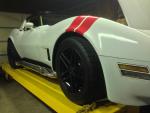
I would have rather used the glass ones but I didn´t intend on molding them in at first until I saw the flex bumpers didn´t fit well. Then after slicing and dicing it was the only way out.
Drifting


Joined: May 2005
Posts: 1,968
Likes: 44
From: East TN
Not sure if this would be something that you are interested in, but thought I'd throw it out there. Instead of redoing the body work to get rid of the ghost line, what about doing an early C3 paint theme, taping off at the ghost line, with the rear bumper another color going into a stripe down the center to the hood? Just a thought.

Race Director
Joined: Mar 2006
Posts: 14,112
Likes: 28
From: Florida
And to be clear, did you use the "fiberglass flex bumpers" or something else?
Thread Starter
Race Director
Joined: Jan 2002
Posts: 11,614
Likes: 350
From: No Where USA
I used Evercoat SMC resin. I don´t think that was the problem.
Yes I used the fiberglass flex bumpers. I have been doing body work for 40 years and Corvette for many of them. I am aware you can not mold stock rubber bumpers onto the car.
Thread Starter
Race Director
Joined: Jan 2002
Posts: 11,614
Likes: 350
From: No Where USA
Not sure if this would be something that you are interested in, but thought I'd throw it out there. Instead of redoing the body work to get rid of the ghost line, what about doing an early C3 paint theme, taping off at the ghost line, with the rear bumper another color going into a stripe down the center to the hood? Just a thought.
I thought about that. Maybe a motion type stripe. But that would be more work than just redoing the back. I would have to paint the stripe and then clear the whole car.
Race Director
Joined: Mar 2006
Posts: 14,112
Likes: 28
From: Florida
Polyester resins are the worst for repairs for many reasons, some of which are, not flexible, up to to 7% shrinkage, final cure up to 30 days (with shrinkage), prone to micro cracking from shrinkage, poor adhesion.
Colder climates exasperate any problems almost creating a "post cure" condition.
On the other hand epoxies have less shrinkage (one I use has ~1%), adheres to all composites, is flexible without cracking, uniform curing, etc.
Black is always difficult because it shows any flaw better.
Not knocking any experience, but the best material is always a good start.
As always there will be some that say they have been using poly since whenever, but chemistry supports epoxy for repairs.
Melting Slicks
Joined: May 2000
Posts: 2,029
Likes: 63
Polyester is only good for fixing parts which were originally made with polyester. Epoxy is good for them all. So, when in doubt always use epoxy or even better always use epoxy as it can be better in fixing polyester based parts also.
I am no pro but have been using epoxy forever making surf boards, doing boat repairs and even minor Vette repairs etc.
I am no pro but have been using epoxy forever making surf boards, doing boat repairs and even minor Vette repairs etc.
Thread Starter
Race Director
Joined: Jan 2002
Posts: 11,614
Likes: 350
From: No Where USA
Evercoat SMC resin is simply a polyester resin with a bit of additive (methyl methacrylate to be precise) to add adhesion on SMC panels that have a built in mold release.
Polyester resins are the worst for repairs for many reasons, some of which are, not flexible, up to to 7% shrinkage, final cure up to 30 days (with shrinkage), prone to micro cracking from shrinkage, poor adhesion.
Colder climates exasperate any problems almost creating a "post cure" condition.
On the other hand epoxies have less shrinkage (one I use has ~1%), adheres to all composites, is flexible without cracking, uniform curing, etc.
Black is always difficult because it shows any flaw better.
Not knocking any experience, but the best material is always a good start.
As always there will be some that say they have been using poly since whenever, but chemistry supports epoxy for repairs.
Polyester resins are the worst for repairs for many reasons, some of which are, not flexible, up to to 7% shrinkage, final cure up to 30 days (with shrinkage), prone to micro cracking from shrinkage, poor adhesion.
Colder climates exasperate any problems almost creating a "post cure" condition.
On the other hand epoxies have less shrinkage (one I use has ~1%), adheres to all composites, is flexible without cracking, uniform curing, etc.
Black is always difficult because it shows any flaw better.
Not knocking any experience, but the best material is always a good start.
As always there will be some that say they have been using poly since whenever, but chemistry supports epoxy for repairs.
I seem to believe that the resin I used was the one to use. It was recommended here. Also the supply house I use recommended it.
I also have done extensive repairs on Corvettes and always used regular fiberglass resin and never had a problem. The last 2 vettes I molded bumpers onto I used regular resin. Never had a crack. And they were both late 70´s vettes. I also don´t think the fiberglass resin would cause the problem because it is a visual problem and not stress cracks, which then I would understand the different resin. The car hasen´t even been driven yet so there was no bumping or stress on the repair. Also if I just filled the notches with bondo they would look great until I started to use the car. The other thing is I used the same stuff on the front bumper and no problem.
As for flaws, there are no flaws. The body is straight as an arrow. The lines seem to appear as the temperature rises. They are more prominent after I run the buffer over them. The problem is under the clear.
So I guess the people who use SMC resin on their panels have been using the wrong products.
Thread Starter
Race Director
Joined: Jan 2002
Posts: 11,614
Likes: 350
From: No Where USA
Polyester is only good for fixing parts which were originally made with polyester. Epoxy is good for them all. So, when in doubt always use epoxy or even better always use epoxy as it can be better in fixing polyester based parts also.
I am no pro but have been using epoxy forever making surf boards, doing boat repairs and even minor Vette repairs etc.
I am no pro but have been using epoxy forever making surf boards, doing boat repairs and even minor Vette repairs etc.
So all the guys on here that have used SMC resin on their cars thinking it was the right material are wrong.