When you click on links to various merchants on this site and make a purchase, this can result in this site earning a commission. Affiliate programs and affiliations include, but are not limited to, the eBay Partner Network.
I thought I`d share one of the improvements I made to my 71 coupe. After buying a couple poor quality hood release cables, and having the handles pull right off, I decided to add an emergency release cable. Using an old piece of brake line for tubing, and a couple small straps, I ran a cable in the tube, up to the release lever. On the bottom end the cable is fastened to a ring that will be used as the pull point. It can be reached through the holes in the lower valance, reaching up behind the headlights. Grab the ring & give it a little tug, and the hood pops right open.
Clever! I also made a tool 43 years ago that is still in my tool box for the early models and made one recently for the late models....(I have one of each)
Utilizing the emergency release points that Chevy was clever enough to provide originally. They are small enough to go into the rear compartment.
Not that I care about NCRS...but using the Chevy release points, you don't have to 'add' to the car.
Can you elaborate on this a bit please? Or share a pic?
Thanks, Greg
On a 70-72.....one can remove the drivers side vents and get to the release tang by reaching up through.......I have done it a few times on mine.
There are plastic knock plugs that are in the upper firewall that you can pop out and trip with a screwdriver.....but it is a funny angle....
To the OP.......that is an OUTSTANDING mod......you should sell these! Total out of the box thinking.......nice job.
Jebby nailed it.....Chevy in their occasional wisdom made these two bail out points...unfortunately, I had to do BOTH early and late....hence the tool(s)
On the early ones they actually put a notch in the hood..so that was designed in.
On the 'long hood' units, they provided knock out plugs at the latches...they push inwards and to the side!
Always an interesting party trick at car shows....." Jeez I didn't know that"
Even the C-7's have a bailout when the battery dies and you can't open the totally electric doors/ hatch.
I am always reticent to describe fully, how to break into C-3's.....
On a 70-72.....one can remove the drivers side vents and get to the release tang by reaching up through.......I have done it a few times on mine.
There are plastic knock plugs that are in the upper firewall that you can pop out and trip with a screwdriver.....but it is a funny angle....
To the OP.......that is an OUTSTANDING mod......you should sell these! Total out of the box thinking.......nice job.
Jebby
Thank you! With my luck, it would be at night, with no tools, far from home when it would break, and I`d need to get it open, LOL!
That`s why I wanted something I could reach, and use, without tools.
OLDGTO. The connection at the latch, I can get the L shaped piece. How did you connect the wire to the L at the latch? Is it a little squeeze on fitting?
Yes, it`s called a "cable stop".... slide it over the end of the cable & smash it down with a hammer.
There`s a small hole in the L bracket, and the cable stop is under there, but you can`t see it in the photo.
I also wanted to make sure my latches were aligned correctly so my hood wouldn't get stuck. I taped a piece of paper over the latch holes, put a bit of grease on the point of the latch cone, closed the hood just enough so the grease would make a mark on the paper. The lower cones were not even close to being in the center of the hood latch. It was easy to adjust them.
This wire will just be a backup if the main hood release breaks or if the lever that the hood release is hooked to breaks. You could run a parallel wire from the left hood latch to the right latch as a backup if the original wire breaks. There might be a way to run a secondary wire to the right hood latch. These backup wires will help if the originals break, but wont help if the latch itself is stuck locked.
EDIT: Looking at the right latch, you could hook a cable to where the spring is attached and run it to the front of the hood just like the left side.




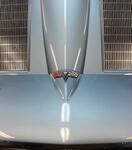

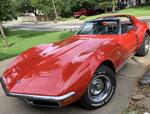

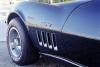


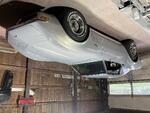




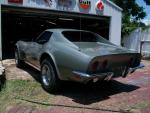


 Emergency hood release