When you click on links to various merchants on this site and make a purchase, this can result in this site earning a commission. Affiliate programs and affiliations include, but are not limited to, the eBay Partner Network.
I have a 1971 that I believe is an LT1 car.
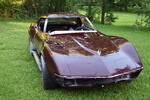
I purchased the car with the body off the frame. The frame has been powdercoated along with many other suspension components.
The body has been primered and is in good shape minus two cracks, one on each front fender above wheel well (someone didn’t support front end properly). Both cracks are below the bonding strips.
I do not currently have the engine for the car but am working on tracking it down.
i currently have 3 items that tell me it’s an LT1 car:
1. Hood without holes for emblems
2. 6500 rpm tach
3. dash plate saying 330hp
I plan to check for the holes in the inner fender for transistor ignition box but is there anything else I can do to confirm it’s a legit LT1 car?
The interior is completely stripped but all glass is in place. Car will need a full restoration. I was planning on spending the money to get the frame to a rolling chassis state with all new bushings and bearings. I have the Numbers matching M21 trans and I’m assuming the rear diff is also original to the car (still need to check gear ratio). Missing front chrome bumper but I have the entire grill and rear chrome bumpers.
Given the information I have provided how much do you think this is worth? Clean title in hand.
the body is primered but they did not fix the cracks prior to primering?
you are looking for a lt1 engine, does it have any engine?
is it coupe or convertible?
all LT1 characteristics can be bought out in the marketplace.
no mention of birdcage rust..
don't have near enough info .......
Since the frame was powdercoated there are no fuel or brake lines on it.
I do not have the engine But might have a lead on its whereabouts.
It is a coupe.
Im guessing the body was ready for paint but cracked after that due to improper handling or storage, hence the cracks on the wheel wells.
IMO, if you can not locate the original engine and get the whole package for 8 to 10 including the cost of the errant engine, this project would be priced like any 72 Corvette project minus an engine. In other words, I would not pay a premium for a 72 LT-1 Corvette w/o the original engine, but just me.
Found this list which might help. Most of it came from this forum.
All Comments, feedback and additions are welcome.Updated 5-20-2020 Here is a great list I saved from a posting here:
There are a few things that only a LT-1 would have , some are pretty easy to change out and some are not very easy at all.in no particular order.
1st. No 1970 or 1971 LT-1 had A/C
2nd. Emission sticker on fire wall behind master cylinder should have letters AX on upper left corner for a 71.
3rd. All LT-1's are 4 speeds. (M20 was std , M21/M22 were optional)
4th. Tach has 6,500 RPM red line on 1970 & 1971 and on 72's w/o AC
5th. All 71 LT-1's came with A.I.R. system. If removed should still have manifolds with holes for the tubes, Car may have headers and if so ask to see old manifolds.
6th. LT-1's had copper radiator W/O a overflow canister on the passenger side fenderwell. There should also be no holes where one had been mounted.
7th. All 70 / 71 LT-1's had Transitor Ign. system. That may have been removed. But if it is removed look for the 3 holes on the front face of the driver side inner fender well where the amplifier box was mounter.
Take a flashlight and look in front of the front wheel or open hood and look at it from the front side. 2 holes on bottom and 1 on top. No TI on the 72 LT-1
8th. Should have a Winters snowflake intake manifold with casting # 3959594 for 1971 and 1972, per NCRS, 1970 should be #3972110. Both manifolds are aluminum (my addition).
9th. LT-1's had a Holley carb. so there is only 1 fuel line , no return line like a quadra-jet carb. Look along frame rail on passanger side for the single line. Also the fuel tank is different. There should be no nipple on the passenger side, side wall for a return line.
If you lay on your back under the rear wheel you can reach your hand up and feel for an indention on the passenger side. If there is a nipple that is capped off , then beware.
Also the single fuel line on a LT-1 was not the same line that was used to feed fuel on the 2 line set up. So if someone removed the return line the look of the 3/8 line is still different. Not a big difference but if you can look at a car with a 2 line set up then you can see what you do not want to find.
10th. LT-1's had solid lifters , but if the car does not then that is not to big a red flag. Many people do not like them and may have replaced with HYD. lifters during a rebuild.
11th. The hardest to fake and most expensive would be the 4 bolt main block. No # on the outside of the block can verify this.
Only way to verify is to remove the pan or have a lighted optical viewer and remove the drain plug.
12th. LT-1's use 2.5" exhaust pipes like the big block cars. But the manifolds were still 2" set up. So the pipes flair from 2 to 2.5" about 6 inches from the manifold. The exhaust hangar at the trans is also different. Look on line at the Corvette Central site and you can see both 2" and 2.5" hangars.
13th. As I recall the highest rear end gear was 3:36 if trans was a M20
And id Trans was a M21 or M22 the 3:55 was highest gear
M20 3:36 Economy
3:55 Standard
3:70 Performance
M21 / M22
3:55 Economy
3:70 Standard
4:11 Performance
14th. The 70 /72 LT-1 Aluminum valve covers should have a rubber oil cap not a twist in. These covers are very hard to find. All the catalog’s sell the twist in cap style.
70 LT-1 might have a twist in oil cap
15th. LT-1's have the same heavy duty half shaft retainers as big block cars. Look at the rear end side yokes, there should be caps with bolts. Base cars used U bolts with nuts.
16th. The rocker arms have a letter O stamped in them.
17th. The balancer on the crankshaft is an 8" unit not a 6"
18th. Original LT-1 hood would not have the holes for 454 number emblems since LT-1 decal and stencil was used.
That is all I know of. and you could not fake all of this and sell a car for a mid 20's price and be worth the effort / expense.
So until someone finds the lost records from St Louis anyone buying a no base model car will be going out on a limb at little unless you are buying from the original owner.
19th Great check list for a LT1. You could add No p/s in 1970 with a CTU engine. CTU had the 6 qt. oil pan. Also, plastic fan shrouds on LT1s. 6-21-18
20th. Lots of places to find this (the key is of course: is it an original stamp?)
I did some more research today and I am now convinced this is an LT1 car.
1. Transistor ignition box was still bolted to inner fender on drivers side. Something to note, only two holes were actually drilled which makes me believe this was an error at the factory.
2. No holes in the hood for badges. No indication of a repair there either.
3. Rear gear ratio is 3.70 which I don’t think was offered on the base car.
4. frame stamp matches the vin tag and trans.
i was also able to get the driver door open to reveal the trim tag. It was originally a 988 steel cities gray over 400 black vinyl. This car has got to be worth something to someone. my idea was to put a generation 5 LT1 in it from a c7 corvette but I think we are going to sell as is.
I am still working on finding the original engine but the person that has it is not getting back to me.
Any fellow forum members interested please give me a call
248-410-4438
thanks
matt
i was also able to get the driver door open to reveal the trim tag. It was originally a 988 steel cities gray over 400 black vinyl. This car has got to be worth something to someone. my idea was to put a generation 5 LT1 in it from a c7 corvette but I think we are going to sell as is.
I am still working on finding the original engine but the person that has it is not getting back to me.
I have a 1971 that I believe is an LT1 car.
I have the Numbers matching M21 trans and I’m assuming the rear diff is also original to the car (still need to check gear ratio).
Your best evidence is a numbers matching M21 - it's really all you need as the M21 was only available with the LT1, LS5, an LS6 engine.
BTW the 3.70:1 rear was standard w/LT1 M21 equipped drive train.
Your best evidence is a numbers matching M21 - it's really all you need as the M21 was only available with the LT1, LS5, an LS6 engine.
BTW the 3.70:1 rear was standard w/LT1 M21 equipped drive train.
perfect thank you very much hammerhead. Yes the trans is numbers matching to vin and Muncie number ends in “BB” which by my research is an M21
there are those on this forum that will tell you that it doesn't matter if the car was originally a base car, a LS5, or a LT1.. , if the engine is missing or the stamp is wrong.. it is not a LT1 car and is just a base corvette from a price basis.
The overwhelming value of such a car is a documented original engine.
I myself think that a LT1 car missing the engine is worth a certain increment over a base car of similar characteristics and condition.
A properly date coded block, heads, intake and carb can be found and stamped accordingly to make it nearly indistinguishable from real. Hard to make money or break even from such an effort though.
keep in mind that a significant subset of LT1 and LS5 are such fakes.. or look into the C2 world...
hard to find a 49 year old transistor box that is working. most were tossed after they failed in 10-15 years.
50 year old fuel lines probably replaced by the much cheaper base car kit...
would such an engine have the 50 year old internals? probably not.. different cam, lifters, headers, carb replaced, bore punched out .060...
all this effects value.
there are those on this forum that will tell you that it doesn't matter if the car was originally a base car, a LS5, or a LT1.. , if the engine is missing or the stamp is wrong.. it is not a LT1 car and is just a base corvette from a price basis.
The overwhelming value of such a car is a documented original engine.
I believe this is true when evaluating the cars worth to a collector, possibly bought for display as an antique. Because the block had a serial number, a no numbers or wrong numbers replacement is easy to detect, unacceptable to some. Even if the block had correct numbers, I'd insist on documentation providing as much evidence as possible it's not a fake. Too many ads out there today openly advertising services to recreate a numbers matching block with broach marks and serial numbers. The higher horsepower cars are high enough in value to make this forgery attractive.
Originally Posted by joewill
I myself think that a LT1 car missing the engine is worth a certain increment over a base car of similar characteristics and condition.
A properly date coded block, heads, intake and carb can be found and stamped accordingly to make it nearly indistinguishable from real. Hard to make money or break even from such an effort though.
keep in mind that a significant subset of LT1 and LS5 are such fakes.. or look into the C2 world...
If a buyer wants an LT1 to drive, much like times before these cars became collectible, this may provide a good foundation to start from. Cheaper than one which is documented original, a driver vs a collectible. Depends on the condition of the birdcage, any bodywork required. Paint can get very expensive.
If the buyer plans to do a restomod, original LT1 parts present may not matter much, in which case it's probably no more valuable to the buyer than a base model. Original parts remaining wouldn't mean much.
Outside of original, documented cars, values tend to vary greatly, depends on what the buyer is looking for.
Last edited by BBCorv70; May 21, 2020 at 10:45 AM.
I myself think that a LT1 car missing the engine is worth a certain increment over a base car of similar characteristics and condition.
I agree with this. In fact Joe makes several good points in his post.
If the car in question were mine and, considering the very limited production (less than 10%) I would seek out a correct block and heads and go the broach and re-stamp route.
I am a firm believer in the complete process of restoring, rebuilding, recreating whatever the car was when when new. Unless the car is a completely documented low miler, I see no difference in recreating it's original engine than I do in installing a complete new interior, repainting the body back to factory color or rebuilding the complete suspension. All are part of the process to bring back a rare car. I don't think a car with a reproduction interior is worth less than car with an original interior. I feel the same about the drive train. If someone has gone to the length of locating all the correct components, I would have no problem buying/owning that car. I have bought many cars that I knew were re-stamped, several I suspected were re-stamped and had a few re-stamped myself. Some see this as blasphemy but on the judging field replacement correct date coded parts and re-stamps are considered a fair part of the restoration process. If the judges and experts are OK with it, why shouldn't I be?
I never considered a simple re-stamp to be a "fake". I would reserve that term for a situation where a base model small block car has been rebuilt as a rare big block car and then documentation is produced to help confirm. That is clearly a different set of circumstances. And, like Joe said, just check the C2's where that kind of thing is rampant but very few ever want to believe that their car could be one of them. In fact, I believe if you could round up all the C2's out there today you'd find a lot more "documented numbers matching original big blocks" than GM ever made.
I think this rare '71 Corvette has the potential to be a great car once again. Good luck whichever way you decide to go.
Greg







 1971 LT1 value and confirmation