When you click on links to various merchants on this site and make a purchase, this can result in this site earning a commission. Affiliate programs and affiliations include, but are not limited to, the eBay Partner Network.
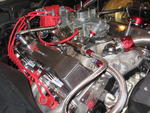
So I recently acquired this new 1977 white corvette, the previous owner put a set of Hedman Headers and boy does it get hot under the hood! I only drove it around the block a few times before I ran into a wiring issue. In this picture if you look at the gasket it looks wavy and not against the block, is that the way their supposed to be? am I losing heat from there? The owner warned me that every once and a while you will need to tighten the header bolts because of the heat, huh ?? not only that but they ran the plug wires under the headers and not over along the valve covers, which i guess they did for looks? is over or under better? or no difference..thoughts on the heat issues?
Last edited by jamiecantar; Jun 11, 2020 at 12:23 PM.
You need to get some sparkplug insulating "Socks" on there now! The way the plug-wires are orientated, those plug boots won't last much longer. The 90* boot is fine, but if they were aimed upward, the boot is farther from the heat.
You may want to switch to a over-the valvecover looms.
Click on my profile, then see all photo albums, my engine build to see the insulators. They are a little pricey for eight. They come way too long. So I cut mine in half and they work perfectly. (order 4)
Next: Header Wraps. Not a big fan of the ugly ****. If you wrap new headers, it will void the warranty if the header company sees its been on there. Wraps do work well in certain situations.
But in my opinion, they have no place on a C3. They have a notorious habit of containing moisture after shutting off the engine. Moisture = Rust. No Thanks.
Next: Those header gaskets made of metal (aluminum-copper) will do that. No harm, no foul. As long as you have a good seal, at each port, what the gasket does between ports is irrelevant. Using a box-end wrench, just snug the header bolts. Don't use a socket / ratchet, torque wrench. Just snug 'em good with a box-end. Work from the center out. Good to go!
Last edited by HeadsU.P.; Jun 11, 2020 at 09:26 PM.
ive been doing some surfing today and in some videos it shows that wrapping only lowers the temp by 20 degrees. verdicts not in yet...although i dont want to start buying new headers right now. it would be nice to work with what i have and wrapping seems the cheaper option. has anyone coated them with VHT ceramic? or is it a gimmicky joke...or get a set of original cast manifolds...
You need to get some sparkplug insulating "Socks" on there now! The way the plug-wires are orientated, those plug boots won't last much longer. The 90* boot is fine, but if they were aimed upward, the boot is farther from the heat.
You may want to switch to a over-the valvecover looms.
Click on my profile, then photo album, engine build to see the insulators. They are a little pricey for eight. They come way too long. So I cut mine on half and they work perfectly. (order 4)
Next: Header Wraps. Not a big fan of the ugly ****. If you wrap new headers, it will void the warranty if the header company sees its been on there. Wraps do work well in certain situations.
But in my opinion, they have no place on a C3. They have a notorious habit of containing moisture after shutting off the engine. Moisture = Rust. No Thanks.
Next: Those header gaskets made of metal (aluminum-copper) will do that. No harm, no foul. As long as you have a good seal, at each port, what the gasket does between ports is irrelevant. Using a box-end wrench, just snug the header bolts. Don't use a socket / ratchet, torque wrench. Just snug 'em good with a box-end. Work from the center out. Good to go!
Those socks look like a good solution for the headers and im going to redo the wires ontop. im not sure yet about the wrap although its a cheaper solution now only if i can find wraps that really lower temps by half...
Here's a terrible photo, but I have a cheap pair of Hooker sidepipe headers, with the wires on top in looms, and the insulation sleeves.
If you have very high underhood temps, that could indicate that your timing is retarded. After I tweaked my timing a bit, the sidepipes are no longer scorching hot (I'll keep the side shields on, though).
I have my wires running under the headers. No problems with burned wires. The heat under the hood was just as hot with manifolds. I actually bought my headers because I heard they lower the under hood temperature.
Jamie,
The boots or sock insulators on mine, I believe are Moroso. They come in sets of four and in different colors. There is a steel ring inside the insulator that slips over the plug boot. You can discard that ring on 90* boots.
Last edited by HeadsU.P.; Jun 11, 2020 at 09:32 PM.
I have my wires running under the headers. No problems with burned wires. The heat under the hood was just as hot with manifolds. I actually bought my headers because I heard they lower the under hood temperature.
Yes, your partially right. Very good ceramic coated headers can lower under hood temps, but i dont think straight stainless or steel headers which is what i have.
I added some wrap around the headers only where the plug wires were close, hard to see in the pics but I have found it works fine and looks tidier than the boots I tried before this.
Yes, one plug wire still to swap out! Wrap on headers to protect spark plug wires Wrap on headers to protect spark plug wires.
I added some wrap around the headers only where the plug wires were close, hard to see in the pics but I have found it works fine and looks tidier than the boots I tried before this.
Yes, one plug wire still to swap out! Wrap on headers to protect spark plug wires.
Is that insulation on the heater hoses in your second photo? Do you have a source for that material? I think @interpon might be interested to see that.
The HEAT in an engine compartment is developed by the engine,....which I know sounds obvious, but my point is that "headers" do not magically generate extra heat, in my opinion. Stock cast iron manifolds get just as hot as a header does,.....again, because the source of the heat is the engine exhaust...not some mythical additional heat added by headers. Now, if a header coating has some insulation properties, I can buy that this insulation prevents heat in the engine compartment and allows the heat to exhaust out the exhaust system. I run stainless uncoated headers on my 77, with no issues at all, and in fact do not believe my underhood temperatures are anywhere near what would be considered hot.
Secondly, factory C3 Corvette plugs wires route under the exhaust, not over it. Been that way from day one without problems. The mere fact that plug wires are close to a manifold does not mean you have a problem, unless the wires are melting. Again, factory wires run under and very near factory cast iron manifolds,.....and always have been. Obviously, given the location of the plugs relative to the exhaust, there is no choice.
So my point is twofold. One,......headers are probably not the problem with what you are calling high heat. Heat comes from the engine. Secondly, plug wires are designed and manufactured to live very near high exhaust temperature. All this aftermarket fixes like heat shields and boots are solutions looking for problems. Sure, they work, but they are not required. I see one picture of heat shield on the steering box, and the exhaust is two inches away!!!! My stainless header is 1/8 inch away, and I see no issue at all.....no degradation in steering, no leaking grease, nothing. Maybe my steering box will fail sooner than one that has less heat exposure,....but I will bet it doesn't....and frankly, given the little driving most Corvette owners do, its another solution looking for a problem. A steering box is made of steel casting, with a few steel gears and bearings, and has hi temp grease in it.....prove to me that exhaust heat is going to hurt something.
Sorry if I don't tow the typical line on this subject, but my experience with stainless headers on a pumped up 350 in a C3 Corvette has proven there is no issue. More gimmicks by aftermarket companies to fix problems that don't exist in most situations., paid for by paranoid people who worry about things that others have long ago designed away.
Last edited by Shovels and Vettes; Jun 12, 2020 at 08:25 AM.
Your response is equally welcome, as all are. thank you. I know sometimes my questions may come across as frustrating but I'm a new corvette owner, never had one before don't know whats norm, not norm. Never had headers. All i know is that when I parked the car in the garage and opened the hood for the first time, I noticed this massive heat just lifting out of the engine bay, more than lets say my wife's Nissan. Maybe its norm with headers, i don't know. The temp gauge in the cabin reads ok. I think a cooler running engine is better than a hotter one...From looking at the front design of the c3 corvette there's not a big grille to let in mounds of fresh cold air. It has to rely on the one engine fan, The closed air cleaner and plastic air intake near the front of the car is removed with an open air cleaner and is sucking in all this very hot air straight down the carb.
Last edited by jamiecantar; Jun 12, 2020 at 08:54 AM.
Obviously, Flyboy has never melted a plug-wire terminal boot on a modified engine.
Depending on sparkplug length, angle of plug in the cyl head, design of headers, diameter of header pipe, type of plug wire boots and material, a problem does exist.
I have seen plug wire boot touching the header due to poor planning, poor design.
The solution is of course to protect the plug boot no matter if its a straight boot or 90* boot. The problem does exist and its no gimmick to place an insulator between the plug boot and the source of extreme heat.
Have a 77 L-82 runs hotter than my charcoal grill! Had two 75 never ran that hot. Pull the cat if you have one dual exhaust the car and toss those headers in the scrap pail. Unless this is a built motor you are gaining nothing but heat .
I added some wrap around the headers only where the plug wires were close, hard to see in the pics but I have found it works fine and looks tidier than the boots I tried before this.
Yes, one plug wire still to swap out! Wrap on headers to protect spark plug wires Wrap on headers to protect spark plug wires.
Jamie,
I run Hedmans on my 69 with no abnormal heat issues. One thing you may check is your engines timing. Incorrect or retarded timing will cause a lot of additional heat.
Norm
The photo is deceptive the plastic ties are a long way from the the headers unlike in this instance with the Dart heads and Hedman headers the spark plug caps on 3,5,4 and 6 cylinders are practically touching the headers and yes I have "cooked" a couple of caps before I wrapped the pipes.
The pic is showing one of the protective boots I had fitted previously. Spark plug cap protective boot
Jamie,
I run Hedmans on my 69 with no abnormal heat issues. One thing you may check is your engines timing. Incorrect or retarded timing will cause a lot of additional heat.
Norm
The Hedmans I have were okay they were fitted by the PO but with the alloy heads I fitted the plug position is closer to the pipes. Older model headers I guess?
Is that insulation on the heater hoses in your second photo? Do you have a source for that material? I think @interpon might be interested to see that.
Hi Interpon, the insulation is on the transmission oil cooler hoses not the heater hoses, this car came to me fitted with industrial hydraulic hoses feeding to an aftermarket transmission oil cooler up front. The setup works well so I have left it alone other than adding the insulation figuring that seeing they feed a cooler why add heat when passing the headers. The insulation came from a local auction site but should be easy to find on e bay etc HEATSHIELD BUILDERS KIT PROTECTION SLEEVE 5/8" X 600MM
Designer Imagines A Corvette That Looks More Like a Corvette Than the Corvette
Slideshow: A Jaguar designer's personal project imagines what a modern front-engined Corvette might look like if Chevrolet revisited the golden age of the Stingray.







 1977 Corvette with Hedman Headers engine bay hot