




Pulling the rear bearing
Thread Starter
Intermediate

Joined: Mar 2021
Posts: 49
Likes: 0
From: Florida
 Pulling the rear bearing
So I've got the spindle out of my rear hub and now I can't seem to get the bearings off. The cone shaped bearing is stuck to the spindle and the circular one is still in the hub. Anybody know the best way to get them off/out? And which way do I push the hub bearing? Towards the wheel or the axle?
Le Mans Master


Joined: Oct 2006
Posts: 7,123
Likes: 433
From: Gladstone MO
C3 of Year Finalist (appearance mods) 2019
To clarify, the inner bearing is the one closest to the threaded end and the outer one is near the wheel /hub flange. The inner is pressed on the spindle and requires a bearing splitter (or bearing knife) and a press to remove. the outer one is also pressed on, but it will come off when you drive the spindle out of the support. It is held in the spindle by the outer seal. You are aware that setting those rear bearings requires some special tools. The clearances and end play are critical.
Thread Starter
Intermediate
Joined: Mar 2021
Posts: 49
Likes: 0
From: Florida
Thread Starter
Intermediate
Joined: Mar 2021
Posts: 49
Likes: 0
From: Florida
Tech Contributor


Joined: Aug 1999
Posts: 15,175
Likes: 3,990
From: Connecticut, USA
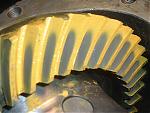
The pictures show the inner bearing, seal, and shield in place. A punch will tap the bearing out. The outer bearing should still be on the axle, if it came off when removed the axle is most likely undersize and no good.
I don't know your plan for setting them up but you get one shot, get it wrong and you will be doing them again or have a failure in use. The spacer and shim need to be checked for parallelism, the shim will not be the right one to use most times.
I don't know your plan for setting them up but you get one shot, get it wrong and you will be doing them again or have a failure in use. The spacer and shim need to be checked for parallelism, the shim will not be the right one to use most times.

Race Director


Joined: Nov 2006
Posts: 13,248
Likes: 7,840
From: Sunshine Coast, Queensland, Australia
2025 C3 of the Year Finalist - Modified
2024 C3 of the Year Finalist- Modified
2022 C3 of the Year Finalist - Modified
Cruise-In VIII Veteran
I'm with GTR, take this to a professional. from everything I've read, your in WAY over your head.

Team Owner


Joined: Mar 2002
Posts: 44,681
Likes: 1,830
From: Huntsville AL
If doing this yourself you're going to need to invest about $400 - $600 in special tools and this is assuming you already have or access to a shop press, blast cabinet, air compressor etc. Yes you can change the bearings and seals while the T/A is still on the car but what's the point in doing that today on 40 plus year old rusty parts. That method was a dealer service repair on a 5 year old car.
There are GM service manuals, internet, YouTube etc. that have more than enough information to walk you through the process. This is considering you brain walk this through from start to finish and have a firm understanding of the disassembly and reassembly process and why you're doing each step.
It's not rocket science and the cost of new replacement parts for an end to end rebuild is about $150ish per side X 2 so $300 plus $500ish in special tools so call it $800 for both sides. You can send your cores out and exchange each side for $430 EA.
If this is just a one time repair it's not really worth buying the special tools unless you're a tool ***** like me and just want to do this yourself.
Good luck.
There are GM service manuals, internet, YouTube etc. that have more than enough information to walk you through the process. This is considering you brain walk this through from start to finish and have a firm understanding of the disassembly and reassembly process and why you're doing each step.
It's not rocket science and the cost of new replacement parts for an end to end rebuild is about $150ish per side X 2 so $300 plus $500ish in special tools so call it $800 for both sides. You can send your cores out and exchange each side for $430 EA.
If this is just a one time repair it's not really worth buying the special tools unless you're a tool ***** like me and just want to do this yourself.
Good luck.
Thread Starter
Intermediate
Joined: Mar 2021
Posts: 49
Likes: 0
From: Florida
Corvette Stories
The Best of Corvette for Corvette Enthusiasts

Top 10 Most Expensive Corvettes Ever Sold on Bring A Trailer
Brett Foote
10 Things Every Corvette Owner Needs (2026 Edition)
Michael S. Palmer
8 Most "Only Corvette Owners Understand" Quirks and Problems
Pouria Savadkouei
10 Reasons the C6 Z06 is Still A Performance Benchmark After 20 Years
Joe Kucinski
How Much Horsepower Every Corvette Engine "LOST" in 1972
Joe Kucinski
Top 10 DOs and DON'Ts for Protecting Your Convertible Top!
Michael S. Palmer
Top 10 Most Explosive Corvettes Ever Made: Power-to-Weight Ratio Ranked!
Joe Kucinski
150 hp to 1,250 hp: Every Corvette Generation Compared by the Specs That Matter
Joe Kucinski
8 Coolest Corvette Pace Cars (and Replicas) of All Time
Verdad Gallardo
2026 Loser of the Year


Joined: Sep 2013
Posts: 36,600
Likes: 7,046
From: New Or-leens Loo-z-anna


The bearing puller required me to grind a "Knife-edge" where the puller fits under the bearing (this will make sense on your first attempt)


I was able to set the bearing distance/end play using a good 12" digital dial caliper after re-reading the procedure 10 times to have a good understanding of what I was trying to accomplish. I did 3 "dry runs" of the assembly before I got the bearing spacing within tolerance. Then I applied plenty of bearing grease and placed the grease seal in position...(it was the last piece to press into place) for the Final assembly
DIY is a learning process
(x's 2)I NEVER could have done it without the advice of the Forum Members

(since I am hard-headed).
Last edited by doorgunner; Apr 4, 2021 at 10:11 AM.