When you click on links to various merchants on this site and make a purchase, this can result in this site earning a commission. Affiliate programs and affiliations include, but are not limited to, the eBay Partner Network.
Hop over to the Paint/Body section for a little reading there too. There's a ton of information there to digest and lots of really good tips. I've been taking lots of notes for my future foray into this on mine. Like mentioned above, if you can knock out a good bit of the prep work yourself, that's the really labor intensive and costly part. Then you don't necessarily have to be as picky on shops for shooting the paint. The comments about production shops rushing through is where you eventually find flaws showing up in your paint down the road from contamination, etc. Ask around a LOT before you select a shop and good luck.
Update. So I had a “mobile” paint guy come look at it. Never knew there was such a business. He was very receptive to what I want done though he won’t hand sand. We determined I have one base coat on primer. The idea would be to sand down to the primer and decide at that point to either lay new primer coat on that one or sand down to fiberglass. He agreed he would either one…..up to me. Once that is decided he stated he would put down 2 coats of paint and 4 clears. Again, I’m not the paint expert here so I’m looking for any feedback. He showed me pictures of c3’s he’s done in the past. Looked good from what I could tell. I happen to need a spot job done on my Infiniti so I hired him for that to be done this Monday. Any thoughts/advice??
I see a lot of red flags here. In no particular order:
With no disrespect intended, leaving the decision up to you to decide on how far to sand only serves to insulate him from any responsibility for future problems (see additional comments following). If he is a painter, he should be willing to weigh in on this critical step. 50% of a good paint job is in the prep, 25% in the application and 25% in the final detail.
4 coats of clear is excessive. You don’t want paint any thicker than it needs to be. 2 coats, then color sand and float a final thin layer. As mentioned in previous post, if a solid color, no need for clear.
Where does he plan to paint the car? In your garage? While I will admit to painting several vehicles in my garages over the years, nothing substitutes for a proper paint booth. Painting with catalyzed paints is dangerous to your health. You don’t want those fumes in your house. As you live in FL, you have a lot of humidity which adds to the problem. An air conditioned booth is what is really needed.
What size of air compressor does he have? When air is compressed, it heats up and when that air enters a cold hose, moisture condenses out of the air, leading to contamination of the paint. Proper spray equipment uses moisture and oil filters to ensure dry, clean air. Small compressors will run nearly constantly, exacerbating this issue. A minimum 60 gallon or higher tank is needed to minimize run compressor run time.
If he won’t sand, presumption is you will? Do you have all of the equipment? A DA (dual action) sander will help considerably in cutting down sanding time.
What about repairing cracks and the other issues I raised in the previous post?
You prep, he sprays, you do the final detail? Who do you blame when a problem surfaces? He’ll blame you for bad prep and/or screwing up the detailing leaving you with no resolution.
Unless you are willing to put in the time and learn how to properly prep the car (it will take a lot more coats of primer than one - trust me), and having to do the detailing hiring out just the spray is going to result in disappointment.
I really don't know why you'd need to sand the paint all the way down to the primer. It's more work than probably necessary ....but if he's up for it, it's a better way to go -- you won't have paint build-up. You need to state to him that one of the hallmarks of a C3 are 'crisp' fender lines ...and that's what you expect. And by crisp, the tops of the front fenders and rear haunches were nice and chiseled 'crisp'. If they aren't that way now, ..now's your chance to do it right. Is he going to pull off the bumpers? Where's he going to paint it?
Yeah, he should put down new primer after it's sanded down ...a couple coats, then let it sit (cure out) a few days, then come back and sand it down. The primer really should have a guide-coat put on and then 'block sanded' with a ..block (foam block probably). Probably he doesn't want to do that. That's the difference between production guys and craftsman. But if you want the bodywork nice and straight, that's how you get there. Especially on a C3 where there isn't a single straight line on the car! ha ha. There's a difference between "Hey, I want new paint on this 87 Civic," and, "I want a dynamite job on my classic car!".
But then again, I have in my day met a few very experienced autobody men who were miestro's with a DA and could do incredible work. But generally speaking, block sanding is going to yield you the best quality of straight bodywork. I know shops that do high-end classic cars (I've done them myself) and NONE of the cars are final sanded with a DA. They're typically block-sanded multiple times actually prior to painting. He might be assuming your bodywork is straight already and perhaps not much block sanding is needed. W/o seeing the car it's hard to say.
Be nice if he had some examples of past work to show you. He's probably a good bodyman and maybe a real quick worker. Some guys can knock stuff out blazingly fast ,,and do a fantastic work. Other guys, talk a good game and later you wish you'd never met them.
I take a vinyl flooring scraper and put 1 drywall blade in it. Then use it in combo with stripper. Do not razor blade the bonding strip area. The glass itself is hard and will reject the blade. The filler used over the bonding strip is soft and the blade will gouge it.
My C3 was re-painted in 1976 by the owner who disliked the original Sunflower Yellow the 1968 Convertible came in so he painted it in the 1969 Daytona Yellow. It is a brighter more Yellow color and makes the car look really great. The only people who didn't like it were other 1968 Owners who kept telling me that is not the "Right" color.... I am going to paint it in the brighter yellow and not the original color as it looks better in the brighter yellow.
When the car had the factory L88 Hood matched to my Color the painter touched-up every ding or scratch on the entire Corvette. Then I noticed a 18 by 24" photograph of my Corvette sitting in front of his shop on the wall behind his desk. He liked the look of my Corvette and did incredibly great work making the Corvette really look "good". Back in 1995 he told me the starting price for painting a whole Corvette was $8000 and it would go up from there based on work.
Now I need a paint job and I was ready to sign him up when I learned he went back to teaching kids how to paint cars at the county public schools. He closed his shop down for lack of business doing Custom Car paint jobs. He had some incredible Custom Rods in his shop getting the "treatment" where they use Lead to fill dings versus Bondo. He is truly an Artist at what he does, I hope there are more like him out there. For the amount of money involved I might paint it myself and do the prep and finishing work in my two car garage. I am now concerned that my body mounts might need to be replaced after reading the above posts.
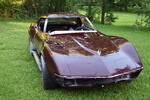
My paint has developed the standard spider webbing in many places. It is starting to really look bad up close. I have started gathering the materials needed to start sanding the paint down to get rid of the spider webs. I have painted a couple cars successfully so I can probably do the Corvette once the body is ready for paint.
Big question, what kind of paint would be the best for my C3? Base coat/ Clear Coat or a new urethane paint job? Any ideas or suggestions are welcome!
[QUOTE
Big question, what kind of paint would be the best for my C3? Base coat/ Clear Coat or a new urethane paint job? Any ideas or suggestions are welcome![/QUOTE]
Apples and Oranges. One is a product and the other a process.
Urethanes (aka polyurethane when it comes to paint) have been the standard for the last 40+ years, replacing acrylics (both lacquer as well as enamel). Deltron (PPG Industries) is the leading aftermarket product and has been around for 50 years +/-. A base coat/clear coat process is also a long-standing standard as the chemistries of the clear offer far superior UV protection (hence dramatically reduced fading).
There are other quality paint suppliers. AKZO-Nobel is huge in Europe and you can buy their products here in the states. If you are looking for custom paint, look no further than Valspar’s House of Kolor line.
Big question, what kind of paint would be the best for my C3? Base coat/ Clear Coat or a new urethane paint job? Any ideas or suggestions are welcome!
There are surely a lot of good options, but just to give you one, here's what I did:
Hand sanded down to bare glass. Was too nervous to do it mechanically.
2 coats of Southern Polyurethanes epoxy primer.
Several coats of Evercoat Slick Sand. It's a polyester build primer and very easy to work with. You spray a coat or two and then block sand with a guide coat. Repeat until the whole car is smooth. I don't remember how many I used. I think 4.
3 coats of base. I used Axalta Chromabase. It was expensive, but I was advised to use a high quality base. Scrimping here could create lots of problems. Plus Chromabase was one of the few brands that could mix Ontario Orange.
4 coats of Southern Polyurethanes Universal Clear. I did that many so I could color sand to my heart's content. I have no orange peel.
Color sanded with 1000, 1500, 2500 and 5000. Probably more grits than I needed, but it worked.
Southern Polyurethanes has a forum and those guys were very helpful. This was the first paint job I have ever done. It's not perfect, but for about $2500 in materials, I could not be happier.
I can't remember how I came across the SP stuff, but everything I had read about them was so good that I decided to use them. I'm using an aftermarket hood on the car, so I used the stock hood as a test panel. It was the first paint I ever shot, outside of some SS on an engine bay a couple years ago. That hood has been sitting out in the weather for over a year now, including the massive winter storm in February, a couple of small hailstorms, and the brutal Texas summer sun. It's still looks great.
OK, the "Believers" aren't going to want to hear this, so they might want to skip this post. This is going to be like calling Vitamins & suppliments a scam. ha ha...
After a couple decades of spraying Dupont, PPG, Sikkens and Martin Senour (Napa) paints at shops etc, I tried spraying Nason and Omni (DuPont and PPG 2nd tier paints) urethanes. I had heard they had improved (at the time) so I figured they were worth a shot. At body shops we kind of scoffed at these paints thinking the top tier brands were far superior. And at one time that was the case. Anyway, I was surprised how well the Nason and Omni sprayed compared to the name brands. Not much difference except usually you need to spray an extra coat of clear to get the same build-up and push it a little harder to get good flow. But for classic cars, usually yer going to sand/buff, and I haven't noticed any DOI difference in the 2nd tier or aftermarket paints. I had heard all along how their bases weren't as good, but I matched many cars and never had a problem. It might take an extra coat to cover ...but that's not a bad thing either.
I also sprayed many cars of friends and relatives ..people I know, and several of my cars too (not only Nason, but also PPG/DuPont, etc high-end paints). Some really nice job, some quickie paint jobs too. People kept some of these cars I painted quite a while, many years, or they were eventually backed up to the edge of the property and still sit there in many cases today rotting away LOL. And some were kicking around town (new owners). So, I've had a chance to look over and observe how long the paint has lasted and compare the name brands to the non name-brand paints.
Very little to no difference in longevity. Actually they've all lasted about the same outdoors ( -- about 13yrs dark colors, a few years longer lighter colors) until the clear begins to break down. Thats 100% outdoors, rain, sleet, sun, snow, ice, etc. No shelter, no garage. Those vehicles which have been garaged, (classic cars), the urethane paints look as good as when they were sprayed, Nason, No-Name clears or, the top PPG/DuPont clears at the time). A guy I know has painted many a 68-69 Mustang fastbacks with the NAPA 2nd tier paints and clears (I forget what they call them now). I helped the guy wetsand his cars, and I did most of the buffing on them (he didn't trust hemself, he he). They looked as good and shiny as any clears after being buffed out too.
There was a time when urethane paint technology was the exclusive domain of major paint companies and it really made a difference going high-end PPG's and DuPonts. But that train left the station about 25 years ago. Nowadays there are countless paint companies out there producing urethanes. A guy can buy universal high-solids Euro-clears at swap meets for $75 a sprayable gallon that ...spray out nice and look fantastic (and seem to last a long time). And some smell almost EXACTLY like Sikkens (if you've ever sprayed Sikkens you know what I mean!).
My point is, as someone shopping for a re-paint. A lot of Corvette owners get really worked up over what paint to use. I personally wouldn't. They all do a good job. I'd go with whatever the shop (or guy) you go with is most comfortable spraying. What he thinks he can lay down the best. He'll know the best gun settings, proper mixing ratios, how far to 'push' them and get the best lay-out. Best to stick with a 'system' (all PPG, or all Axalta, all Nason, etc), straight across the board: using the same brand sealers/base/clear. I know guys use this base and that clear. It works, but you introduce 'risk' in your paint job and if something didn't 'like' another paint, yer screwed and it's too late to do anything about it. Also, you definitely don't want to take your ABC cheap paint to a body guy who is used to spraying XYZ brand. He won't know their properties very well, yer asking for trouble. But if you spray Nason on your car ( which is 1/3 as much as a PPG mainline), it's going to look and last as long as you'll have the car.
OK, the "Believers" aren't going to want to hear this, so they might want to skip this post. This is going to be like calling Vitamins & suppliments a scam. ha ha...
(Ok flammers ....Get your darts out!! ha ha.....)
I'm not sure if this was pointed at me for using a different brand of base and clear, but if so, here's my explanation
I'm not a Believer or a Flamer. Especially when it comes to P&B work. I'm one step above someone who knows nothing about it since I've done exactly one paint job. When I decided to do my own paint, I had to start doing some research. There are a number of P&B forums out there, and I looked at a quite a few. As is the case many times, I read lots of conflicting info. After a while I felt like I was getting analysis paralysis and thought I was never going to be able to do this.
Then I found the Southern Polyurethanes forum. Many of those members are professional P&B guys, they make their living at it. As I read more and started asking questions, I started feeling comfortable that I was getting good info. That eventually proved correct, the advice they gave me kept me from making several major mistakes. The owner of SP is also on that forum and is available for questions by phone or the forum. That helped me, as a total novice, quite a bit. You're not going to get an owner at PPG or DuPont. That may not be a big deal to a pro, they have years of experience and they don't need that hand-holding. But for me it was invaluable.
These pros were so complimentary of the SP products, it gave me a comfort level with them. I think your statement about using primer, base and clear from one system is totally valid. And I think most of those guys on that forum would agree with that on a general basis. But they all love the SP epoxy primer and clears, in particular, so much that they veer from it.
The reason I chose Chromabase over a lower priced base like Nason was only in part because it is considered one of the top tier bases. I read a lot about those having better coverage and being more forgiving than cheaper paints. You may disagree with that, some others I read do too. Personally, I have no opinion on it as I don't have the experience to make that judgement. But on the chance that it was true, I paid the premium. Since I wasn't paying a body shop thousands of dollars for labor, I had the money to spend. But frankly, the biggest reason I did it was that there was a jobber in my area that could mix Ontario Orange with it. I called a number of others that just couldn't do it, even though I had the paint codes.
So I made the decisions to use what I used because it worked for me, in my particular situation. It certainly may not work for others.
Is there any cracking in your current paint? Do you have new body bushings under it?
Jebby
Good question. Just to clarify, a '70 came with solid body mounts. (Aluminum blocks) Not sure when rubber body mounts was introduced into C3s, I think '74. Who knows what's under there now.
I'm not sure if this was pointed at me for using a different brand of base and clear, but if so, here's my explanation
No. it wasnt a reaction to your or any post. Just trying to give the OP some info that there's a lot of good product out there, regardless of price and name (Incl Southern Poly). Not to get sucked into that "What's the best paint for me?" spiral. If you use S/P I think we pretty much agree on the same thing. And I'm not against the major's top-line bodyshop paints either.
Yeah, I think Chromabase has better coverage (same with their clears) than Nason (I mentioned that in my post). Nothing a 3rd coat can't resolve. In fact, the 'coverage' debate can be a downside too. Production paints tout quick-coverage coats which is great for getting crash work out of the booth. But for restoration-style paint jobs, sometimes that extra (3rd or 4th) coat of clear (or base) allows a guy to ensure certain spots weren't missed or went a little too light. Or if there was minor lifting you get a chance to possibly detect and correct it with a 3rd coat that you might not with a 2nd. But now we're getting into the minutia of painting, aren't we? Painters will know what I mean ...lol.... And of course there are still (or were up until fairly recently) some (not many) colors not available in Nason that are with premium paints. I'm not waving the Nason flag, I'm pretty brand-agnostic. Mainly for the OP that there are lot of options out there which regardless of name will work great.
Hop over to the Paint/Body section for a little reading there too. There's a ton of information there to digest and lots of really good tips. I've been taking lots of notes for my future foray into this on mine. Like mentioned above, if you can knock out a good bit of the prep work yourself, that's the really labor intensive and costly part. Then you don't necessarily have to be as picky on shops for shooting the paint. The comments about production shops rushing through is where you eventually find flaws showing up in your paint down the road from contamination, etc. Ask around a LOT before you select a shop and good luck.
There are surely a lot of good options, but just to give you one, here's what I did:
Hand sanded down to bare glass. Was too nervous to do it mechanically.
2 coats of Southern Polyurethanes epoxy primer.
Several coats of Evercoat Slick Sand. It's a polyester build primer and very easy to work with. You spray a coat or two and then block sand with a guide coat. Repeat until the whole car is smooth. I don't remember how many I used. I think 4.
3 coats of base. I used Axalta Chromabase. It was expensive, but I was advised to use a high quality base. Scrimping here could create lots of problems. Plus Chromabase was one of the few brands that could mix Ontario Orange.
4 coats of Southern Polyurethanes Universal Clear. I did that many so I could color sand to my heart's content. I have no orange peel.
Color sanded with 1000, 1500, 2500 and 5000. Probably more grits than I needed, but it worked.
Southern Polyurethanes has a forum and those guys were very helpful. This was the first paint job I have ever done. It's not perfect, but for about $2500 in materials, I could not be happier.
man, you did a hell of a job here. Was this your first time doing body and paint?
No. it wasnt a reaction to your or any post. Just trying to give the OP some info that there's a lot of good product out there, regardless of price and name (Incl Southern Poly). Not to get sucked into that "What's the best paint for me?" spiral. If you use S/P I think we pretty much agree on the same thing. And I'm not against the major's top-line bodyshop paints either.
Yeah, I think Chromabase has better coverage (same with their clears) than Nason (I mentioned that in my post). Nothing a 3rd coat can't resolve. In fact, the 'coverage' debate can be a downside too. Production paints tout quick-coverage coats which is great for getting crash work out of the booth. But for restoration-style paint jobs, sometimes that extra (3rd or 4th) coat of clear (or base) allows a guy to ensure certain spots weren't missed or went a little too light. Or if there was minor lifting you get a chance to possibly detect and correct it with a 3rd coat that you might not with a 2nd. But now we're getting into the minutia of painting, aren't we? Painters will know what I mean ...lol.... And of course there are still (or were up until fairly recently) some (not many) colors not available in Nason that are with premium paints. I'm not waving the Nason flag, I'm pretty brand-agnostic. Mainly for the OP that there are lot of options out there which regardless of name will work great.