When you click on links to various merchants on this site and make a purchase, this can result in this site earning a commission. Affiliate programs and affiliations include, but are not limited to, the eBay Partner Network.
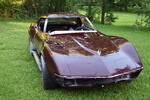
I've been considering to buy a well worn '68 C3 and saw that it had these cracks on the top of both front fenders at the front hood corners. (the cracks are the red lines in the attached crude drawing.). The cracks look pretty deep and about 1 and a half inches long. Almost looks like someone tried to over-open the hood. Are these cracks common? Is it a major shop-type of repair or is it something that I can fix myself? I have quite a bit of DIY experience with boat fiberglass, zero Corvette fiberglass, but not scared to try.
The car is not going to be Concors level or judged. Pretty much a daily driver and I'm just trying to scope out the magnitude of the repair.
Thanks,
John
the rad support rusts and drops. or other stuff like bumper brackets and frame extensions are out of whack. then everything north of there hangs down and the hood surround cracks there. you can't fix the cracks until you have the nose mounted back where it belongs. also sometimes the bonding at the back of the nose lets go. it is common. especially on inexpensive chrome bumper cars. roll down to post 107 and read. especially the rust issues rule 5. that nose may be the least of it's problems. if not, buy it... https://www.corvetteforum.com/forums...orvette-6.html
derekderiek and PJO, thanks for the replies. I've been looking for a long time for a C2 Coupe, but so far either they have gotten away or they are way out of what I want to spend. In the meantime, this 68 came up through a friend of mine and I wanted to broaden my scope a little.
I read Post 107 and will view the video tonight. The rust pictures are sobering and based on your comments about the possible causes, it might be too much to fix. I now have a better idea of what to look for.
Whichever car I do decide to pursue, I will have someone do an inspection. I was looking at a '66 in Salt Lake City recently and contacted the local NCRS chapter who put me in touch with a good inspector. Best money I could have spent.
Are there any C3 inspectors you could recommend in the Washington DC/Alexandria VA area?
GM did not use any brackets on the noses of the 68's to help support the tremendous weight of the new headlights. All early and mid build 68 Corvettes will crack in that location. To satisfy expensive warrenty claims, they later had to add a long nose rod down to the radiator support, two twist brackets and two triangle shaped reinforcements to the top of the inner fenders to support the rear headlight metal bar riveted to the underside of the front fiberglass. So if no one added these brackets it will crack there and the rest of the car could be okay. My late March 68 coupe had NO reinforcements and cracked there. Hope this helps from a 49 year 68 owner. Lou.
Lou, that's very interesting and glad you shared it. I'll ask about those reinforcements. I would imagine the body work to fix the cracked areas in the fenders is going to be doable, but non-trivial.
Thanks,
John
This was an inherent problem in all 1968 Corvettes. In 1969 this area the vertical lip were increased and longer helped reduce the problem.
Agree and what I did when I body worked/painted my 68 as a preventive measure is clean up this area under the hood surround with Dawn and water, rough up with 40 or 80 grit and add some resin (or epoxy) plus glass as a backer material. Out of sight and this hopefully gives it some extra strength in this stressed area similar the 69+ improved design.
You could do the same if you really like this 68 and hopefully greatly reduce the chances of more cracking or at least stabilize it to keep it from getting worse.
As you know the best fix is to grind out the cracks and repaint the whole car, but if you want this 68 for a fun driver; not warranted. And these cracks verify it is a 68, ha!
BTW, of late I have been using 3m blue painter's tape on top of the last piece of saturated glass to mash the whole patch down and hold in place plus it leaves a better surface when dry and you pull the tape off.
but before fixing a crack anywhere on a vette body, the stress that caused the crack has to be removed. all of the stuff that mounts-supports the nose has to be in place. the correct place. so the headlights, bumper, brackets, etc are supported by the front crossmember, frame extensions, horseshoe, etc and raised back up so that the cracks appear to close themselves. the front of the inner fenders are mounted to the rad support. they have a sheet metal tab riveted to each that the rear headlight support bar mounts to. any cracks in the inner fenders and they no longer hold their share of the load. any rust in the bottom of the rad support and everything droops.
20merc: thanks for the links, It will keep me off the streets at night! I've recently started to put tape over fiberglass repairs I did on a rowing shell. It came out nice and minimal sanding to finish.
derekderek: Well put. Unless the cause of the crack is addressed, any repair will just be practice. I'll contact a qualified inspector to see what the story is on the nose, as well as all the other areas listed in the "10 steps to buying a C3". I'm very suspicious of this one because when I asked the owner about rust, he said, "none to my knowledge". LOL.
Always fun to check out a C3 and have a good plan to look it over very carefully. For me, all C3's have rust, yes, yes, and period. The question is not "whether" but rather how much and how bad. And severe rust is always the deal breaker for me. All of them have surface rust. And sometimes difficult to see whether severe rust is bad enough to warrant a pass. For example, the last 68 I bought was a Cali Corvette and the frame looked just super and the trim tag color was exactly what I had been looking for awhile. I noticed the windshield frame had a small amount of rust, but I thought, yeah, not too bad. However, when I pulled the cracked windshield glass out, it was uh oh.., a few small holes in the windshield frame. All fixed now, but I learned (again), it is hard to tell the extent of rust underneath windshield glass unless you pull the glass out and no sane seller is going to allow that. So, you take your best shot and deal with the results. The odds are good (I think and hope) that really bad bad rust you are going to find if you look carefully. And these are 50+yr old car, so they are going to need something.
it is far better to regret the car you didn't buy 6 months ago than to regret the POS in your garage you knew you shouldn't have bought but convinced yourself "it'll be fine!"
Hmm, I'm sensing a lot of negative vibes about early C3s and rust. My priority when I started looking for a Vette was a C2 Coupe. Given the prices and availability, I've widened my search to a C3 and a buddy of mine happens to have a '68 427/390 that he would deal on. I had a pretty good handle on C2 rust and cracks. Are you guys saying the C3 rust issues are worse than the average C2? Or is it just that I am very green to C3s and they have the same level of rust issues as C2s?
Derek, great point, I really try hard to leave the emotions behind when I research a car, but sometimes the weak willed human comes out in me. I gotta watch that, it's cost me dearly in the past.
I have never owned a C2 and do not want one, so no real life experience for me. However, since the C2 frame design is almost identical to the C3 frame, I would expect similar problems with each for rust. The C2's would be a little older which might be a factor. There was a period when neither one of these generations were thought to be valuable and so left outside, etc. I do not think or ever have seen that C3's have any more rust issue than any other 50+ yr old auto's. I think you are on the right path, get a knowledgeable inspection and make the best informed decision possible.
Are you guys saying the C3 rust issues are worse than the average C2? Or is it just that I am very green to C3s and they have the same level of rust issues as C2s?
The C3s probably have more birdcage rust issues than the C2s because every C3 is essentially a convertible given the way the T-top configuration is designed with all the seams in the trim. Most attention is on the windshield framing but T-top cars can also rust out the structure at the rear of the birdcage because, again, of the seams required for the t-top design.
The chassis frame issues at the rear "kick-up" are very similar between the two.
GM did not use any brackets on the noses of the 68's to help support the tremendous weight of the new headlights. All early and mid build 68 Corvettes will crack in that location. To satisfy expensive warrenty claims, they later had to add a long nose rod down to the radiator support, two twist brackets and two triangle shaped reinforcements to the top of the inner fenders to support the rear headlight metal bar riveted to the underside of the front fiberglass. So if no one added these brackets it will crack there and the rest of the car could be okay. My late March 68 coupe had NO reinforcements and cracked there. Hope this helps from a 49 year 68 owner. Lou.
Spot on. Here’s a couple of pics of the inner fender/surround brackets and the support rod on my December 69 production car. The “twist” brackets are located at the outer corners where the bumper bolts up. The bracket has a 90 degree twist to it allow to be secured to the bottom of the front most surround reinforcement. If you want a pic of them let me know and I will find them and mock them up for you.
Here is the difference between a the surround at the front hood corner. You can see the additional support at the radius to help reduce cracking in this area.
Early 68's had only a small "L" shaped bracket that bolted to the place that the later rod bolted to. The other end of the bracket bolted to, are you 68 owners ready for this, the 68 only front chrome bumper! This first design front bumper had a tab welded to it for the bracket to bolt to.
My late 26 March coupe had this bracket and bumper. Lou.






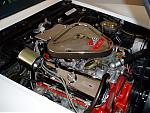




 '68 Fender Cracks