When you click on links to various merchants on this site and make a purchase, this can result in this site earning a commission. Affiliate programs and affiliations include, but are not limited to, the eBay Partner Network.
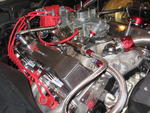
I’m building a 383 stroker -10:1 compression -Brodix IK200 200cc,64cc. -1.52 ratio ultra pro magnum Roller rockers -edelbrock performer intake
i am going to be using a quick fuel q-street series 650 double pumper mechanical secondary’s no choke. The picture shows the stock jetting it has right now, does anyone have any experience here with what jetting I should be using is the stock jetting here good or am I going to have to go bigger because the engine is now a 383.
Its not always more cubic inches that justifies richer jetting. For example. Some run a 780 carb on a little 302. Some run a 780 on a big 454.
What does constitute richer jetting is volumetric efficiency. Without getting into all that, let's just say that with more cam profile and headers, usually a jetting of two sizes larger is a good start.
Here is where an Air Fuel Ratio gauge will be a Godsend to helping you find the perfect A/F ratio.
The old way was pulling / reading plugs with every jet change.
Yup, over here in Australia the old saying is, "How long is a piece of string".
Meaning, could be anything.
This is why companies that make carburetors are always very vague on jetting specs. They tell you anything and your engine burns down and then it's there fault.
Reading plugs is how I always did it.
Vacuum guage for working on Holley power jets and vacuum secondary springs.
But this carb you wish to run I know nothing about.
I’d listen to headsUP and start 2 sizes richer. Take it for a drive and see how it feels. Make an adjustment and compare. When I installed a new full length exhaust I was stressing about the tune. It ended up being way easier than i had thought. You can really feel how the engine changes its behavior with different amounts of fuel.
I’d listen to headsUP and start 2 sizes richer. Take it for a drive and see how it feels. Make an adjustment and compare. When I installed a new full length exhaust I was stressing about the tune. It ended up being way easier than i had thought. You can really feel how the engine changes its behavior with different amounts of fuel.
should I change the primary jet and secondary or which ones are you saying 2 sizes up
There is an old saying about jet changes:
Thou Who Shall Error Towards the Rich Side Will Be Blessed.
Thou Who Shall Error Towards the Lean Side Will Be Cursed.
Ok, so I made that up. But what it means is, a richer jet setting seldom does any damage. May foul a plug, but not horrible.
On the other hand, a lean condition will fry pistons to the point of catastrophic proportions. So, one can say you are always better off richer than leaner. But how far?
Holley & Q.F. both sell jets in every size imaginable. A jet change of one size will never be noticeable so it's recommended to jump two sizes at a time to get results.
And yes, change both Primary & Secondary. Otherwise at W.O.T. you could go lean again in the secondaries.
I find jet changes a pain in the *** in the car. So I only do it twice and call it good. Your plugs will let you know, or a AFR gauge will.
There is an old saying about jet changes:
Thou Who Shall Error Towards the Rich Side Will Be Blessed.
Thou Who Shall Error Towards the Lean Side Will Be Cursed.
Ok, so I made that up. But what it means is, a richer jet setting seldom does any damage. May foul a plug, but not horrible.
On the other hand, a lean condition will fry pistons to the point of catastrophic proportions. So, one can say you are always better off richer than leaner. But how far?
Holley & Q.F. both sell jets in every size imaginable. A jet change of one size will never be noticeable so it's recommended to jump two sizes at a time to get results.
And yes, change both Primary & Secondary. Otherwise at W.O.T. you could go lean again in the secondaries.
I find jet changes a pain in the *** in the car. So I only do it twice and call it good. Your plugs will let you know, or a AFR gauge will.
thank you, sorry this is a stupid question I’m just really new to jetting carburetors I’m trying to find what two sizes up from 22-68 and 22-76 is.
Well if your Holley is like others it would be:
70 on the primaries.
78 on the secondaries.
Its just not worth the effort or money to increase one size.
On my 4150, 650 DP, I tried going from 67 on the primaries to 65. Knowing that the double pumper is somewhat of a gas hog I was trying to save some cruise speed gas. It ran worse so went back to the std 67s.
You can buy Holley jet kit assortments at Summit ($81+). Dozens & dozens of choices. But unless you are bracket racing or the like, just move up two notches and call it good. Some posters on here set up a temporary Air / Fuel Ratio gauge in the cockpit and go for a ride. Then disconnect when satisfied.
All this tweaking depends on how much you want to get involved. At $10 a pair of jets, its $20 every time you experiment, to the good or bad.
Last edited by HeadsU.P.; Aug 26, 2022 at 09:50 AM.
thank you, sorry this is a stupid question I’m just really new to jetting carburetors I’m trying to find what two sizes up from 22-68 and 22-76 is.
not a stupid question. I’d start with the jets that it came with as a baseline. It shouldn’t be off by a lot. Going up 2 sizes would be from 22-68 to 22-70 and 22-76 to 22-78







 Jetting