When you click on links to various merchants on this site and make a purchase, this can result in this site earning a commission. Affiliate programs and affiliations include, but are not limited to, the eBay Partner Network.
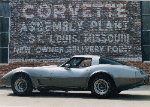
I watch a lot of Corvette You Tube videos. Its not really an issue for me, but I wondered if my numbers match on the engine and vin number. Not even close. I checked the number stamped on the block, passenger side just below the head. It reads 22011. Only 5 numbers. My vin # last 5 numbers are 20398. Now I don't have a clue what engine is in my car. Is it possibly a crate engine? Shadow's (Car Name) debut on the forum
A swap to a different engine from stock? I'm hoping someone can hep me out, I know there are a lot of gurus and sleuths on this forum, Thanks for any help, Sean
Last edited by seanshine; Mar 22, 2023 at 04:59 PM.
Reason: error
No help on numbers..maybe take a few pics of number..
my comment is that you havea beautiful all black mirrored tops…nice!
my 79#
I think its more than 5 numbers of vin
8 in my case
Last edited by interpon; Mar 22, 2023 at 05:57 PM.
Starting with interpon, as best I can tell, I would say he may have the original engine still in his 1979 Corvette. If my eyes are not deceiving me, his stamp pad reads V1120ZBA. If that is correct, it indicates his engine was assembled at the Flint Michigan V8 plant on Nov 20, 1979 1978 as an L82 SHP destined to be mated to a manual 4-speed gearbox.
For comparison, my stamp pad reads, V0725ZBA, which translates to an engine assembled at the Flint Michigan V8 plant on Jul 25, 1979 as an L82 SHP, also readied for a 4-speed manual. My car assembly date is 13 Aug 1979.
To the OP, I love the glass tops. However, I don’t recognize your engine block casting date, which you stated is 22011. The engine casting date is behind the right-side cylinder head. Mine is G139, which translates to an engine block casting date of Jul 13, 1979.
The interpon pic is of his engine stamp pad at the front right of his engine block.
In any case, these dates should go in sequence. That is, ...
Engine casting date
Engine assembly date
Car assembly date
I hope this helps. You both have beautiful cars!
Last edited by C3Highway; Mar 22, 2023 at 09:54 PM.
In any case, these dates should go in sequence. That is, ...
Engine casting date
Engine assembly date
Car assembly date
I hope this helps. You both have beautiful cars!
As an FYI, the car assembly date technically is the VIN derivative and was stamped simultaneously with the transmission. The frame also has the VIN derivative at the left rear fender, believe just before the frame kicks up.
On a 79-related topic, I've gotten curious about the 70 amp alternator introduced mid-to-late in the model year. I read where it was used when the trailer package was called out, but I have an early 79 buildsheet with ZN1 and no 70 amp alternator.
Does either of your 79s have a 70 amp alternator? And if so, buildsheet as well.
As an FYI, the car assembly date technically is the VIN derivative and was stamped simultaneously with the transmission. The frame also has the VIN derivative at the left rear fender, believe just before the frame kicks up.
Isn't the interpon pic above showing his VIN derivative, under his engine assembly stamp, which doesn't include a date, but the sequence number, right? Please clarify.
Originally Posted by hunt4cleanair
On a 79-related topic, I've gotten curious about the 70 amp alternator introduced mid-to-late in the model year. I read where it was used when the trailer package was called out, but I have an early 79 buildsheet with ZN1 and no 70 amp alternator.
Does either of your 79s have a 70 amp alternator? And if so, buildsheet as well.
My car has a 63 amp Delco alternator. Bear in mind, the car was thirty years old when I bought it. It has no evidence of the trailer package (ZN1).
I have NCRS documentation that specifies 63-amp or 70-amp alternator for cars with RWD, A/C, and HD battery. I wonder if Chevrolet underestimated the power needed for the RWD in the much larger rear window that was new in '78?! And then added the 70-amp in late '79? Just a thought that has crossed my mind.
Originally Posted by interpon
No 70 amp here.
thanks for info c3 highway. All correct except my 79 was built in nov 78.
Thank you. I stand corrected. I edited my post above as you indicate so I don't confuse unsuspecting souls.
Isn't the interpon pic above showing his VIN derivative, under his engine assembly stamp, which doesn't include a date, but the sequence number, right? Please clarify.
Yes! The VIN derivative does not include a date code...it's a derivative of the VIN (vehicle identification number) and includes the serial number.
I have NCRS documentation that specifies 63-amp or 70-amp alternators for cars with RWD, A/C, and HD battery. I wonder if Chevrolet underestimated the power needed for the RWD in the much larger rear window that was new in '78?! And then added the 70-amp in late '79? Just a thought that has crossed my mind.
I would say your correct but there is also a heavy-duty battery that is called out with ZN1, heavier duty than that offered in 78...more cranking amps.
I'm referring to the NCRS 1968-1982 Corvette Specifications Guide.
It states on pg 121, for 1979...
70-amp: with C60 & C49 or UA1
63-amp: with C60 and/or C49
61-amp: with C60, except C49 or UA1
42-amp: all other cars
1976 was the first year for the electric filament RWD, with no added amps considered.
In 1977 they bumped up top amps from 61 to 63 and considered C49.
In 1978 came the big window expansion of C49.
During 1979 top amps goes to 70.
There is a story being told here.
Last edited by C3Highway; Mar 23, 2023 at 08:47 AM.
Yeah...engineers consumed with meeting federal regulations for emission control requirements, vehicle safety measures and fuel economy had little time to measure the impact of that big-*** window and the amperage to operate the recently introduced rear-window electric defogger.
Yeah...engineers consumed with meeting federal regulations for emission control requirements, vehicle safety measures and fuel economy had little time to measure the impact of that big-*** window and the amperage to operate the recently introduced rear-window electric defogger.
Yes, great point! The engineers were seriously distracted by a heavy and diverse barrage of gov't demands!







 1979 Engine Matching Number