When you click on links to various merchants on this site and make a purchase, this can result in this site earning a commission. Affiliate programs and affiliations include, but are not limited to, the eBay Partner Network.
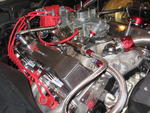
Hey, guys. I've got a '73 Stingray with a built SBC 350: bored .030" over, hydraulic roller Comp cam, RHS aluminum heads, Performer intake, Holley 650, etc. (all mods done by a previous owner). I've owned the car for several years but my wife and I put maybe 600 miles a year on it.
I posted several weeks ago with an oil pressure question but that all seems to be resolved. FWIW, I'm running 5W-20 Valvoline synthetic blend and I've got plenty of pressure (52PSI at idle -- yes, I know it sounds a bit high but if you were involved in my previous post, well, you'd understand...).
ANYWAY, since I did have the oil pressure question a few weeks ago (thanks to everyone who chimed in on that one), I decided I wanted to take a look at the top end of the engine, while idling, to see how my oil flow was. I pulled each valve cover, set up some cardboard splatter shields, and fired up the engine. On all 8 valves on the driver's side, I had really nice oil flow to the rockers -- plenty of splash, if you will. On 6 of the 8 valves on the passenger side, I had that same nice flow. Oddly, for cylinder #8, I had only moderate flow for the exhaust rocker/valve and what I'd call less-than-moderate flow for the intake rocker/valve. See the video I have attached which shows the passenger side (cylinders 2-4-6-8).
The oil flow you see on cylinders 2-4-6 is the same sort of flow that I saw on the entire driver's side bank (cylinders 1-3-5-7). I did not attach the video for that bank of cylinders but I can if you want.
My question to you all is this: what would you suggest I do to remedy/troubleshoot this? Based on what I've read, the oil flow actually starts from the rear of the block and flows towards the front so, technically, cylinders 7 and 8 would have the oil flow first before it moved forward towards the remaining cylinders on each bank. As you can see, it's not that I have NO flow... it's just that #8 has visibly less flow than all of the other seven cylinders. There is audio in my video and you'll hear... well, basically, nothing of concern. There is no clattering of any sort. If I hadn't seen the lower-than-average flow for the #8 rockers/valves with my own eyes, I wouldn't even be making this post.
How long has it been this way? I can't answer that. I'm more concerned about whether there is something I should do about it. Could this be due to clogged pushrods? Lifter issue (lifters are believed to be hydraulic but that's one engine build fact that I never learned from the PO)? Something else?
if they all have oil flow you are done and go drive it ... Lifter position (open or closed) and lifter plunger (.050 down or bottomed out) all has an effect on oil flow that you can not pin point with some valves being open and some closed
if they all have oil flow you are done and go drive it ... Lifter position (open or closed) and lifter plunger (.050 down or bottomed out) all has an effect on oil flow that you can not pin point with some valves being open and some closed
Trust me: I’d love to just button things up and drive it. I just found it odd that with the engine running (like it is in my video) that 2 rockers would have visibly less oil flow than all the others. I could comfortably live with your explanation if the engine wasn’t running and I was merely spinning the oil pump with a priming tool; in a case like that, it would be very understandable that some rockers might have less flow than others based on cam orientation and its effect on the lifters.
the oil still comes from the lifter so you can switch lifters between the poor flowing to good flowing valves to see if follows the lifter (I don't recommend doing), or install a new set of lifters after making sure the pushrods are clean and unrestricted ..... it's not clattering so the lifter is getting oil , maybe check rocker oil feed hole and make sure it's not clogged along with that pushrod
Normally I would say draw a felt pen line on the pushrod to verify the lifter is rotating.
But in your case with rollers . . . . . . . . .
Hate to see you have to pull the Intake just to clean some lifters. So, the only thing you can do now is verify there is not some shop-towel fuzz or crud inside the pushrod.
And double check the oiling hole in the rocker too.
Of course, first, put that valve in the fully closed position, pull the push rod, clean, then reset the lash. Run it again.
Normally I would say draw a felt pen line on the pushrod to verify the lifter is rotating.
But in your case with rollers . . . . . . . . .
Hate to see you have to pull the Intake just to clean some lifters. So, the only thing you can do now is verify there is not some shop-towel fuzz or crud inside the pushrod.
And double check the oiling hole in the rocker too.
Of course, first, put that valve in the fully closed position, pull the push rod, clean, then reset the lash. Run it again.
And if I’m not mistaken, “resetting the lash” would mean tightening the rocker arm nut until the exact point when there is no more play at all in the pushrod (can’t move it up or down and can’t rotate it anymore, either) and then going another 180degrees tighter with the wrench. Is that correct?
Is there a tried and true method of rotating the crankshaft exactly 90 degrees at a time? I don’t believe my flywheel damper has 90 degree marks on it.
In this case, you only need to set the valve-lash for two.
An easy way, no crank turning by hand, put the drivers window down so you can reach the IGN key.
Just jog the key until one valve is open, one valve is close. Lash the closed one obviously. Jog the key and do the other valve.
Your method is correct, zero play on the pushrod, then a half a turn on the rocker nut.
What rockers?
How was pushrod length determined?
Any burrs in the rocker oil hole...or pushrod?
There is no tapping, and the others in the row are gushing out which means lifter oil passthrough is good......
Is lash different in that hole?
If it is roller.....swap pairs of lifters to another hole.....does the problem chase it? You may no want to do this but ultimately it is the end all trouble shoot on this.....
The 90 degree lash method is the one I use.....start at TDC #1 and lash that cylinder.....every 90 degree turn of the crank is the next TDC in the firing order......until you reach #2. EZ button and impossible to **** up even if you get distracted. Preload from zero lash is 1/2 turn or about .025.....
Can't answer those as PO did all the previous work. I can look at little more closely at the rockers to see if I can see any stampings/part #s/etc. But, all 16 rockers are identical, as I'd assume all 16 pushrods are.
Originally Posted by Jebbysan
Any burrs in the rocker oil hole...or pushrod?
I'll be checking those shortly.
Originally Posted by Jebbysan
Is lash different in that hole?
Again, that's something I'll be adjusting... and which I'll also try to check as I undo the rocker nuts to remove the pushrods and rockers to look for any restrictions.
Originally Posted by Jebbysan
If it is roller.....swap pairs of lifters to another hole.....does the problem chase it? You may no want to do this but ultimately it is the end all trouble shoot on this.....
You're right. I don't want to have to do that. I'll start with the easily researched possible causes described above (restrictions, improper lash) before I commit to pulling the intake manifold.
In this case, you only need to set the valve-lash for two.
An easy way, no crank turning by hand, put the drivers window down so you can reach the IGN key.
Just jog the key until one valve is open, one valve is close. Lash the closed one obviously. Jog the key and do the other valve.
Your method is correct, zero play on the pushrod, then a half a turn on the rocker nut.
I like your thinking -- that solution is a winner on a car with an automatic transmission. With the manual stick I've got, GM decided it'd be safer to have the starter locked out when the clutch isn't depressed. I'm sure I could defeat that safety measure by temporarily disconnecting some wire somewhere but it'd be easier for me to just enlist the help of my lovely assistant (wife).
Honestly, I may just pull all the plugs anyway to have a look at them and that makes rotating the crank very doable.
OK. As a refresher, the cam in this car (again, the build was done by a previous owner) is a Comp Cam hydraulic roller 249-12-432-8. I only state this because I'm actually starting to wonder about which style of lifters (hydraulic or solid) were used in this build. Read on to understand why I have my doubts...
I got cylinder #8 to TDC. Both intake and exhaust valves fully closed. At this point, I was able to SPIN (with some very slight resistance) both the exhaust and intake pushrods but I could not move them up or down at all. I also could not push down on the pushrod end of either of the #8 rocker arms. For what it's worth, I couldn't push down on ANY of the rocker arms on the entire passenger bank (cylinders 2/4/6/8). All of the remaining pushrods on this bank were either too tight to spin (due to camshaft position) or also could be spun with some slight resistance. NONE of them could be moved up or down, which is good. The fact that I couldn't push down at all on the pushrod end of even a single rocker arm leads me to believe I may have solid lifters in this engine.
Anyway, since the whole point of this exercise was to investigate why the oil flow seemed weaker on the #8 rocker arms, I removed the PolyLock rocker arm nuts and pulled the arms off and pulled out the pushrods (keeping everything together so each part went back exactly where it came from). The pushrods were both clear (the passage up the center of the rod) and the rods themselves looked fine. The rocker arms were also fine. The passageway in each rocker arm that mates up with the top of its pushrod was clear. The passageway near the nose of each rocker arm (where the oil bleeds/seeps down onto the rocker arm's roller tip and the top of the valve and spring) was also clear. In other words, no debris of any sort was found in either pushrod or rocker arm. So, no explanation for the low flows I originally observed.
Now, when I reassembled things, I put things back exactly as I found them. As I adjusted the lash for each rocker arm, I made things behave exactly as they did before I took it apart. That is, I ensured that the pushrod could only be spun (not sloppily or super-freely) and that there was no up-and-down play in the pushrod at all. I then backed off the PolyLock about 1/8th turn, gently seated the Allen screw in the PolyLock, then turned the nut-and-screw as a unit down 1/8th turn, leaving the pushrod just free enough to be spun. I did NOT put any sort of additional half-turn preload on anything (again, suspecting that I may not have hydraulic lifters after all).
I then ran the engine and it ran just like it did before I did any of this cylinder #8 rocker arm investigative work. As for the oil flow, the exhaust rocker still had better flow than the intake rocker at idle but once I came off idle even just a little bit, oil was flowing generously from every rocker arm -- so much so that some splattered a bit onto my intake manifold since I hadn't put a cardboard splatter guard on that side of the head. Lesson learned.
Since this car spends most of its time off idle and since this low-oil-flow-on-cylinder-8-rockers condition may have existed for longer than I've owned the car, I'm not worrying about it anymore.
Here's where my comment about "the more I read, the less I know" comes into play.
Since I could not push down on the pushrod side of any of the rocker arms, I'm starting to doubt that I actually have hydraulic lifters -- despite having a hydraulic roller cam. I have read that there's nothing wrong with running solid lifters on a hydraulic roller cam. I know that I could pull the intake manifold and look to find out for sure but that's more trouble than I'm interested in tackling at this time.
In my readings, I did see this approach which offers a "test" to see if you have hydraulic or solid lifters:
--
You can test the solid versus hydraulic as follows:
Bring one cylinder (any cylinder, but #1 is easiest) up to TDC on compression. Both valves will be fully closed at this point. At this position, both a solid and a hydraulic setup will have both valves a little "wiggly," and you can get some side-action wiggle out of both rockers. Try it out and get a feel for the "sloppiness". Then, take one of the valves and simply run the adjuster down 1 full turn. This will make that rocker really tight and solid on both a solid and a hydraulic lifter. Feel it and feel how rock solid it is: It is holding the valve open just a tad against spring pressure. Now, disable your ignition system by either pulling the coil wire or disconnecting power to the distributor, and use the starter to "bump" the engine over 4 full revolutions. This will put the lifter through 2 cam lift cycles on that cylinder, and will allow a hydraulic lifter to bleed down to its "0" lash position again. Once you're back to TDC after 4 turns of the crank, grab that rocker arm and wiggle it again. If it wiggles just like it did when you first tried it out, you have a hydraulic lifter. If it's as rock solid as it was when you ran the adjuster down 1 turn, you have a solid.
Be sure to back the nut off the 1 turn setting before you start the engine.
--
MAYBE I'll look into that... depending on what sort of feedback you guys might have. I'm thinking that if a hydraulic lifter was messed up (not pressuring up or bleeding down), it could behave like a solid lifter. Again, since I couldn't push down on any of the rocker arms on the passenger side bank (didn't try the driver's side bank as it was all buttoned up), if I did have hydraulic lifters, it would mean that they're all jacked up (not just one or two). And that seems unlikely.
As for right now, the engine's all put back together and she's waiting for the next sunny day for a run to the gas station and grocery store.
If you attempt to lash a solid lifter setup like a hydraulic setup....the engine will not start because all of the valves will be open.
Jebby
I FULLY understand that and that makes total sense. I was just hoping there might be some quicker way other than lashing everything as if they were hydraulic just to find out it won't start and then having to do it all over again using an approach appropriate for solid lifters (a feeler gauge). The little passage that I pasted above suggests doing the lash on 1 valve for 1 cylinder as if the lifters were hydraulic and seeing if it runs poorly. I'd even be ok doing both valves for the same cylinder as if the lifters were hydraulic (and then trying to start it) if you all think that that would give me all the evidence I need. If the engine runs poorly (running on less than 8 cylinders), then I would conclude that I had solid lifters.
Here's another approach to my question: is there any way that I should be able to compress a pressured-up hydraulic lifter? That is, if I had enough mechanical advantage (like a short 12"-15" or so bar maybe, using the rocker arm stud and nut as my lever's pivot point), should I be able to press down on a pushrod resting on a hydraulic lifter and have the lifter compress? Or is there just too much pressure built up and I should not be able to compress it?
I then backed off the PolyLock about 1/8th turn, gently seated the Allen screw in the PolyLock, then turned the nut-and-screw as a unit down 1/8th turn, leaving the pushrod just free enough to be spun..
I am probably misinterpreting what you describe, but as I read it, that's not how Polylok nuts work. You back off the Allen head set screw in the center, adjust the nut as required, then while holding the nut in position, tighten up the Allen head set screw again.
I am probably misinterpreting what you describe, but as I read it, that's not how Polylok nuts work. You back off the Allen head set screw in the center, adjust the nut as required, then while holding the nut in position, tighten up the Allen head set screw again.
Actually you find out where final position is....come back counter clockwise like 10-15 degrees.....lock the setscrew then tighten the poly-lock nut to final position with the setscrew at the same time......the extra leverage from the wrench will force the pointed tip of the setscrew into the top of the rocker stud.......you actually swege the point into the stud face using the nut.....takes a little practice, but once you have it, it is easy.......
I am probably misinterpreting what you describe, but as I read it, that's not how Polylok nuts work. You back off the Allen head set screw in the center, adjust the nut as required, then while holding the nut in position, tighten up the Allen head set screw again.
You’re not misreading it. I saw many other threads in many different car blogs stating that the prescribed approach (what you described) often left things not locked as securely as people felt; one guy had his rockers come loose time and time again. As I read it (and I buy into this), the underlying rationale is that there’s no way to get much torque on a small 3/16” Allen screw — certainly not as much as you can get on the 9/16” outer nut. Doing it the way I did it was an approved method from many in terms of ensuring that it’s really locked in place. I’m sure it’s one of those “your mileage may vary” things but I’m comfortable with the approach I used.
In the end, the tightness of the outer nut dictates the lash and whether you use the prescribed approach or my approach, the outer nut’s position ends up being identical. What’s up for discussion is just how secure (how locked into position) that outer nut is. Agreed?
Side note: when I first attempted to remove the PolyLocks on my #8 rockers, I could not budge the inner Allen screw at all. So, I simply undid the outer 9/16” nut which immediately freed the pair (outer nut and inner screw) simultaneously. I’m of the mind that the person who last put these rocker arms in (or last adjusted them) also locked them down using the approach I used. If not, they had one heck of a long handled Allen wrench
Trust me, this isn’t an argument for which I’m going to fall on a sword. People can do it however they want to. I’m content with what I did and it happens to be the same approach my brother in law uses and he has done numerous successful engine builds. I was actually glad to hear him say that he does just what I did when I mentioned what was going on with my situation.
Also, I JUST NOW read Jebby’s post above and I’m even more content with what I did since it mirrors his response.
Back to the question of how can I tell if I have hydraulic lifters.
On Harley's we always prefill the lifters. Then adjust, then wait for them to bleed back before rotating the engine.
Simple test.
On one lifter, (pushrod). Certain that this valve is closed. Turn your adjustment nut another 1/2 turn tighter. Your pushrod will go totally tight. Unable to rotate. Wait. Give it 15 minutes, does the pushrod now turn? Generally that is enough time. If not certain wait a bit longer. Does the pushrod turn? Hydraulics will bleed off given some time
if it never bleeds off. Perhaps you have solids. Not likely that someone would build a street engine with solids. But this way you will know.
then by all means put the adjustment back where it belongs.
Back to the question of how can I tell if I have hydraulic lifters.
On Harley's we always prefill the lifters. Then adjust, then wait for them to bleed back before rotating the engine.
Simple test.
On one lifter, (pushrod). Certain that this valve is closed. Turn your adjustment nut another 1/2 turn tighter. Your pushrod will go totally tight. Unable to rotate. Wait. Give it 15 minutes, does the pushrod now turn? Generally that is enough time. If not certain wait a bit longer. Does the pushrod turn? Hydraulics will bleed off given some time
if it never bleeds off. Perhaps you have solids. Not likely that someone would build a street engine with solids. But this way you will know.
then by all means put the adjustment back where it belongs.
YES!!! This is the sort of "quick test" type of experiment I was looking for. Thank you!
Quick question: do the hydraulic lifters ONLY bleed down over time when the pushrod they are activating is under pressure? If so, what keeps a lifter that's currently under high pressure (one that has some valve nearly fully open) from just bleeding down while the car sits for hours/days of non-use? And if the answer is, "nothing keeps it pressurized; it will bleed down", then I am questioning the entire process of setting valve lash because it would seem to me that every lifter under pressure would no longer be filled and, therefore, setting the preload lash on those lifters would be meaningless. Yet I read article after article and watch video after video that all say exactly what I've been reading here.
Correct me if I'm wrong but I thought a lifter would only "pressure up" when the engine is running. If that's true, then here is my question du jour: what magically keeps a lifter filled -- even after the car has sat for hours/days -- that allows for the preloading adjustments that have been described here and all over the internet? I truly am missing something.







 Top end oil flow question














 I'm sure I could defeat that safety measure by temporarily disconnecting some wire somewhere but it'd be easier for me to just enlist the help of my lovely assistant (wife).