When you click on links to various merchants on this site and make a purchase, this can result in this site earning a commission. Affiliate programs and affiliations include, but are not limited to, the eBay Partner Network.
An engine spec stamp showing 350 ci engine 370 hp 380 torque and 11.0:1 compression ratio The wider than stock fender flares The \"fastback" window \"CE" engine stamp indicating a (possibly under warranty at the time) engine swap
so, in lookin into the car further, it has a 1970 engine placard in it. (I have read about a labor strike and weird emission restriction deadlines that basically led to about half the 71s just being 70s with a 71 serial number). The placard on this car also confirms it is either an LT1 or ZR1 based on specs. However, I check the engine stamp seeking the CGY or CGZ engine codes, and there a CE code instead. Indicating a swap (possibly under warranty at the time) of the engine. So my only indicator of exact package would be confirming the transmission in this car.
Anyone have any idea if warranty swap could be verified?
those console plates have been reproduced for a while with all kinds if fictious data. unless you have a real POP, dealer sales sheet or window sticker everything you have is a story. you can join NCRS and do a dealer shipping report to add to your story
I'm not an expert but I'm reading the number right after "CE" is the year. Looks like a 2 to me. The console plate is easily swapped so a '70 plate in a '71 is probably not original.
I read somewhere Baldwin Motion only made one Corvette with a 350 in it and that was in '69. All the others were big blocks.
What is the VIN and what do the headlights look like?
I'm not an expert but I'm reading the number right after "CE" is the year. Looks like a 2 to me. The console plate is easily swapped so a '70 plate in a '71 is probably not original.
I read somewhere Baldwin Motion only made one Corvette with a 350 in it and that was in '69. All the others were big blocks.
What is the VIN and what do the headlights look like?
the headlights are factory. Still have the headlight assembly but the fenders/hood are long gone after an unfortunate towing incident in the late 70s early 80s where the cable cut the fenders and hood in half. So my grandfather cut the light assembly out, took off the trim, grills, bumper, and other random stuff, and threw the rest out
I'm not an expert but I'm reading the number right after "CE" is the year. Looks like a 2 to me. The console plate is easily swapped so a '70 plate in a '71 is probably not original.
I read somewhere Baldwin Motion only made one Corvette with a 350 in it and that was in '69. All the others were big blocks.
What is the VIN and what do the headlights look like?
te VIN is a 71 vin. any idea how I could find out if the engine was replaced under original factory warranty?
te VIN is a 71 vin. any idea how I could find out if the engine was replaced under original factory warranty?
That I don't know. The most interesting thing about it is the back window. I know Baldwin Motion cars have that. Don't know if people ever copied that and made their own. It's possible, I guess.
If it is actually a Baldwin Motion car, it's possible the big block was blown and they had it replaced with a small block. Then changed the console plate to show a 350.
An engine spec stamp showing 350 ci engine 370 hp 380 torque and 11.0:1 compression ratio
As others have said, those data plates are easily (and often) switched. Before the repro's of them came out 30-35 years ago, you could walk into any Chevy dealer and buy them. I have a couple NOS ZL1 and L-88 ones I picked up 40 years ago. A data plate doesn't really prove anything.
"CE" engine stamp indicating a (possibly under warranty at the time) engine swap
A "CE" engine could be a warranty replacement or an engine bought over the counter at a Chevy parts department. The "CE" number stamped on these engines is nothing more than a serial number. They usually decode as "CE" for Chevrolet Engine, "2" for 1972 the year the engine was assembled, and for V8 engines from Flint 20000 thru 49999 as an engine serial number. Once they reach 49999 at Flint an "A" was added after the year and the numbering started over again now as A20000. Tonawanda engines were the same except the numbers started at 50000 thru 79999. Flint six cylinders CE engines ran 00001 thru 19999. Nothing externally on a CE engine identified how it was built internally. There is no way to know if a CE engine is a 307 or an LT-1 without taking it apart.
so, in lookin into the car further, it has a 1970 engine placard in it. (I have read about a labor strike and weird emission restriction deadlines that basically led to about half the 71s just being70s with a 71 serial number).
This is not true at all. 1970 production ended in July 1970 and 71 production began in late August 71. There were NO 71's built with 70 engines. With the start of production in August, all 1971 engines had reduced compression ratios to allow them run on regular unleaded gas. 1971 was the first year the EPA tested engines for evap and other emissions, which would have made it impossible for 70 high compression engines to end up in cars titled and sold in 71.
The placard on this car also confirms it is either an LT1 or ZR1 based on specs. However, I check the engine stamp seeking the CGY or CGZ engine codes, and there a CE code instead. Indicating a swap (possibly under warranty at the time) of the engine. So my only indicator of exact package would be confirming the transmission in this car.
If the trans is an M-21 close ratio 4 speed, that could indicate the car started life with an LT-1, but only if it is original and has the car's VIN stamped in it. A wide ratio M-20 wouldn't be of any help because it was the base trans with both the L-48 and LT-1. The M-22 was only available with the LS-6.
Does the car have one or two fuel lines on the right side of the frame. Q-Jet cars came with a fuel line and a vapor return line. Cars with Holley's (LT-1's and LS-6's) came with a fuel line, but no return line.
What radiator does the car have in it, the 19" aluminum one with separate expansion tank or the copper 26" one with attached tanks? LT-1's came with the copper radiator, L-48 4 speed cars without AC came with the aluminum radiator.
Does the car have power brakes? All ZR-1's came with power brakes and the J-56 calipers with two pins and the auxiliary caliper support bracket. What size sway bar does the car have, the LT-1 had a larger diameter front bar. What redline is the tach? Does the car have transistor ignition, 70 and 71 LT-1's all came with TI and the amp for it on the core support. What is the casting number and casting date on the rear of the block?
Anyone have any idea if warranty swap could be verified?
Without any warranty or other original paperwork there's is no way to tell if a CE engine was a warranty replacement, or a crate engine bought through a parts department.
Originally Posted by zxryder72
That I don't know. The most interesting thing about it is the back window. I know Baldwin Motion cars have that. Don't know if people ever copied that and made their own. It's possible, I guess.
Ecklers sold the rear window as a kit in the 70's, a guy in my Corvette club back then put one in his 74 in 74 or 75. I don't recall anymore, but Eckler's might even have been making the kit for Motion?
As others have said, those data plates are easily (and often) switched. Before the repro's of them came out 30-35 years ago, you could walk into any Chevy dealer and buy them. I have a couple NOS ZL1 and L-88 ones I picked up 40 years ago. A data plate doesn't really prove anything.
A "CE" engine could be a warranty replacement or an engine bought over the counter at a Chevy parts department. The "CE" number stamped on these engines is nothing more than a serial number. They usually decode as "CE" for Chevrolet Engine, "2" for 1972 the year the engine was assembled, and for V8 engines from Flint 20000 thru 49999 as an engine serial number. Once they reach 49999 at Flint an "A" was added after the year and the numbering started over again now as A20000. Tonawanda engines were the same except the numbers started at 50000 thru 79999. Flint six cylinders CE engines ran 00001 thru 19999. Nothing externally on a CE engine identified how it was built internally. There is no way to know if a CE engine is a 307 or an LT-1 without taking it apart.
This is not true at all. 1970 production ended in July 1970 and 71 production began in late August 71. There were NO 71's built with 70 engines. With the start of production in August, all 1971 engines had reduced compression ratios to allow them run on regular unleaded gas. 1971 was the first year the EPA tested engines for evap and other emissions, which would have made it impossible for 70 high compression engines to end up in cars titled and sold in 71.
If the trans is an M-21 close ratio 4 speed, that could indicate the car started life with an LT-1, but only if it is original and has the car's VIN stamped in it. A wide ratio M-20 wouldn't be of any help because it was the base trans with both the L-48 and LT-1. The M-22 was only available with the LS-6.
Does the car have one or two fuel lines on the right side of the frame. Q-Jet cars came with a fuel line and a vapor return line. Cars with Holley's (LT-1's and LS-6's) came with a fuel line, but no return line.
What radiator does the car have in it, the 19" aluminum one with separate expansion tank or the copper 26" one with attached tanks? LT-1's came with the copper radiator, L-48 4 speed cars without AC came with the aluminum radiator.
Does the car have power brakes? All ZR-1's came with power brakes and the J-56 calipers with two pins and the auxiliary caliper support bracket. What size sway bar does the car have, the LT-1 had a larger diameter front bar. What redline is the tach? Does the car have transistor ignition, 70 and 71 LT-1's all came with TI and the amp for it on the core support. What is the casting number and casting date on the rear of the block?
Without any warranty or other original paperwork there's is no way to tell if a CE engine was a warranty replacement, or a crate engine bought through a parts department.
Ecklers sold the rear window as a kit in the 70's, a guy in my Corvette club back then put one in his 74 in 74 or 75. I don't recall anymore, but Eckler's might even have been making the kit for Motion?
I cannot currently get under the car to check the trans.
The car has a quadrajet carb on it. It is a transistor ignition. I will have to check everything else at a later time. Thank you for the information
That I don't know. The most interesting thing about it is the back window. I know Baldwin Motion cars have that. Don't know if people ever copied that and made their own. It's possible, I guess.
If it is actually a Baldwin Motion car, it's possible the big block was blown and they had it replaced with a small block. Then changed the console plate to show a 350.
Keep at it, perhaps the mystery can be solved...
I've contacted motion performance to attempt verification of the car with them but it is a bit out of my cost range at the moment without knowing the rest of the history of the car. Whoever did change this window out was one he'll of a fiberglass guy cause I see no seeming, waving stress cracking or anything at all and the car has been sitting for 40 years, the last 15 of which were more or less in a field. So craftsmanship A+ if its not a motion car
Ecklers sold the rear window as a kit in the 70's, a guy in my Corvette club back then put one in his 74 in 74 or 75. I don't recall anymore, but Eckler's might even have been making the kit for Motion?
That's interesting. So someone could have installed the window kit and slapped fender flares on a base '71 and made it look like a Baldwin Motion. Or it could be a real Baldwin Motion that had the engine swapped. Will be hard to know with so much of it missing.
That's interesting. So someone could have installed the window kit and slapped fender flares on a base '71 and made it look like a Baldwin Motion. Or it could be a real Baldwin Motion that had the engine swapped. Will be hard to know with so much of it missing.
The way I see it its either a very unique backyard custom, or a sought after rarity. I just want to know before I start a restoration or restomod. Either way this car is not going to be and art piece in my garage. Fully intend on enjoying the car entirely when its done. I thank all of you for the info and help you've given me so far and I'll be sure to take you on this journey with me
Cool story, cool car. excited for you to carry on in the family and get to the bottom of the story of this car.
i know it has been said before, but truly post up pics and details, numbers, etc.. you can post as many as you want. No other resource on earth than here with all the knowledge to get this mystery resolved.. and of course very interesting and exciting informative for the rest like me!
it will also help document your journey.
That's interesting. So someone could have installed the window kit and slapped fender flares on a base '71 and made it look like a Baldwin Motion. Or it could be a real Baldwin Motion that had the engine swapped. Will be hard to know with so much of it missing.
Yes as I said Eckler's sold that kit for years and I think Motion sold it to anyone who wanted to buy it to install themselves. I don't recall anymore, but it might even have been Ralph Eckler that came up with the fastback window, and not Motion.
There was nothing special about the flares Motion used, in fact Motion didn't come up with them GM did. They were designed by Zora Duntov in 1968 so racers could put larger tires on their Corvettes. You could buy what were commonly called back then "L-88 Flares" at any Chevrolet dealership, they even had a GM part number. If I remember right, the original Corvettes Motion was building in 68/69 didn't have flares, it was only later that they started adding flares to the Motion cars?
I'd say study the engine carefully to see if it's worth trying to save. A replacement engine like that could have been built to LT-1 specs but you can't tell from the stamp. Part numbers of heads, intake, etc. might help narrow it down. I'm interested in seeing photos of the engine, maybe others are too.
There should be numbers on the transmission and rear differential that could be useful. Here's a couple of shots of where you can look for them:
te VIN is a 71 vin. any idea how I could find out if the engine was replaced under original factory warranty?
You have a very outside chance, thru NCRS, finding out where the car was delivered to new, and if it turns out to be a place still in business, the next outside chance would be that they have a back room or attic full of old paperwork where more information about your car could be, possibly.
those console plates have been reproduced for a while with all kinds if fictious data. unless you have a real POP, dealer sales sheet or window sticker everything you have is a story. you can join NCRS and do a dealer shipping report to add to your story
^^^THIS^^^
Interesting project,
this car's console plate confirms nothing; it suggests the moon and the stars.
MY1971 marked the beginning of a new era of low-compression and low-performance; certainly none of this "11.00:1 COMP RATIO" shroom juice.
Pull the valve covers to disclose head casting numbers and casting dates. Likewise, block also has a casting number and casting date. They'll tell much of the tale.
Also beginning MY1971, and in anticipation of mandated unleaded fuel to come, heads' exhaust valve seats were Induction-Hardened. These can be visually verified upon close inspection (heads off).
Seems head in picture is a "double hump" aka "camel hump" casting; those were not installed in MY1971 serial production. FYI, MY1971 sbc heads bear casting number 3973478; low-compression large comb chamber about 75-76cc. FWIW Any 350 assembled w/ small dome pistons & hump heads will easily make 11:1 CR.




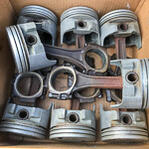
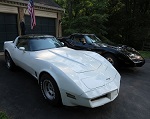



 weird 71 gets weirder