







Timing technique-which do you do?

Thread Starter
Drifting


Joined: Nov 2001
Posts: 1,469
Likes: 6
From: 68 427 4.11s Roadster
 Timing technique-which do you do?
I see a lot of degrees advice for timing. Do you set your timing to a value of degrees?
Or road test the car and set the timing that way.
Or road test the car and set the timing that way.
Drifting
Joined: Dec 2004
Posts: 1,345
Likes: 3
I start by setting to a high performance specification 12 degrees BTDC. If it knocks under load with the gas I normally run I back off 2 degrees at a time until it is OK. Once I know the sweet spot, I reset to that value when changing points, rotor, or cap.
Race Director


Joined: Aug 2004
Posts: 10,628
Likes: 132
From: Duvall, WA
Originally Posted by WhichVette?
I set to 36 degrees under full mechanical advance with the vacuum advance plugged, then adjust with road testing.

Racer

Joined: Dec 2003
Posts: 304
Likes: 0
From: Pasadena Maryland
I found from experience over the years to just set it to factory specs if you're running a stock engine. When you start to modify by changing cam's, valve trains, carbs, etc, etc you should then go with the total degree way which is usually 36 degree's on a SBC. Just went thru this with my son's 327 on his t-bucket. Seem's 34-36 total is fine. We're not running any vacuum advance so this is total in around 2800 RPM's.

Race Director

Joined: Dec 1999
Posts: 19,610
Likes: 778
From: Forked River NJ
If your dist. has over 30K miles on it just setting it to factory idle specs is not going to cut it. They wear out and the advance will be more than what is needed. Mine was supposed to give a total of 36 and it had over 50. The plate was worn after only 45K very badly. I took it to a guy with a dist machine to have it set up. I had 14 to 16 initial and 36 total. I am now working with vacuum cans to get the idle even better. I only pull about 10 inches at idle so a VC1810 can is going in. I am shooting for around 26 degrees at idle with the vacuum can running manifold vacuum. It idles very nicely at this timing. I have it set at 36 total and this seems to provide the best times at the strip and the best driving. I have never been able to get this motor to detonate. It has a lot of duration and only around 10 to 1 compression with aluminum heads. Every combo is going to be different and needs to be optimized. This is why Lars is so popular. He knows what he is doing when it comes to timing.

Drifting
Joined: Sep 2004
Posts: 1,532
Likes: 4
From: Fairview Heights Illinois, near Saint Louis MO, STL C3 Shark
Originally Posted by Gordonm
I had 14 to 16 initial and 36 total....... I have it set at 36 total and this seems to provide the best times at the strip and the best driving.
 afterwards. Of course I also freed up the stuck mech advance while I was at it so it was night and day.
Corvette Stories
The Best of Corvette for Corvette Enthusiasts

Top 10 Most Expensive Corvettes Ever Sold on Bring A Trailer
Brett Foote
10 Things Every Corvette Owner Needs (2026 Edition)
Michael S. Palmer
8 Most "Only Corvette Owners Understand" Quirks and Problems
Pouria Savadkouei
10 Reasons the C6 Z06 is Still A Performance Benchmark After 20 Years
Joe Kucinski
How Much Horsepower Every Corvette Engine "LOST" in 1972
Joe Kucinski
Top 10 DOs and DON'Ts for Protecting Your Convertible Top!
Michael S. Palmer
Top 10 Most Explosive Corvettes Ever Made: Power-to-Weight Ratio Ranked!
Joe Kucinski
150 hp to 1,250 hp: Every Corvette Generation Compared by the Specs That Matter
Joe Kucinski
8 Coolest Corvette Pace Cars (and Replicas) of All Time
Verdad Gallardo
Drifting

Joined: May 2005
Posts: 1,909
Likes: 6
From: Lake Arrowhead - Georgia > 72 Base Coupe & 74 BB Roadster
OK....Here's a curve ball for you. If I have a Pertronix Ignitor II installed ... Does the Pertronix module take care of the ADVANCE or do the springs still control the advance rate. My 72 calls for 8 degrees - I have it set at 10 degrees at idle with the vacuum capped during adjustment. Runs good - but I always look for ways to improve.
Thanks for any feedback.............
Thanks for any feedback.............
Race Director
Joined: Dec 1999
Posts: 19,610
Likes: 778
From: Forked River NJ
The Pertronix has nothing to do with the advance of the timing. It is controlled by the springs and weights and the vacuum advance. The Pertronix just sends the "fire" down the line to the plugs.

Instructor
Joined: Apr 2005
Posts: 101
Likes: 0
From: webster ny
79 vette timing
I would like to check the timing on my 79 vette.(42k miles) Its running ok, it just hasnt been done since???? (probably 15 years) I would like to set the timing for best performance with the fuel I use which is 91 -93 octane.
Should I just check it at idle per factory specs? is this good enough? From what I have read, you need to also check it at full advance, to see what the timing is at that point - is this correct? I read Lars paper, and it indicates that for a HEI ignition (which I think I have) you need to install a soft set of springs if you want to check timing at full advance. Where would I get softer springs? How are they identified? Thanks,
Hef
Should I just check it at idle per factory specs? is this good enough? From what I have read, you need to also check it at full advance, to see what the timing is at that point - is this correct? I read Lars paper, and it indicates that for a HEI ignition (which I think I have) you need to install a soft set of springs if you want to check timing at full advance. Where would I get softer springs? How are they identified? Thanks,
Hef
C6 the C5 of tomorrow

Joined: Nov 2000
Posts: 6,665
Likes: 2
From: Twin Cities Minnesota
Any vette engine will run better with the total timing set at ~36. But you may need to modify the mechanical advance...
spring can be had at NAPA, autozone etc. just ask for a distributor recurve kit.
spring can be had at NAPA, autozone etc. just ask for a distributor recurve kit.
Drifting
Joined: May 2005
Posts: 1,909
Likes: 6
From: Lake Arrowhead - Georgia > 72 Base Coupe & 74 BB Roadster
Originally Posted by fotyfobravo
OK....Here's a curve ball for you. If I have a Pertronix Ignitor II installed ... Does the Pertronix module take care of the ADVANCE or do the springs still control the advance rate. My 72 calls for 8 degrees - I have it set at 10 degrees at idle with the vacuum capped during adjustment. Runs good - but I always look for ways to improve.
Thanks for any feedback.............
Thanks for any feedback.............

Melting Slicks

Joined: Apr 2004
Posts: 2,083
Likes: 2
From: Montreal Qc.
I would like to check the timing on my 79 vette.(42k miles) Its running ok, it just hasnt been done since???? (probably 15 years) I would like to set the timing for best performance with the fuel I use which is 91 -93 octane.
Should I just check it at idle per factory specs? is this good enough? From what I have read, you need to also check it at full advance, to see what the timing is at that point - is this correct? I read Lars paper, and it indicates that for a HEI ignition (which I think I have) you need to install a soft set of springs if you want to check timing at full advance. Where would I get softer springs? How are they identified? Thanks,
Hef
Should I just check it at idle per factory specs? is this good enough? From what I have read, you need to also check it at full advance, to see what the timing is at that point - is this correct? I read Lars paper, and it indicates that for a HEI ignition (which I think I have) you need to install a soft set of springs if you want to check timing at full advance. Where would I get softer springs? How are they identified? Thanks,
Hef



Instructor
Joined: Apr 2005
Posts: 101
Likes: 0
From: webster ny
mechanical advance / vacuum advance
Originally Posted by Empatho
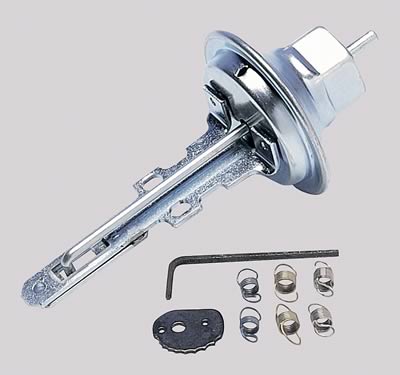
I used the Crane adjustable vacum advance kit

Pro

Joined: Sep 2004
Posts: 517
Likes: 0
Originally Posted by Hef
Ok there is mechanical advance and vacuum advance. If you have a manually adjustable vacuum advance kit like the one shown above, how does that help you adjust for the mechanical advance?
Drifting
Joined: Sep 2004
Posts: 1,532
Likes: 4
From: Fairview Heights Illinois, near Saint Louis MO, STL C3 Shark
adjustable vacuum advance helps you avoid the following:
lets say you set your intial timing to 16*, centrifugal is at 36* at 3000rpm so that is 16* plus 20* mech. Now if your crusing on interstate at 3000 rpms, you vacuum advance ALSO comes into play, if your vacuum advance pulls MORE than another 16*, you'll get MORE than 52* timing advance, any more than 52 and your in trouble with possibility of pinging etc, burnt pistons.
So if your vac advance would normally add 20*, you can adjust it to be a lower value of vac advance.
A "stock" smog 350 would be something like:
8* initial, 10* mech, + 20 vacuum for a total of 38* cruising
Make sense?
lets say you set your intial timing to 16*, centrifugal is at 36* at 3000rpm so that is 16* plus 20* mech. Now if your crusing on interstate at 3000 rpms, you vacuum advance ALSO comes into play, if your vacuum advance pulls MORE than another 16*, you'll get MORE than 52* timing advance, any more than 52 and your in trouble with possibility of pinging etc, burnt pistons.
So if your vac advance would normally add 20*, you can adjust it to be a lower value of vac advance.
A "stock" smog 350 would be something like:
8* initial, 10* mech, + 20 vacuum for a total of 38* cruising
Make sense?