



Rusty frame

Thread Starter
Advanced


Joined: Jun 2005
Posts: 97
Likes: 0
 Rusty frame
I'm restoring my 72 vette rusted frame, and not taking the body off to do it. Maybe one of you paint and body experts can answer a question.
I have been counseled that POR15, Eastwoods, Rustbullet etc paint does an excellent job on Rust, but my question is;
Is it best in the long haul to sand or blast the rust off where I can, or is it better to paint over the rust with one of the aforementioned paints?
Thanks to others who have already given their comments about painting over rust.
Thanks RGVette
I have been counseled that POR15, Eastwoods, Rustbullet etc paint does an excellent job on Rust, but my question is;
Is it best in the long haul to sand or blast the rust off where I can, or is it better to paint over the rust with one of the aforementioned paints?
Thanks to others who have already given their comments about painting over rust.
Thanks RGVette

Safety Car


Joined: Apr 2002
Posts: 4,653
Likes: 6
From: North Royalton, OH
St. Jude Donor '06-'07
It's always best when you can remove the rust entirely and coat the steel properly. BUT since you are doing this without removing the body, you will always have a layer of rust on the some parts of the top surface of the frame that will not get coated. This will compromise the whole paint system as far as longevity is concerned. Not removing the rust also leaves a rougher finish to the steel once painted, so aesthetics can play a role here. It is certainly easier to coat with an encapsulant and paint over that, but it will not look as good as a frame that has had the rust removed and painted as if new. I don't think that any way you go will show a lesser life span than the other, it will just depend on how you want the frame to look for that length of time and how much work you want to put into this effort. Sanding to smooth is time-consuming!
Thread Starter
Advanced
Joined: Jun 2005
Posts: 97
Likes: 0
Thanks for your insight about painting a rusted frame. Have you also found that you can treat the bare metal as well as those parts still rusted the same way before painting with an encapsulator?
Thanks RGvette
Thanks RGvette

Le Mans Master

Joined: Apr 1999
Posts: 6,134
Likes: 46
From: Raleigh North Carolina
As a Veteran of the War On Rust (Syracuse & Binghamton NY) I have 1st hand experience with frame rust. If it is severe, any form of coating will do you no good. The frame will eventually fail. One of mine broke off just behind the front tires when I hit a "whup" on Rt 81 near Cortland NY. The windshield craked in half very nicely right down the middle because of the stress.
Coating is okay if the rust has not affected the frames structural integrity.... otherwise it is just a temporary band-aid.
I just wanted to point this out in case you were thinking that products such as POR15 are a cure-all.
Depends on how severe the rust is. Frames rust from the inside out- you need to examine the INSIDE of the frame to see the true extent of the problem.
Just a heads up.
Coating is okay if the rust has not affected the frames structural integrity.... otherwise it is just a temporary band-aid.
I just wanted to point this out in case you were thinking that products such as POR15 are a cure-all.
Depends on how severe the rust is. Frames rust from the inside out- you need to examine the INSIDE of the frame to see the true extent of the problem.
Just a heads up.
Thread Starter
Advanced
Joined: Jun 2005
Posts: 97
Likes: 0
Thanks for the heads up and sorry about your experience in NY with the frame giving our and the window cracking from the stress.
Yes, the inside of the frame is also rusted, however I've found that it's surface rust and only in the rear end frame (surprisingly the front is just fine). I do believe there is no structural damage and that is why I want to treat it, so that perhaps I can at least slow down any further rusting.
Yes, the inside of the frame is also rusted, however I've found that it's surface rust and only in the rear end frame (surprisingly the front is just fine). I do believe there is no structural damage and that is why I want to treat it, so that perhaps I can at least slow down any further rusting.

Intermediate
Joined: Aug 2005
Posts: 49
Likes: 0
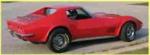
my experience with rust on a corvette is that it is worse on just those places you hardly can reach/see without a body off.. a tricky place you should look carefully the part of the frame infront of the rear wheel( the front side where the frame is bends up.. just try to pinch with something in the corners cause you probably can't see but feel id metal is still solid ( see pic)

another good place to check is the bodymount just infront of the door (inside doorpillar) .
and ofcourse... always better to sandblast then just put that encapsulator on it
and for the inside of the frame: spray wax
art-corvette
another good place to check is the bodymount just infront of the door (inside doorpillar) .
and ofcourse... always better to sandblast then just put that encapsulator on it
and for the inside of the frame: spray wax
art-corvette
Last edited by art-corvette; Aug 25, 2005 at 04:05 PM.
Intermediate

Joined: Nov 2003
Posts: 33
Likes: 0
From: Windsor ON
One thing that works well against rust is oil spray. I've had Oilgard sprayed on several of my non-vette cars and never had a rust problem.
I know there are some access holes in the frame but I don't know if it's possible to get the spray everywhere inside the frame. Has anyone ever had it done?
It's a bit messy but it will stop the inside-out rusting process completely if it can be applied.
I know there are some access holes in the frame but I don't know if it's possible to get the spray everywhere inside the frame. Has anyone ever had it done?
It's a bit messy but it will stop the inside-out rusting process completely if it can be applied.
Melting Slicks

Joined: Jul 2000
Posts: 2,848
Likes: 0
From: Beacon NY
Originally Posted by RGVette
Thanks for your insight about painting a rusted frame. Have you also found that you can treat the bare metal as well as those parts still rusted the same way before painting with an encapsulator?
Thanks RGvette
Thanks RGvette
I bought the complete system, but haven't tried any of the products yet. It'll probably be a few weeks before I get that far in my Corvette project.
Also, a while back, I read a post from a guy who lifted the body without removing it completely from the frame. (i.e. he removed the body mounts, suspended the frame off the ground, then lowered the frame/chasis several inches to give him clearance to work on the frame). When I paint my frame, I plan on doing sometihng similar to what he described.
His exact explanation is copied below (I'm sorry, but I don't remember which forum member originally wrote this):
"I needed to seperate the frame/body to mainly install new gas lines. I have a convertible, and to lift the body, it appears you need to remove the doors and replace the doors with rigid brace bars to support the rear of the body during a lift. To replace the gas lines you only to lift the body up 10 inches (?). It looked to me to be easier to just drop the frame if this was all the lift I needed.
..............
I started with the car sitting on its front wheels and the rear supported with a floor jack (rear wheels removed). I removed the #1, #2, and #4 body mount bolts and also I removed the radiator support to front crossmember bolts. Next I replaced the radiator support/front crossmember bolts with bolts about 8 inches long. This would allow the body/frame seperation at the radiator support but would prevent the body from moving sideways when I finally did the frame/body reattachment.
Next I first jacked the entire car up until the front wheels were about 6 inches off of the ground. (Two floor jacks) Then I began placing supports between the body and the ground. The idea was to support the body. For supports I used sections of 4" by 4" and 2" by 4" lumber. Also I bought 2000 lb bottle jacks from Sears (3 of them for $14). I built wooded supports for the tip of the nose, the rear storage compartment (wood supports for the compartment floor to ground). Also 4" by 4" supports across the floor of the passenger compartment to ground (actually after placing a wood beam under the compartment floor) and supporting this beam with a floor jack.
Now with the body supported, I removed the #3 body mount bolts and lowered the frame. The front wheels are supporting the frame in the front, and the rear of the frame is being supported at the differential with a floor jack. I have about 10 inches of frame seperation at the rear and about 6 inches at the front.
With this seperation, it was easy to replace the gas lines. I replaced the lines with stainless steel repro lines. (I've already installed repro ss brake lines). The gas tank was removed before the frame seperation. I installed a new gas tank and I think it was a lot easier with the body lifted. This amount of frame seperation is also sufficient to clean and paint the top of the frame under the bird cage.
..........
Lessons Learned. I had to increase the amount of structural support under the passenger compartment floor. The body is primarily supported at this location. It probably weighs about 1000 pounds with all the interior, the nose, and the doors, and this is a lot of weight for the fiberglass floor to support. Also...shim control!! Some shims remained attached to the body, and later fell to the ground. Also other shims fell to the ground. I was eventually able to sort out where the shims came from. Next time I'll be more watchful and drop the frame slower. Some extra eyes would be a good idea.
I did have my engine/transmission removed. That helped a little, but dropping the frame is not all that hard, just tedious unbolting all the bits and pieces. You have to seperate the master cylinder/brake lines so you'll have a brake bleed task ahead.
I did this all by myself with no help from anyone. I'm over 60 years old and just have normal upper body strength. The bottle and floor jacks do all jthe work!!!
I plan to rebuild a 70 Coupe. I probably do a traditional body lift. However,note that the frame drop technique doesn't require much space - you just need room to work the floor jacks around the car and you don't need much overhead."
hope that helps

Victor
Corvette Stories
The Best of Corvette for Corvette Enthusiasts

Every 2027 Corvette Engine Explained
Joe Kucinski
Designer Imagines A Corvette That Looks More Like a Corvette Than the Corvette
Verdad Gallardo
10 Ugly Corvettes That We Still Kinda Love
Joe Kucinski
Top 10 Most Expensive Corvettes Ever Sold on Bring A Trailer
Brett Foote
10 Things Every Corvette Owner Needs (2026 Edition)
Michael S. Palmer
8 Most "Only Corvette Owners Understand" Quirks and Problems
Pouria Savadkouei
10 Reasons the C6 Z06 is Still A Performance Benchmark After 20 Years
Joe Kucinski
How Much Horsepower Every Corvette Engine "LOST" in 1972
Joe Kucinski
Top 10 DOs and DON'Ts for Protecting Your Convertible Top!
Michael S. Palmer
Le Mans Master
Joined: Jun 2002
Posts: 8,339
Likes: 24
From: I can walk to MA
For longevity, a little surface rust is best for the encapsulants.
I have used POR15 for mine. Wirebrushing seems to be best for
this (get the chunks and flakes off).
Clean metal must be etched for POR15 to stick. MetalReady is
a phosphoric acid solution with zinc added. It will etch into the
surface of clean metal - giving a slightly rough surface for the
POR15 to grab onto. I have used alternative phosphoric acid
solutions: "A Must for Rust" and NavalJelly are my favorites.
The Naval Jelly sticks well to vertical surfaces.
Good Luck
I have used POR15 for mine. Wirebrushing seems to be best for
this (get the chunks and flakes off).
Clean metal must be etched for POR15 to stick. MetalReady is
a phosphoric acid solution with zinc added. It will etch into the
surface of clean metal - giving a slightly rough surface for the
POR15 to grab onto. I have used alternative phosphoric acid
solutions: "A Must for Rust" and NavalJelly are my favorites.
The Naval Jelly sticks well to vertical surfaces.
Good Luck

Safety Car
Joined: Aug 2001
Posts: 4,883
Likes: 11
From: North Easton Mass
I FINALLY started painting some of my parts with Rust Bullet and it sticks to bare metal as well as rusted without any special surface prep other than degreasing and washing. I have some Rust Encapsulator also, and while it sticks fine to rusted metal, it tended to leave a lot of brush marks on bare metal. Rust Encapsulator seemed to dry rather quickly also, but maybe I'm just too slow! The weather here last Sunday was extremely humid, and since Rust Bullet cures by absorbing moisture from the air, it cured fast also, but didn't present any problems with brushing. It goes on like a very thin paint.
I took a couple of pics of the parts I was working on before I started since I want to see how well Rust Bullet covers pitted areas. I'll be taking pics again this weekend after the second coat and I'll post pics of the before and after results.
Rick B.
I took a couple of pics of the parts I was working on before I started since I want to see how well Rust Bullet covers pitted areas. I'll be taking pics again this weekend after the second coat and I'll post pics of the before and after results.
Rick B.
Burning Brakes


Joined: Jul 2005
Posts: 866
Likes: 1
From: Northeast Ohio
[QUOTE=Blair Winch Project]I FINALLY started painting some of my parts with Rust Bullet and it sticks to bare metal as well as rusted without any special surface prep other than degreasing and washing. I have some Rust Encapsulator also, and while it sticks fine to rusted metal, it tended to leave a lot of brush marks on bare metal. Rust Encapsulator seemed to dry rather quickly also, but maybe I'm just too slow! The weather here last Sunday was extremely humid, and since Rust Bullet cures by absorbing moisture from the air, it cured fast also, but didn't present any problems with brushing. It goes on like a very thin paint.
I took a couple of pics of the parts I was working on before I started since I want to see how well Rust Bullet covers pitted areas. I'll be taking pics again this weekend after the second coat and I'll post pics of the before and after results.
 Rust Bullet is definetly the way to go for bare metal. POR 15 likes rust. Bullet behaves more like regular paint. It does chip easier and is less tough than the POR though.
Also, I think if you multi coat with the bullet and sand between it fills nicely. POR does not sand well as it tends to "pill" or "edge roll" when it gets this (on bare metal as I sand blast all my parts and do the marine and do the metal ready etc.) Bullet is one step and done. Again , not as durable IMO though.
I took a couple of pics of the parts I was working on before I started since I want to see how well Rust Bullet covers pitted areas. I'll be taking pics again this weekend after the second coat and I'll post pics of the before and after results.
Rust Bullet is definetly the way to go for bare metal. POR 15 likes rust. Bullet behaves more like regular paint. It does chip easier and is less tough than the POR though.Also, I think if you multi coat with the bullet and sand between it fills nicely. POR does not sand well as it tends to "pill" or "edge roll" when it gets this (on bare metal as I sand blast all my parts and do the marine and do the metal ready etc.) Bullet is one step and done. Again , not as durable IMO though.
Last edited by dboz; Aug 25, 2005 at 10:36 PM.
Safety Car
Joined: Aug 2001
Posts: 4,883
Likes: 11
From: North Easton Mass
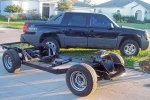
I've been gaining experience with Rust Bullet over the last couple of weeks - the frame is ~75% finished with the first coat and the front control arms and radiator support are done. It sticks very well to the brown areas - my son hit a couple of painted areas with the grinder/wire wheel and the bullet stayed put. I did manage to knock off a couple of chips from a surface that was previously bare metal so there may be some inspection/maintenance of the chassis required over time.
With the weather being much less humid the drying time is longer but the parts are still dry to the touch after a couple of hours.
I started topcoating a couple of pieces with Eastwood Chassis Black and the finished result looks very nice. The silver of the undercoat shows through the black a little and looks almost like a metallic black. The gloss of the Eastwood paint really does nail the factory look.
Rick B.
With the weather being much less humid the drying time is longer but the parts are still dry to the touch after a couple of hours.
I started topcoating a couple of pieces with Eastwood Chassis Black and the finished result looks very nice. The silver of the undercoat shows through the black a little and looks almost like a metallic black. The gloss of the Eastwood paint really does nail the factory look.
Rick B.
Safety Car
Joined: Jun 2002
Posts: 4,135
Likes: 1
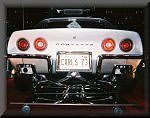
look at the condition of my frame (unseen with body on) when we pulled the body on this cheesey web site-------http://www.geocities.com/carlclub2/------i never thought it would be as bad as it was,threw it away and got a new one!! used por-15 and top coat of g.m. chassis black,,,,,,then sent the frame to a z bart dealer ,,,coated the inside of frame ,,,built chassis ,,dropped body and took it back to another z bart dealer to let someone else catch what the first guy may have missed
Last edited by carl a; Sep 30, 2005 at 09:26 PM.
Melting Slicks


Joined: May 2005
Posts: 2,486
Likes: 71
From: Elkhart Lake, Wisconsin
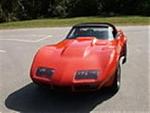
So I am taking my 69 vert apart for a rebuild. It had sat for 20 years in a garage but had a new frame put under it before it was garaged for those years. There are just a few spots with some surface rust otherwise it's nearly new. I was going to just wire brush the surface rust and put Eastwood Extreme Chassis black epoxy over the cleaned frame. I will also spray POR or somethink like it inside the frame rails. Will this be adequate or should I use something as a primer before I put the epoxy on?
Melting Slicks
Joined: Jul 2004
Posts: 3,248
Likes: 48
From: westland mi
i did my whole rearend w/por-15 including the frame(frame on) and the shell, trays, and wheelwells. i took everything apart and sandblasted it then etched em then a coat of por-15 then topcoated em. on the frame i took it down to bare metal w/a diegrinder then etched it then por-15 and then topcoated it. the stuff is awesome. even put it on the underside of my tilt front end. i did the rear and the shell and the trans crossmember using 3/4 of a pint. it goes a long way.

