




Piston question

Thread Starter
Team Owner


Joined: Apr 2002
Posts: 62,198
Likes: 1
From: All humans are vermin in the eyes of Guru VA
Cruise-In IV Veteran
Cruise-In V Veteran
 Piston question
What the hell are gas ports?
something about holes around the rings or something. What do they do?
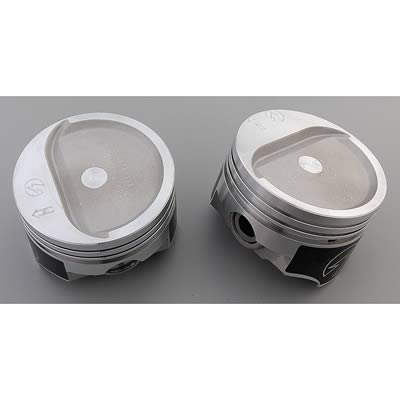
something about holes around the rings or something. What do they do?

Drifting

Joined: Sep 2004
Posts: 1,959
Likes: 1
From: North Bend Ohio
Gas ports were small holes drilled from the piston top to the inner edge of the top ring land. This applied combustion pressure directly to the top ring to improve sealing. This is a racing thing.
BigBlockk
Later.....
BigBlockk
Later.....
Burning Brakes

Joined: Feb 2005
Posts: 894
Likes: 91
Gas Ports vs. Street Cars
Originally Posted by Guru_4_hire
is it worth the trouble on a street car?
P.S. The "average all around street unit" dosen't need them however.

Drifting
Joined: Jul 2001
Posts: 1,418
Likes: 1
Since you did not post a pic of pistons with gas ports , did you actually mean to ask about pistons and designs that use accumulator grooves ?
Originally Posted by Guru_4_hire
What the hell are gas ports?
something about holes around the rings or something. What do they do?
something about holes around the rings or something. What do they do?
Thread Starter
Team Owner
Joined: Apr 2002
Posts: 62,198
Likes: 1
From: All humans are vermin in the eyes of Guru VA
Cruise-In IV Veteran
Cruise-In V Veteran
I dont actually know why I posted that picture except that those are the pistons I plan on buying.
Are accumulator grooves and gas ports the same thing?
Are accumulator grooves and gas ports the same thing?
Corvette Stories
The Best of Corvette for Corvette Enthusiasts

Top 10 Most Expensive Corvettes Ever Sold on Bring A Trailer
Brett Foote
10 Things Every Corvette Owner Needs (2026 Edition)
Michael S. Palmer
8 Most "Only Corvette Owners Understand" Quirks and Problems
Pouria Savadkouei
10 Reasons the C6 Z06 is Still A Performance Benchmark After 20 Years
Joe Kucinski
How Much Horsepower Every Corvette Engine "LOST" in 1972
Joe Kucinski
Top 10 DOs and DON'Ts for Protecting Your Convertible Top!
Michael S. Palmer
Top 10 Most Explosive Corvettes Ever Made: Power-to-Weight Ratio Ranked!
Joe Kucinski
150 hp to 1,250 hp: Every Corvette Generation Compared by the Specs That Matter
Joe Kucinski
8 Coolest Corvette Pace Cars (and Replicas) of All Time
Verdad Gallardo
Drifting
Joined: Jul 2001
Posts: 1,418
Likes: 1
Originally Posted by Guru_4_hire
Are accumulator grooves and gas ports the same thing?
Go to the KB website . The info there will tell you some more about the accumulator grooves and what they do .
KB is not the only piston makers using the accumulator grooves FWIW . JE uses them on certain pistons as well .

Race Director


Joined: Dec 1999
Posts: 16,945
Likes: 9
the piston he posted doesn't have either an accumulator groove or vertical gas ports (an accumulator groove is basically a groove in the 2nd ring land to increase volume there and reduce pressure differential from blowby gas between top and 2nd ring)
Can't see from that angle if it has lateral gas ports but I suspect it has neither.
Can't see from that angle if it has lateral gas ports but I suspect it has neither.
Thread Starter
Team Owner
Joined: Apr 2002
Posts: 62,198
Likes: 1
From: All humans are vermin in the eyes of Guru VA
Cruise-In IV Veteran
Cruise-In V Veteran
OK so any piston I would buy could have gas ports machined into them.
Thats cool. The speed-pro doesnt come with either. what is the benefit of the accumulator groove? Is there a benefit to the a KB piston versus the speed-pro except for the groove?
Thats cool. The speed-pro doesnt come with either. what is the benefit of the accumulator groove? Is there a benefit to the a KB piston versus the speed-pro except for the groove?

Melting Slicks

Joined: May 2001
Posts: 2,131
Likes: 4
From: May help you? You can sure as hell try!
The accumulator groove is a circumferential groove machined in the ring land between the top and 2nd rings. The purpose of it is to balance the gas pressures above and below the top ring. This helps keep the top ring from lifting off of the bottom of the top ring groove which can cause it to lose it's seal and consume more oil. These are used to prevent "ring flutter" at high RPM's where the inertia forces on the ring are very high. Definitely a good idea for any performance oriented street motor.
The gas ports are an old idea with little merit IMO. Small holes are drilled through the piston tops and into the root of the top ring groove. The idea (in theory) is to direct the combustion pressure to push on the back of the ring to force it against the bore wall and (supposedly) improve ring seal. The truth of the matter is there is plenty of clearance between the top land and cylinder bore for the combustion gases to get behind the ring, forcing it to the bottom of the groove and also into the cylinder wall to seal.
The reality is these ports add nothing to ring seal and at worst weaken the top land by introducing stress risers due to the small holes. If not done correctly, they can even disrupt the ring seal by causing it to lift off the bottom the groove. Dumb idea for a street motor, or a racing motor, for that matter. I'm putting on the flame suit for all the racing "experts" out there who have drilled little holes in the tops of all their pistons.
The gas ports are an old idea with little merit IMO. Small holes are drilled through the piston tops and into the root of the top ring groove. The idea (in theory) is to direct the combustion pressure to push on the back of the ring to force it against the bore wall and (supposedly) improve ring seal. The truth of the matter is there is plenty of clearance between the top land and cylinder bore for the combustion gases to get behind the ring, forcing it to the bottom of the groove and also into the cylinder wall to seal.
The reality is these ports add nothing to ring seal and at worst weaken the top land by introducing stress risers due to the small holes. If not done correctly, they can even disrupt the ring seal by causing it to lift off the bottom the groove. Dumb idea for a street motor, or a racing motor, for that matter. I'm putting on the flame suit for all the racing "experts" out there who have drilled little holes in the tops of all their pistons.

Race Director


Joined: Apr 2000
Posts: 17,676
Likes: 201
From: Who says "Nothing is impossible" ? I've been doing nothing for years.
Another thing those pistons won't have after a 1000 miles is that coating on the sides. 
SpeedPro makes good pistons but that coating tends to come off. I chose to get the uncoated version when I built my motor after I saw a set of pistons at the machine shop that had the coating worn off and the motor has to be redone
SpeedPro makes good pistons but that coating tends to come off. I chose to get the uncoated version when I built my motor after I saw a set of pistons at the machine shop that had the coating worn off and the motor has to be redone
Thread Starter
Team Owner
Joined: Apr 2002
Posts: 62,198
Likes: 1
From: All humans are vermin in the eyes of Guru VA
Cruise-In IV Veteran
Cruise-In V Veteran
I was gonna have them coated by Swaintech in NY. They do some NASCAR truck series engines. how do you get the ones without the coating? Expecially since I want their turbo dish pistons.
Drifting
Joined: Jul 2001
Posts: 1,418
Likes: 1
Don't worry about trying to obtain that piston w/o the skirt coating .
Swaintech only coats the piston skirts with a exact or similar coating and applies the ceramic thermal barrier to the piston top .
Just have the ceramic thermal barrier added if thats your intentions . The other coating comes for free ... more or less .
Swaintech only coats the piston skirts with a exact or similar coating and applies the ceramic thermal barrier to the piston top .
Just have the ceramic thermal barrier added if thats your intentions . The other coating comes for free ... more or less .

Le Mans Master


Joined: Dec 2003
Posts: 5,727
Likes: 38
From: Fremont CA
I wouldn't want to use gas ports on any long term motor I would build. They are fine for Drag Racing but no one else uses this technology for engines (they are not seen in Nextel cup, road race or other racing series.) They will "kill" top rings and then the small diameter holes in the piston will fill up with carbon and the ring seal will be much worse than if you had gone with a conventional ring set-up. I would also stay away from thin ring packages on a street/strip type engine.