







Spal Wiring

Former Vendor
Joined: Jan 2000
Posts: 5,593
Likes: 631
From: Brighton

Originally Posted by tersian
Tom,
Can I wire this into the old supplied sender and I see you need an additional relay to control a second fan, I am assuming I can re-use the relay I currently have from your original setup?
Can I wire this into the old supplied sender and I see you need an additional relay to control a second fan, I am assuming I can re-use the relay I currently have from your original setup?
I don't know what type of sender you have but the 195 & 185 switches that we used to supply with the harnesses will not work with the controller. These were "switches" which are on/off devices. The controller works with an analog device that varies the signal (ohms). If you have this type of device, it should work ok. The controller comes with a standard GM type oval (two prong) connector. If your's is a single prong, simply cut the plug off, and use the green wire only to your sender.
Melting Slicks


Joined: Nov 2001
Posts: 2,668
Likes: 43
From: Eastern US XX
Originally Posted by Tom DeWitt
You can (actually must) use the relay harness with the controller for dual fans. When you use a controller with dual fans you should wire one fan (primary) with the controller, and the second fan (secondary) with the relay harness. The control will ramp the primary fan speed up until it gets to full speed, then it kicks the relay harness on and the second fan goes on full. The primary fan drops down and begins the ramping again as required.
I don't know what type of sender you have but the 195 & 185 switches that we used to supply with the harnesses will not work with the controller. These were "switches" which are on/off devices. The controller works with an analog device that varies the signal (ohms). If you have this type of device, it should work ok. The controller comes with a standard GM type oval (two prong) connector. If your's is a single prong, simply cut the plug off, and use the green wire only to your sender.
I don't know what type of sender you have but the 195 & 185 switches that we used to supply with the harnesses will not work with the controller. These were "switches" which are on/off devices. The controller works with an analog device that varies the signal (ohms). If you have this type of device, it should work ok. The controller comes with a standard GM type oval (two prong) connector. If your's is a single prong, simply cut the plug off, and use the green wire only to your sender.

Melting Slicks
Joined: Dec 2005
Posts: 2,441
Likes: 0
Flex-a-lite has a similar product available at summit p/n FLX-31165.
*soft start ramp-up eliminates sudden start-up shock to electrical system
*adjustable on/off settings
*30 second run after engine shut-off
*30 amp rated
*under $80.00
*you don't need an extra relay
*no I don't work for summit or flex-a-lite
I have this on my car driving Becool's dual 11" set-up (spal fans), works great.
*soft start ramp-up eliminates sudden start-up shock to electrical system
*adjustable on/off settings
*30 second run after engine shut-off
*30 amp rated
*under $80.00
*you don't need an extra relay
*no I don't work for summit or flex-a-lite
I have this on my car driving Becool's dual 11" set-up (spal fans), works great.

Pro

Joined: Aug 2002
Posts: 560
Likes: 0
From: The Valley of The Sun AZ
Originally Posted by Tom DeWitt
I don't know what type of sender you have but the 195 & 185 switches that we used to supply with the harnesses will not work with the controller. These were "switches" which are on/off devices. The controller works with an analog device that varies the signal (ohms). If you have this type of device, it should work ok. The controller comes with a standard GM type oval (two prong) connector. If your's is a single prong, simply cut the plug off, and use the green wire only to your sender.
I have the old type on/off sender with the threaded nut on the top. I replaced my standard GM temp sender with it and now I can't find it. So now I have to buy a standard GM sender from you(or GM) to replace the one I bought from you to run the PWM unit I'm going to buy from you. I think I see a trend here

Thanks for the info Tom.

Pro


Joined: May 2005
Posts: 745
Likes: 0
From: Miami Florida
i havent really investigated how its wired, but mine come on with the ignition key. i never really questioned this as in miami, we almost always run the ac and for the most part, ambient air is above 80.. were in the coldest part of the year now and it was still 76 by 3pm . can there be any problem with this? running them always?
Corvette Stories
The Best of Corvette for Corvette Enthusiasts

Top 10 Most Expensive Corvettes Ever Sold on Bring A Trailer
Brett Foote
10 Things Every Corvette Owner Needs (2026 Edition)
Michael S. Palmer
8 Most "Only Corvette Owners Understand" Quirks and Problems
Pouria Savadkouei
10 Reasons the C6 Z06 is Still A Performance Benchmark After 20 Years
Joe Kucinski
How Much Horsepower Every Corvette Engine "LOST" in 1972
Joe Kucinski
Top 10 DOs and DON'Ts for Protecting Your Convertible Top!
Michael S. Palmer
Top 10 Most Explosive Corvettes Ever Made: Power-to-Weight Ratio Ranked!
Joe Kucinski
150 hp to 1,250 hp: Every Corvette Generation Compared by the Specs That Matter
Joe Kucinski
8 Coolest Corvette Pace Cars (and Replicas) of All Time
Verdad Gallardo
Melting Slicks
Joined: Dec 2005
Posts: 2,441
Likes: 0
Originally Posted by Tom DeWitt
Puller fans are like vacuum cleaners, sucking air through the radiator core. Spal lists a range of air flow/amperage for different restrictions in front of the fan. The thicker the radiator or density of fin, the higher the restriction. The higher the restriction, the higher the amp draw. Just like when you put your hand over the vacuum hose, you can hear that motor scream. In most cases, you can use the middle of the range to estimate your air flow/amperage unless of course you're doing something really special.

Drifting

Joined: Nov 2002
Posts: 1,665
Likes: 1
From: Ontario
Originally Posted by shafrs3
Well I said that makes perfect sense but after a second thought I don't think the vacuum cleaners motor is screaming because of a greater load, it's screaming because of the lack of load; it has no air to pump and is freewheeling. And if that is true the amperage draw should go down.
Apply Voltage to an electric motor, put an ammeter in series with it and squeeze the shaft with your fingers as it spins. You will see that the current reading will rise. Your fingers squeezing the shaft increases the load on the motor.
In its most basic form: Power = Voltage * Current. By squeezing the rotating shaft you are demanding more power from the motor. Voltage stays constant so Current must rise in order for Power to rise.

Melting Slicks
Joined: Dec 2005
Posts: 2,441
Likes: 0
Originally Posted by Boofers
The term load implies opposing force. The more restriction to airflow, the higher the load.
Apply Voltage to an electric motor, put an ammeter in series with it and squeeze the shaft with your fingers as it spins. You will see that the current reading will rise. Your fingers squeezing the shaft increases the load on the motor.
In its most basic form: Power = Voltage * Current. By squeezing the rotating shaft you are demanding more power from the motor. Voltage stays constant so Current must rise in order for Power to rise.
Apply Voltage to an electric motor, put an ammeter in series with it and squeeze the shaft with your fingers as it spins. You will see that the current reading will rise. Your fingers squeezing the shaft increases the load on the motor.
In its most basic form: Power = Voltage * Current. By squeezing the rotating shaft you are demanding more power from the motor. Voltage stays constant so Current must rise in order for Power to rise.
If you loose some suction, you'll loose some of the load, if you loose all suction you'll loose all load. Your right, squeezing the shaft would increase load.
Last edited by shafrs3; Jan 16, 2006 at 07:46 PM.
&amp;quot;Rodstoration &am p;quot; In Progres

Joined: Jun 2004
Posts: 1,397
Likes: 1
From: Frisco TX
Originally Posted by Tom DeWitt
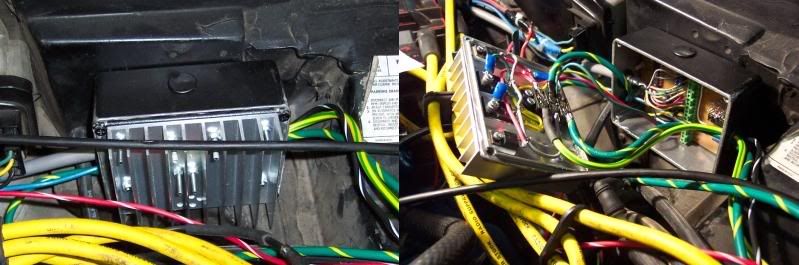
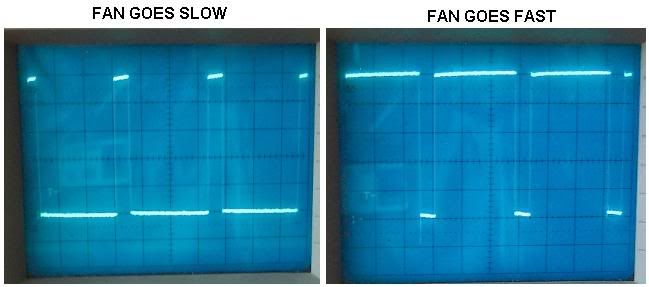
We have now changed to standardize on the SPWM (controller) for our fan controls. The older relay package and switch is still available but I think Spal will eventually drop it because the controller does so much more. The SPWM controls one fan by itself and for dual fans you need to buy the extra relay harness (SPFRH). You never want to wire the fans together or in series. Each fan should be individually fused and protected so you loose a fuse, not a fan.
The SPWM will ramp the fan speed as needed instead of running full blast. It is also capable of using the stock temp (gauge) sending units so you do not have to install anything into the engine, simply tap off the gauge sender. The controller has a two-prong plug for the sender and a lot of the older ones are single. This can still work by using the green wire only. But just to make sure that you are not going to have trouble, we now include a two prong switch with each controller. When you run two fans (duals) the controller works in conjunction with a relay harness. You then have a primary and secondary system. The controller ramps up the primary fan and if it gets to full speed, then it kicks on the seconday fan and starts ramping the primary again. It has auto AC accuation if you have that feature. Direct link
The SPWM will ramp the fan speed as needed instead of running full blast. It is also capable of using the stock temp (gauge) sending units so you do not have to install anything into the engine, simply tap off the gauge sender. The controller has a two-prong plug for the sender and a lot of the older ones are single. This can still work by using the green wire only. But just to make sure that you are not going to have trouble, we now include a two prong switch with each controller. When you run two fans (duals) the controller works in conjunction with a relay harness. You then have a primary and secondary system. The controller ramps up the primary fan and if it gets to full speed, then it kicks on the seconday fan and starts ramping the primary again. It has auto AC accuation if you have that feature.
Direct link
