








Intake manifold THEORY. Rough vs Smooth

Thread Starter
Burning Brakes

Joined: Oct 2001
Posts: 1,185
Likes: 0
From: New Wilmington PA
 Intake manifold THEORY. Rough vs Smooth
I've heard that when modifying an intake manifold or head on the intake side a rough finish should be left behind.
The explanation given was that the rough surface helped airflow (like dimples on a golf ball) and prevented the fuel from settling out of the airstream.
From the pictures I've found online of LS1 and LS6 intake manifolds they seem really smooth. Granted, their shape is specially designed to take advantage of the ports on those heads but the smoothness is what gets me.
With fuel injection, is the rough finish a tradeoff? Now that fuel doesn't need to be suspended in the stream, would a smooth finish inside a manifold be beneficial?
What originally made me start looking for why intakes could have a rough finish is the manifold that came with my fuel injection setup. It had the texture of 80 grit sandpaper.


Any thoughts?
The explanation given was that the rough surface helped airflow (like dimples on a golf ball) and prevented the fuel from settling out of the airstream.
From the pictures I've found online of LS1 and LS6 intake manifolds they seem really smooth. Granted, their shape is specially designed to take advantage of the ports on those heads but the smoothness is what gets me.
With fuel injection, is the rough finish a tradeoff? Now that fuel doesn't need to be suspended in the stream, would a smooth finish inside a manifold be beneficial?
What originally made me start looking for why intakes could have a rough finish is the manifold that came with my fuel injection setup. It had the texture of 80 grit sandpaper.
Any thoughts?

Burning Brakes


Joined: Nov 2004
Posts: 1,193
Likes: 176
From: Hillsborough NC
I have heard and read the same things regarding the intake in Vizard's books. Your'e supposed to leave the surface rough to generate turbulance in the flow. It's the turbulance that is supposed to help the atomized fuel particles stay suspended in the air while in the manifold.
With fuel injection (where the injectors are right near the valves), that doesn't seem to be a requirement and I would agree that it would seem like less turbulance equates to more flow and more power.
With fuel injection (where the injectors are right near the valves), that doesn't seem to be a requirement and I would agree that it would seem like less turbulance equates to more flow and more power.

Race Director


Joined: Sep 2004
Posts: 11,874
Likes: 263
From: Arlington Va Current ride 04 vert, previous vettes: 69 vert, 77 resto mod
i thought dimples in the golf ball made it spin....any way Vizard seems to know his sh*t , and i would listen to his comments

Le Mans Master


Joined: May 2005
Posts: 9,996
Likes: 0
From: if you have a ? on my avatar, please contact me directly, you spineless twit
St. Jude Donor '09
Originally Posted by bobs77vet
i thought dimples in the golf ball made it spin....any way Vizard seems to know his sh*t , and i would listen to his comments
The dimples on a golf ball do help it spin, by catching the air and creating the turbulence mentioned above, the same way the seams on a baseball help the ball 'break' while throwing a curve, and in the essence, from what I've read, creating that same type of turbulence, helping keep the air/fuel mixed, rather than the fuel puddling (however small those puddles might be) in the intake when they should be flowing down into the combustion chamber.
At least that's the way I understand it.

Instructor


Joined: Sep 2005
Posts: 241
Likes: 0
From: St Louis Missouri
It has been a long time since I took fluid dynamics, but if memory serves the air moves so fast in the runners of the intake it has a Renalds number that makes it turbulent. One can not compare the roughness of an intake to the dimples of a golf ball. The golf ball has smooth dimples while the intake has a jagged surface.
The velocity of air at the surface of the intake is 0 regardless of the texture of the surface. The reason that people don’t smooth out the intake more is that it is a pain in the a@@.
The velocity of air at the surface of the intake is 0 regardless of the texture of the surface. The reason that people don’t smooth out the intake more is that it is a pain in the a@@.
Corvette Stories
The Best of Corvette for Corvette Enthusiasts

Top 10 Most Expensive Corvettes Ever Sold on Bring A Trailer
Brett Foote
10 Things Every Corvette Owner Needs (2026 Edition)
Michael S. Palmer
8 Most "Only Corvette Owners Understand" Quirks and Problems
Pouria Savadkouei
10 Reasons the C6 Z06 is Still A Performance Benchmark After 20 Years
Joe Kucinski
How Much Horsepower Every Corvette Engine "LOST" in 1972
Joe Kucinski
Top 10 DOs and DON'Ts for Protecting Your Convertible Top!
Michael S. Palmer
Top 10 Most Explosive Corvettes Ever Made: Power-to-Weight Ratio Ranked!
Joe Kucinski
150 hp to 1,250 hp: Every Corvette Generation Compared by the Specs That Matter
Joe Kucinski
8 Coolest Corvette Pace Cars (and Replicas) of All Time
Verdad Gallardo
Pro

Joined: Jan 2006
Posts: 548
Likes: 0
Originally Posted by Hauq`
It has been a long time since I took fluid dynamics, but if memory serves the air moves so fast in the runners of the intake it has a Renalds number that makes it turbulent. One can not compare the roughness of an intake to the dimples of a golf ball. The golf ball has smooth dimples while the intake has a jagged surface.
The velocity of air at the surface of the intake is 0 regardless of the texture of the surface. The reason that people don’t smooth out the intake more is that it is a pain in the a@@.
The velocity of air at the surface of the intake is 0 regardless of the texture of the surface. The reason that people don’t smooth out the intake more is that it is a pain in the a@@.

Le Mans Master
Joined: Feb 1999
Posts: 6,807
Likes: 0
From: Hoosier
Cruise-In III Veteran
Originally Posted by Nemesis_152
that's kinda what i was thinking. you're not going to smotth it to the point that you get laminar flow. the reynolds number will still be in the turbulent range (what is it, > 500,000 or something like that?). I dont really see fuel puddling in there, but i'd love to see some tests to verify anybody's theories.

Team Owner


Joined: Apr 1999
Posts: 21,953
Likes: 1,445
From: Reno Nevada
2024 C3 of the Year Finalist- Modified
Dry airflow should be mirror polished to get the most flow out of a given Intake runner.
Wet air flow "with fuel suspended" requires turbulance and heat to keep the fuel a mist instead of dropletts.
It's apples and oranges trying to compare a carburated single plane manifold to a dry air ported and polished Super Ram or LS1-lS6 intake.
You have to think about intake dynamics. For more than 1/2 the time in a running 4 cycle motor no air is moving in the intake port
Wet air flow "with fuel suspended" requires turbulance and heat to keep the fuel a mist instead of dropletts.
It's apples and oranges trying to compare a carburated single plane manifold to a dry air ported and polished Super Ram or LS1-lS6 intake.
You have to think about intake dynamics. For more than 1/2 the time in a running 4 cycle motor no air is moving in the intake port
Last edited by gkull; Jan 31, 2006 at 03:45 PM.


Thread Starter
Burning Brakes
Joined: Oct 2001
Posts: 1,185
Likes: 0
From: New Wilmington PA
VERY interesting posts guys. Thank you very much. The consensus seems to be that the roughness was important when everyone was carbed but now that all new cars are FI it isn't really critical one way or the other.
I realize that comparing an LS6 intake to an old school manifold on the basis of roughness alone would be silly and there are obviously different dynamics at play on the large scale. I haven't had fluid dynamics yet (I think that's 3rd year, I'm still in my first) but it is one class I really look forward to.
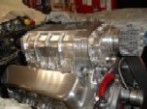
This manifold is an EFI manifold despite its old-school design. I am considering smoothing it up next spring.
Norval, judging by the size of that bolt hole those must be HUGE. Looks nice.
Again, big thanks to everyone, I really appreciate it.
I realize that comparing an LS6 intake to an old school manifold on the basis of roughness alone would be silly and there are obviously different dynamics at play on the large scale. I haven't had fluid dynamics yet (I think that's 3rd year, I'm still in my first) but it is one class I really look forward to.
This manifold is an EFI manifold despite its old-school design. I am considering smoothing it up next spring.
Norval, judging by the size of that bolt hole those must be HUGE.
Looks nice. Again, big thanks to everyone, I really appreciate it.
Team Owner
Joined: Apr 1999
Posts: 21,953
Likes: 1,445
From: Reno Nevada
2024 C3 of the Year Finalist- Modified
Norval can get away with smooth intake tracks. Because Super Chargers with dual top mounted carbs really get the fuel whipped up going through high speed compressor vains.
 Sure is fun to look at though.

Burning Brakes
Joined: Jun 2000
Posts: 892
Likes: 0
From: GA
Not sure about the intake surface but I remember from physics class about the golf ball. The dimples are not so much for spin but rather distance and drag reduction. The dimples help with aerodynamics believe it or not. Without the dimples the laminar air flow around the golf ball separates and this separation of the boundry layer increases drag. By adding dimples to the golf ball it is easier to turbulate the boundry layer which is less likely to separate. By keeping the air closer to the surface of the ball, it produces less drag and allows it to travel fast and futher. Not sure how this applies to the intake and fuel but for golf *****, it is all about distance and drag.
I would think for an intake, smooth would work better. I say this because of velocity... and extrude honing. Isn't it to make the inside of the piece smooth? Our headers are smooth so I would think it is about velocity of air flow? Again, just my thoughts on the intake...
I would think for an intake, smooth would work better. I say this because of velocity... and extrude honing. Isn't it to make the inside of the piece smooth? Our headers are smooth so I would think it is about velocity of air flow? Again, just my thoughts on the intake...
