







Engine work...suggestions?

Thread Starter
Racer


Joined: Jun 2004
Posts: 376
Likes: 0
From: Va
 Engine work...suggestions?
I have a 71 coupe with a small block that just turned 60K miles and needs a good cleaning. It has light rust and some leaks that need to be addressed. I was planning to pull it and replace with a crate of some sort to get a little more kick, but quickly learned, I need to save a few more bucks before I take that plunge. So now I think I'd like to pull it, clean it and put it back in until I can afford a ZZ4. That being the case, what should I replace while it's out? I'd like to keep it original as possible, so I'm not looking to build it, but figure there are probably some seals or gaskets that I can replace while it's out and easy to get to. Never done this before so I appreciate any recommendations and ideas...
peter
peter

Le Mans Master

Joined: Apr 1999
Posts: 6,134
Likes: 46
From: Raleigh North Carolina
Pick up an engine stand if you don't already have one.
You might as well buy a complete gasket set instead of onesies & twosies. A complete set includes front & rear crank seals. Once you get the engine out, and on a stand, you probably won't be able to resist pulling the heads. But before you do, realize that you'll need a torque wrench to put it back together.
Check the harmonic damper for damage/separation between the hub and the outer ring... see if it has spun or moved.
Uh oh.... here we go $$$
60K miles.... probably could use a timing chain & gear set.
If the valve train is quiet, then you can probably clean it up & re-use it. It won't be "perfect", but it may be okay. The lifters are probably full of sediment... they can be disassembled & cleaned. Re-used valve train parts must be put back in the exact same place they came from... wear patterns. So you'll have to be "organized". You can get away cheap here if you show some restraint... most people can't.
You'll have to make some judgement calls as well.... if you miss something that is on its way out, you may end up pulling the engine again in a short while.
You might as well buy a complete gasket set instead of onesies & twosies. A complete set includes front & rear crank seals. Once you get the engine out, and on a stand, you probably won't be able to resist pulling the heads. But before you do, realize that you'll need a torque wrench to put it back together.
Check the harmonic damper for damage/separation between the hub and the outer ring... see if it has spun or moved.
Uh oh.... here we go $$$
60K miles.... probably could use a timing chain & gear set.
If the valve train is quiet, then you can probably clean it up & re-use it. It won't be "perfect", but it may be okay. The lifters are probably full of sediment... they can be disassembled & cleaned. Re-used valve train parts must be put back in the exact same place they came from... wear patterns. So you'll have to be "organized". You can get away cheap here if you show some restraint... most people can't.
You'll have to make some judgement calls as well.... if you miss something that is on its way out, you may end up pulling the engine again in a short while.
Thread Starter
Racer
Joined: Jun 2004
Posts: 376
Likes: 0
From: Va
Tom,
Thanks for the info. I've never done this before but am eager to jump in. Figure I better have a plan and do some research before this little project turns into a nightmare.
Can you recommend a good book to help along the way? And, can you think of anything else that starts with, "DON'T DO THIS...."
All your input is greatly appreciated.
peter
Thanks for the info. I've never done this before but am eager to jump in. Figure I better have a plan and do some research before this little project turns into a nightmare.
Can you recommend a good book to help along the way? And, can you think of anything else that starts with, "DON'T DO THIS...."
All your input is greatly appreciated.
peter
Le Mans Master
Joined: Apr 1999
Posts: 6,134
Likes: 46
From: Raleigh North Carolina
Originally Posted by raider21
Tom,
Thanks for the info. I've never done this before but am eager to jump in. Figure I better have a plan and do some research before this little project turns into a nightmare.
Can you recommend a good book to help along the way? And, can you think of anything else that starts with, "DON'T DO THIS...."
All your input is greatly appreciated.
peter
Thanks for the info. I've never done this before but am eager to jump in. Figure I better have a plan and do some research before this little project turns into a nightmare.
Can you recommend a good book to help along the way? And, can you think of anything else that starts with, "DON'T DO THIS...."
All your input is greatly appreciated.
peter
There are loads of good books out there on Chevy engines. Even if you end up farming out the work, reading the book(s) will give you great insight into
what is involved in engine work. Check out the lit section of the Summit catalog (or web page)... write down some of the publishers/authors, and do a search on them. Once you determine the entirety of what's available, go back & put the part numbers in at Summit to see what they have (they don't have all of their stuff listed in the catalog), or better yet, go to one of the major book stores to get a hands on. It's actually better to see the book in person before you buy it, rather than just seeing the cover on the web. This will help you determine if it's at the level you need.
Don't tear the engine down until you have a good idea of just how much time & money you can spend on it. I used to own & operate a machine shop... I still do some machine work. Don't get talked into unnecessary machine work... for example- blocks almost never "have" to be decked... but almost everybody does it... "just to be safe". Of all the engines I rebuilt, I only decked about 1% of them. Never a problem.
You can ballpark the project cost by pricing the parts that normally wear.. complete gasket set, separate head gaskets if you don't want the ones that come in the set, cam bearings, rod bearings, main bearings, piston rings, water pump (they tend to leak when used & left to dry), thermostat etc. Add it all up. You can get prices on-line from stores like Autozone, Advance Auto, NAPA. I use them as a resource, and balance their offering from what I find in Summit/Jegs etc. Sometimes you get a better deal by just walking into a local autoparts store. Use a spreadsheet to keep track of your sources & pricing & part numbers. When you're ready to buy, you can group parts by best deal. It can save a lot of $$.
Figure on a chunk of change for new tools & cleaning supplies. Unless you've done this before, you likely won't have the necessary tools. It's a messy task, so you'll need a "method of choice"... paper towels, solvents, cleaning tank/pan. If you have a significant other... set up the ground rules before you start. The friction can fester... carb in the sink, exhaust manifolds on the kitchen table, frying pan on your head.
All the "stuff" adds up... and may affect your decision about "diving in". In my opinion, if it's something you want to do, and it will give you a great sense of accomplishment, then go for it, don't look back. Every engine builder has to have their "1st". I did my first V8 when I was 14. It's not that hard... but you have to follow some rules.
There are a lot of good engine builders here on the forum... even though the opinions don't always agree, you can dig through it all, eliminate the irrelevant to your goal, and make your own decisions. If you want just a simple rebuild on the first pass, then stick to the basics. The next one can be a stroker.
You can rebuild an engine fairly cheap, but you can't build a race car cheap relative to a simple rebuild. Stock heads are free. HP Heads are big bucks.
If/when you pull the engine and disassemble it, you need to measure the bores to see how much wear they have. This will determine if you're going to get away "cheap", or if you will be dumping some serious $$$ into the project.
Start with the books, and go from there.
Don't be afraid to get your hands dirty... cut the apron strings.
Soap Box End:
Last edited by Tom454; Mar 2, 2006 at 08:29 PM.
Thread Starter
Racer
Joined: Jun 2004
Posts: 376
Likes: 0
From: Va
Good info!
Tom,
WOW! That's a lot of good info. I'll take a trip to Borders tomorrow to get some books and start building a list with a spreadsheet to keep track. The engine runs great, but is a little messy. Couple small leaks but nothing ever ends up on the floor. I'm hoping to have to do as little as possible so I can save for the ZZ4. Any chance you want to come up to VA and help me? Wait, you said I should cut the apron strings....guess that means I'm on my own....
I'll check back with you when the hood comes off.
Thanks again for all the great gouge.
peter
WOW! That's a lot of good info.
I'll take a trip to Borders tomorrow to get some books and start building a list with a spreadsheet to keep track. The engine runs great, but is a little messy. Couple small leaks but nothing ever ends up on the floor. I'm hoping to have to do as little as possible so I can save for the ZZ4. Any chance you want to come up to VA and help me? Wait, you said I should cut the apron strings....guess that means I'm on my own.... I'll check back with you when the hood comes off.
Thanks again for all the great gouge.
peter
Le Mans Master
Joined: Apr 1999
Posts: 6,134
Likes: 46
From: Raleigh North Carolina
Originally Posted by raider21
...
>Any chance you want to come up to VA and help me? >Wait, you said I should cut the apron strings....guess >that means I'm on my own....
Yeh... maybe I can start a "Building Engines For Beer" tour. heh heh
(It's those genes again ... now I owe Lars another beer.)
> I'll check back with you when the hood comes off.
Email me... it's easier.
>Thanks again for all the great gouge.
>peter
>Any chance you want to come up to VA and help me? >Wait, you said I should cut the apron strings....guess >that means I'm on my own....
Yeh... maybe I can start a "Building Engines For Beer" tour. heh heh
(It's those genes again ... now I owe Lars another beer.)
> I'll check back with you when the hood comes off.
Email me... it's easier.
>Thanks again for all the great gouge.
>peter
And welcome to the insanity.

Corvette Stories
The Best of Corvette for Corvette Enthusiasts

Top 10 Most Expensive Corvettes Ever Sold on Bring A Trailer
Brett Foote
10 Things Every Corvette Owner Needs (2026 Edition)
Michael S. Palmer
8 Most "Only Corvette Owners Understand" Quirks and Problems
Pouria Savadkouei
10 Reasons the C6 Z06 is Still A Performance Benchmark After 20 Years
Joe Kucinski
How Much Horsepower Every Corvette Engine "LOST" in 1972
Joe Kucinski
Top 10 DOs and DON'Ts for Protecting Your Convertible Top!
Michael S. Palmer
Top 10 Most Explosive Corvettes Ever Made: Power-to-Weight Ratio Ranked!
Joe Kucinski
150 hp to 1,250 hp: Every Corvette Generation Compared by the Specs That Matter
Joe Kucinski
8 Coolest Corvette Pace Cars (and Replicas) of All Time
Verdad Gallardo
Drifting


Joined: Jul 2005
Posts: 1,562
Likes: 2
From: Spring Texas
A 60k mile 71 coupe and no one has yet mentioned matching numbers. If the rest of your Vette is relatively unmolested and your Vin, engine, trans, etc. all have matching numbers, you should consider keeping the motor original. OK NCRS style rant over.
If you are going to pull the matching # engine, fix it right, help it breathe better, and make it look original.
If you want to save more money for that ZZ4, you don't need to pull the engine to stop a few leaks. You can replace head gaskets with the block in the car, but if the head gaskets are not broken, leave em alone. Valve cover gaskets, pan gaskets and timing cover (the major leakers) can all be replaced with the block in place. You can replace motor mounts too by jacking the motor from underneath tipping it to one side or another to remove and replace the mount.
To save even more, if the leaks don't make puddles, leave it alone, drive it, and enjoy it.
If matching #'s aren't an issue then..... there is alot of advice available here on spending your money
If you are going to pull the matching # engine, fix it right, help it breathe better, and make it look original.
If you want to save more money for that ZZ4, you don't need to pull the engine to stop a few leaks. You can replace head gaskets with the block in the car, but if the head gaskets are not broken, leave em alone. Valve cover gaskets, pan gaskets and timing cover (the major leakers) can all be replaced with the block in place. You can replace motor mounts too by jacking the motor from underneath tipping it to one side or another to remove and replace the mount.
To save even more, if the leaks don't make puddles, leave it alone, drive it, and enjoy it.
If matching #'s aren't an issue then..... there is alot of advice available here on spending your money
Thread Starter
Racer
Joined: Jun 2004
Posts: 376
Likes: 0
From: Va
71rdster,
It is a matching numbers car. Except for the front suspension, (me with help) and radio (previous Bubba) the car is unmolested. I'm not going for NCRS, but would like to keep it as original as possible, but upgrade reliability and looks.
That's basically what I plan to do, just looking for some advice on what I should or shouldn't do while it's out.
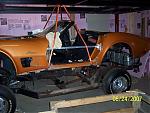
I thought about that, but the whole engine bay is a mess. I don't have great pictures, but here's a couple examples. I figure it would be easier to pull it, clean the engine and engine bay and then drop it back in.
-
That's where I am now.... but still would prefer to clean it up.
It's a great driver, starts up every time and runs strong. Two schools of thought to keep it that way....
1 - if it aint broke, don't fix it
2 - a clean car is a happy car
I also love working on the car and getting my hands dirty.
Thanks for the great ideas....
peter


It is a matching numbers car. Except for the front suspension, (me with help) and radio (previous Bubba) the car is unmolested. I'm not going for NCRS, but would like to keep it as original as possible, but upgrade reliability and looks.
If you are going to pull the matching # engine, fix it right, help it breathe better, and make it look original.
If you want to save more money for that ZZ4, you don't need to pull the engine to stop a few leaks. You can replace head gaskets with the block in the car, but if the head gaskets are not broken, leave em alone. Valve cover gaskets, pan gaskets and timing cover (the major leakers) can all be replaced with the block in place. You can replace motor mounts too by jacking the motor from underneath tipping it to one side or another to remove and replace the mount.
To save even more, if the leaks don't make puddles, leave it alone, drive it, and enjoy it.
That's where I am now....
but still would prefer to clean it up.It's a great driver, starts up every time and runs strong. Two schools of thought to keep it that way....
1 - if it aint broke, don't fix it
2 - a clean car is a happy car
I also love working on the car and getting my hands dirty.
Thanks for the great ideas....
peter
Intermediate
Joined: May 2005
Posts: 27
Likes: 0
From: Beaver Falls Pa
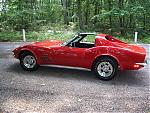
I am doing a similiar project. I have a 71 with 61,000 miles. It also is nearly original, and I want to keep it as close as I can to original. I wanted to clean/paint the engine bay, so I deceided to pull the engine.
The vette didn't smoke at all. I took the head to a machine shop. The valve guides were worn, so I got oversized valve stems and new valve springs. The cylinder walls were not worn, so I am leaving the pistons alone.
The intake was full off carbon, so I took the metal plate off of the underneath of it and had the intake bead blasted.
I am currently painting the exhaust manifolds with por 15 Manifold grey. I hope to change the rear oil seal tomorrow and put the heads back on.
It has been alot of fun so far, but finding the time to work on it is another story. Good luck with your 71.
The vette didn't smoke at all. I took the head to a machine shop. The valve guides were worn, so I got oversized valve stems and new valve springs. The cylinder walls were not worn, so I am leaving the pistons alone.
The intake was full off carbon, so I took the metal plate off of the underneath of it and had the intake bead blasted.
I am currently painting the exhaust manifolds with por 15 Manifold grey. I hope to change the rear oil seal tomorrow and put the heads back on.
It has been alot of fun so far, but finding the time to work on it is another story. Good luck with your 71.

Le Mans Master
Joined: Sep 2001
Posts: 7,739
Likes: 630
From: Unreconstructed, South Carolina
Real good sbc build book
Possibly the best book for beginners on sbc build-rebuild.
Lotsa good info, pictures, shortcuts & tips. Clear, concise & user-friendly.
"How to rebuild your Small-Block Chevy" ... author: David Vizard ... publisher: HPBooks ... ISBN 1-55788-029-8 ... should be under $20 USD.
Lotsa good info, pictures, shortcuts & tips. Clear, concise & user-friendly.
"How to rebuild your Small-Block Chevy" ... author: David Vizard ... publisher: HPBooks ... ISBN 1-55788-029-8 ... should be under $20 USD.
Burning Brakes

Joined: Feb 2005
Posts: 977
Likes: 1
From: wash. dc
there's a lotta good advice here...the only thing i would add is this...research....research...research.. .there's always more to know about these cars... good luck and most of all, have fun... keep a pic record of your progress from start to finish.