



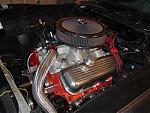





My 350 Block Bummer

Thread Starter
Melting Slicks


Joined: Dec 2000
Posts: 3,407
Likes: 2
From: Carmichael CA
 My 350 Block Bummer
Short story: Block was milled too low...measurements indicate that pistons may touch head/valves (gap is measured to be less than .010" while specs require minimum .040" gap)
I've put the engine back together with 2 sheets of dead-soft copper plus the gasket between each head & block to bring the gap up to the required .040". But, it is leaking oil between the head and block...a problem which I originally pulled the engine for and which I can not live with.
The engine was a good solid running base engine except for the oil leaks that dynoed 200RWHP. The milling job removed the block numbers so now I don't even have a numbers matching Vette, so that's no longer an issue.
Options:
A: Pull the manifolds and heads back apart and use more sealant with the 2 sheets of dead-soft copper & gasket and keep doing this until it stops leaking. +: cheap. -: lots of work and may never get it to stop leaking. And, there is a good chance of blowing a gasket further down the road.
B: Pull the manifolds and heads back apart and use a thick (.32") gasket and pray that the pistons don't hit. Optionally take a wire wheel to the top of the pistons to try and take .030" off of them. +: Just requires 1 additional top-end dismantle and rebuild. -: Might destroy the engine so that option D will be required along with fixing any damages that it does such as replacing entire car when it burns to the ground.
C: Pull engine completely apart and buy an identical replacement block. +: a sure fix and relatively cheap. -: a complete rebuild and the piston's will no longer exactly match and new cam shaft bearings will need to be installed, etc.
D: Sell engine as is and buy a new engine. +: can get a fuel efficient engine with more HP. -: expensive...around $1,730USD for 290HP 350 crate #12499529 or $2,440USD for 330HP 350 crate #12486041 or $3,800USD for 355HP ZZ4 #24502609. I'd also be spending $2,000USD for the Edelbrock EFI #3503.
Right now I'm leaning toward option D since I have the entire front suspension, steering, and brake system to rebuild and I'm hoping to get back on the road before Sept. A crate engine would make things a whole lot easier for me right now.
I've put the engine back together with 2 sheets of dead-soft copper plus the gasket between each head & block to bring the gap up to the required .040". But, it is leaking oil between the head and block...a problem which I originally pulled the engine for and which I can not live with.
The engine was a good solid running base engine except for the oil leaks that dynoed 200RWHP. The milling job removed the block numbers so now I don't even have a numbers matching Vette, so that's no longer an issue.
Options:
A: Pull the manifolds and heads back apart and use more sealant with the 2 sheets of dead-soft copper & gasket and keep doing this until it stops leaking. +: cheap. -: lots of work and may never get it to stop leaking. And, there is a good chance of blowing a gasket further down the road.
B: Pull the manifolds and heads back apart and use a thick (.32") gasket and pray that the pistons don't hit. Optionally take a wire wheel to the top of the pistons to try and take .030" off of them. +: Just requires 1 additional top-end dismantle and rebuild. -: Might destroy the engine so that option D will be required along with fixing any damages that it does such as replacing entire car when it burns to the ground.
C: Pull engine completely apart and buy an identical replacement block. +: a sure fix and relatively cheap. -: a complete rebuild and the piston's will no longer exactly match and new cam shaft bearings will need to be installed, etc.
D: Sell engine as is and buy a new engine. +: can get a fuel efficient engine with more HP. -: expensive...around $1,730USD for 290HP 350 crate #12499529 or $2,440USD for 330HP 350 crate #12486041 or $3,800USD for 355HP ZZ4 #24502609. I'd also be spending $2,000USD for the Edelbrock EFI #3503.
Right now I'm leaning toward option D since I have the entire front suspension, steering, and brake system to rebuild and I'm hoping to get back on the road before Sept. A crate engine would make things a whole lot easier for me right now.

Le Mans Master

Joined: Sep 2001
Posts: 7,739
Likes: 630
From: Unreconstructed, South Carolina
Originally Posted by Rockn-Roll
Short story: Block was milled too low...measurements indicate that pistons may touch head/valves (gap is measured to be less than .010" while specs require minimum .040" gap).
I suggest NAPA-Victor Reinz composition head gasket P/N 5746 ... available locally ... it's 0.026" thick when fully compressed & correctly torqued.
We run block "zero decked" (milled) so that piston is level with block ... and we run 5746 gasket ... flattop pistons, .480" lift cam ... NO, NO interferance problem whatsoever in sustained high RPM circle track sbc. You certainly will have no interferance problem with a base vette 350 (OE base 75 L48 has dished pistons and less than .420" lift).
That "best combination has the piston from 0.030" to 0.040" away from head" is known as "quench height" or "quench distance" ... and it is well established for it actually helps reduce spark knocking ... that may seem counter-intuitive but it's quite true.
-edit- If your ~0.010" down in hole is about correct, and you use 5746, and sheetcan the copper ... the motor will be a bit peppier and will not leak at head gaskets and will be less prone to spark knock. Also, clean every speck of silicone/gasket sealer/adhesive off heads & block ... then go over it with clean rags & lacquer thinner ... then put the 5746 on with NO sealer/adhesive at all ... sealer/adhesive not needed with 5746.
Last edited by jackson; Jun 9, 2006 at 05:13 PM.
Thread Starter
Melting Slicks
Joined: Dec 2000
Posts: 3,407
Likes: 2
From: Carmichael CA
Yes...it's the original base L48 350. The piston rims are the problem and I measured them to be less than .010" from the top of the block.
It sounds like the recommendation is option B which is to dismantle the top end and using like FPP-1003. I appreciate the post Jackson, but NAPA parts have never worked right for me.
It sounds like the recommendation is option B which is to dismantle the top end and using like FPP-1003. I appreciate the post Jackson, but NAPA parts have never worked right for me.
Le Mans Master

Joined: Oct 2002
Posts: 7,098
Likes: 378
From: Las Vegas - Just stop perpetuating myths please.
Measure with clay on 1 piston.
U would be surpised to find that neither vlv with be fully open while in overlap when the piston is on TDC as it reverses for the intake stroke. And then next time the piston is at TDC is for the ignition/power stoke and both vlvs are closed. What i'm saying is that you have more clearance since the vlvs are not fully open.
The common method for measuring vlv clearance is with a thin coat of clay (0.100") on piston top and assemble head with cam with the cyl vlvs adjusted then rotate the crank to impress the vlvs into clay (at least 2 full turns). U will need to measure and account for the head gasket thicknes (or lack of).
The GM Performace manual states the required clearance as i can't recall that number (but 0.050" sounds good).
This clay method can also be used to verify your quench height as it sounds like u are worried 'bout the piston rims. But with a normal 0.039" gasket and .010" down the hole u should be just fine for a little quench benifit (0.035"-0.055").
Yea, pop 1 head and spread a little clay (Walmart hoppy/crafts) on (use the old gasket too), then measure the vlv impressions for thinnist clay layer to piston.
Your trying too hard here but it should pay off as u will soon be the forum expert on piston height Mr. R&R.
Lets us know it this works. cardo0
The common method for measuring vlv clearance is with a thin coat of clay (0.100") on piston top and assemble head with cam with the cyl vlvs adjusted then rotate the crank to impress the vlvs into clay (at least 2 full turns). U will need to measure and account for the head gasket thicknes (or lack of).
The GM Performace manual states the required clearance as i can't recall that number (but 0.050" sounds good).
This clay method can also be used to verify your quench height as it sounds like u are worried 'bout the piston rims. But with a normal 0.039" gasket and .010" down the hole u should be just fine for a little quench benifit (0.035"-0.055").
Yea, pop 1 head and spread a little clay (Walmart hoppy/crafts) on (use the old gasket too), then measure the vlv impressions for thinnist clay layer to piston.
Your trying too hard here but it should pay off as u will soon be the forum expert on piston height Mr. R&R.
Lets us know it this works. cardo0
Corvette Stories
The Best of Corvette for Corvette Enthusiasts

Top 10 Most Expensive Corvettes Ever Sold on Bring A Trailer
Brett Foote
10 Things Every Corvette Owner Needs (2026 Edition)
Michael S. Palmer
8 Most "Only Corvette Owners Understand" Quirks and Problems
Pouria Savadkouei
10 Reasons the C6 Z06 is Still A Performance Benchmark After 20 Years
Joe Kucinski
How Much Horsepower Every Corvette Engine "LOST" in 1972
Joe Kucinski
Top 10 DOs and DON'Ts for Protecting Your Convertible Top!
Michael S. Palmer
Top 10 Most Explosive Corvettes Ever Made: Power-to-Weight Ratio Ranked!
Joe Kucinski
150 hp to 1,250 hp: Every Corvette Generation Compared by the Specs That Matter
Joe Kucinski
8 Coolest Corvette Pace Cars (and Replicas) of All Time
Verdad Gallardo
Le Mans Master
Joined: Sep 2001
Posts: 7,739
Likes: 630
From: Unreconstructed, South Carolina
NEVER ever attempt to cut piston height using a wire wheel!
Don't try & measure quench using clay ... it's so malleable it's hard to get anywhere near accurate reading. Dimensions for compressed gasket thickness is well established & published. Go get yourself a $25 6" steel dial caliper ... you'll use it for lots of stuff ... use its tailpiece to measure how far piston is down in hole and then add published "COMPRESSED" gasket thickness to that for VERY accurate quench dimension. Measure around piston edge at least 4 spots ... then take the average ... you'll probably see some variance between outboard & inboard heights due to some piston rock ... that's why you take an average.
The clay is OK for valve-to-piston ... but it seems you aren't anywhere near needing that (small cam & flat or dished pistons down in hole). If you're 0.010" down & then add 0.041" you'll be at 0.051" and that ain't ideal quench range ... may be little or no quench benefit with that.
Napa don't make the 5746 gasket ... Victor Reinz does ... same group that make Clevite bearings ... buy 5746 from another store if you don't like Napa ... and 5746 are VERY good gaskets ... Victor is NOT some second-rate gasket maker ... they are first-class ... quality has been & remains as good as better-known FelPro. No gasket is worth snot if the surfaces aren't prepped properly / if installation is bungled.
Don't try & measure quench using clay ... it's so malleable it's hard to get anywhere near accurate reading. Dimensions for compressed gasket thickness is well established & published. Go get yourself a $25 6" steel dial caliper ... you'll use it for lots of stuff ... use its tailpiece to measure how far piston is down in hole and then add published "COMPRESSED" gasket thickness to that for VERY accurate quench dimension. Measure around piston edge at least 4 spots ... then take the average ... you'll probably see some variance between outboard & inboard heights due to some piston rock ... that's why you take an average.
The clay is OK for valve-to-piston ... but it seems you aren't anywhere near needing that (small cam & flat or dished pistons down in hole). If you're 0.010" down & then add 0.041" you'll be at 0.051" and that ain't ideal quench range ... may be little or no quench benefit with that.
Napa don't make the 5746 gasket ... Victor Reinz does ... same group that make Clevite bearings ... buy 5746 from another store if you don't like Napa ... and 5746 are VERY good gaskets ... Victor is NOT some second-rate gasket maker ... they are first-class ... quality has been & remains as good as better-known FelPro. No gasket is worth snot if the surfaces aren't prepped properly / if installation is bungled.
Le Mans Master
Joined: Oct 2002
Posts: 7,098
Likes: 378
From: Las Vegas - Just stop perpetuating myths please.
A micrometer is the best tool for this - if u can get 1.
If your gonn'a measure vlv clearance with clay your gonn'a see what the head quench does to the clay anyways. Depending on consistancy of clay and how much it sticks to piston and head will show the quench height and it could be good enough for your situation/considerations. Try just wiping/wetting the head's area over the bore and head chamber with oil before installing to reduce sticking (but let clay stick to the piston). Measure thickness of flattened clay area just as u do for the vlv clearance.
Ok the proper way to measure piston clearance is using a micrometer with a flat base wide enough to cover the bore. U need a true flat accross the bore for a reference and i don't know how a dail indicator would provide this reference (accurately). Measuring over the piston pin area (fulcrum center) will give u that average height and look for the area closest to the top/block deck. Add that measurement to the hd gasket compressed height to figure your quench. But unless u own or have access to a mic like that u gonn'a see the quench impression when u check the vlv clearance with clay anyways.
 Yea removing metal from the pistons is for the pros - save yourself some major headaches and buy new pistons 1st ($300 for good hyperuetectics much cheaper than a crate motor that likey will have hyperuetectics also).
Good luck R&R. cardo0
Ok the proper way to measure piston clearance is using a micrometer with a flat base wide enough to cover the bore. U need a true flat accross the bore for a reference and i don't know how a dail indicator would provide this reference (accurately). Measuring over the piston pin area (fulcrum center) will give u that average height and look for the area closest to the top/block deck. Add that measurement to the hd gasket compressed height to figure your quench. But unless u own or have access to a mic like that u gonn'a see the quench impression when u check the vlv clearance with clay anyways.
Yea removing metal from the pistons is for the pros - save yourself some major headaches and buy new pistons 1st ($300 for good hyperuetectics much cheaper than a crate motor that likey will have hyperuetectics also).Good luck R&R.
cardo0
Instructor


Joined: May 2006
Posts: 202
Likes: 16
Jackson is on the money. If the slug is 10 down the hole it's no problem. We run them @0. The gasket makes up the diff for clearance. Don't use any goop on a good gasket (dry & clean)
Why is oil leaking out the head? The oil drains down into the lifter galley.... Make sure you clean the head bolts good. Look at the area where the head bolts seat. Is it ok? Use a bit of clear silicone on the head bolt threads when you reassemble.
Why is oil leaking out the head? The oil drains down into the lifter galley.... Make sure you clean the head bolts good. Look at the area where the head bolts seat. Is it ok? Use a bit of clear silicone on the head bolt threads when you reassemble.

Melting Slicks
Joined: Sep 2004
Posts: 2,412
Likes: 3
Don't have time to read the whole post but I got to where you said that oil is leaking between the heads and the block...
There are no oil passages from the heads to the block, only coolant passages. The oil leaks down the back of the head to the lifter valley.
There are no oil passages from the heads to the block, only coolant passages. The oil leaks down the back of the head to the lifter valley.
Thread Starter
Melting Slicks
Joined: Dec 2000
Posts: 3,407
Likes: 2
From: Carmichael CA
Originally Posted by jackson
NEVER ever attempt to cut piston height using a wire wheel!
Originally Posted by jackson
Don't try & measure quench using clay
Originally Posted by jackson
Napa don't make the 5746 gasket ... Victor Reinz does
Originally Posted by JBB
Why is oil leaking out the head? The oil drains down into the lifter galley.... Make sure you clean the head bolts good.
Originally Posted by torqvette
There are no oil passages from the heads to the block, only coolant passages. The oil leaks down the back of the head to the lifter valley.
Heck, I'm not even sure that it will continue to leak when I get the engine running...perhaps the copper will expand and seal the leak. But, if it's leaking oil right now, then it will probably leak coolant when I get it running. I'm just worried and want to do what needs to be done while the engine is out and I have it in the garage...I may not get another chance for years.

Drifting


Joined: Aug 2004
Posts: 1,883
Likes: 124
From: Lubbock TX
The clay is used to give an exact clearance between piston and chamber as well as valves. As good as your caliper is, it can't measure piston to valve clearance at differing stages of valve lift/crank rotation - piston position. The only other way is to use checking springs (like they use on a flow bench) and use a dial gauge to measure clearance during crankshaft rotation. Even then, that won't show any very near-misses on the perimeter of the valve pockets that won't show up without clay. As for quench, use a dial gauge on a bridge to see exactly how far the slugs are coming out of the hole, then adjust gasket thickness accordingly. Cometic makes the best gaskets there are for folks at our level and they're reusable so they may be cheaper in the long run.
Thread Starter
Melting Slicks
Joined: Dec 2000
Posts: 3,407
Likes: 2
From: Carmichael CA
Originally Posted by L88Plus
The clay is used to give an exact clearance between piston and chamber as well as valves. As good as your caliper is, it can't measure piston to valve clearance at differing stages of valve lift/crank rotation - piston position. The only other way is to use checking springs (like they use on a flow bench) and use a dial gauge to measure clearance during crankshaft rotation. Even then, that won't show any very near-misses on the perimeter of the valve pockets that won't show up without clay. As for quench, use a dial gauge on a bridge to see exactly how far the slugs are coming out of the hole, then adjust gasket thickness accordingly. Cometic makes the best gaskets there are for folks at our level and they're reusable so they may be cheaper in the long run.
Melting Slicks
Joined: Sep 2004
Posts: 2,412
Likes: 3
Originally Posted by Rockn-Roll
There is a small pool of oil on the left rear of engine between head and gasket which has absolutely no liquid of any kind above or below or to either side.
Heck, I'm not even sure that it will continue to leak when I get the engine running...perhaps the copper will expand and seal the leak. But, if it's leaking oil right now, then it will probably leak coolant when I get it running. I'm just worried and want to do what needs to be done while the engine is out and I have it in the garage...I may not get another chance for years.
Heck, I'm not even sure that it will continue to leak when I get the engine running...perhaps the copper will expand and seal the leak. But, if it's leaking oil right now, then it will probably leak coolant when I get it running. I'm just worried and want to do what needs to be done while the engine is out and I have it in the garage...I may not get another chance for years.
Also, you can buy extra thick head gaskets.
http://store.summitracing.com/partde...5&autoview=sku
Last edited by enkeivette; Jun 13, 2006 at 03:41 AM.