




Rear clunking again
Thread Starter
Racer


Joined: Jul 2006
Posts: 478
Likes: 56
From: Woodstock Georgia
 Rear clunking again
The jury is still out on the slow speed clunking of the rear end when warmed up. However, yesterday I noticed that the R Rear wheel has a camber problem and is leaning in on the top (not plumb). I jacked up the car and was able to move the wheels at least 4 inches pushing the top of the tire and pulling the bottom. The play seemed to be the half shafts at the rear end. Is this normal? Worn bearings?

Drifting

Joined: Jul 2002
Posts: 1,995
Likes: 110
From: Garland Texas
It sounds like your stub axles are shot. There seems to be a rash of these lately. i have a few pics in another thread called "differential pics" showing the damage caused by worn out stub axles.
Mike
Mike

Le Mans Master

Joined: Jan 2000
Posts: 8,918
Likes: 27
From: New Hill NC
This is a condition that seldom occured on the old ones, but starting in 75 and increasing in frequency through 79 it became epidemic. I had long discussions with the General back then, but they never would admit that there was a problem, eventhough it was readily apparent. The conditon results in a lot of metal ground up and deposited in the gears etc. This results in accelerated wear and positration clutch chatter. That is what you hear when you take off from a start after the rear is warm.
Drifting
Joined: Jul 2002
Posts: 1,995
Likes: 110
From: Garland Texas
Wombvette,
The reason I was told for the rapid wear was reduction in the rockwell hardness rating. Had the same problem starting in 78 with cam wear and valve guide wear. I remember hearing a statement from a GM rep saying the reason for the wear is people are driving slower and the cams aren't getting enough lube because of it. Still laughing at that one.
Mike
The reason I was told for the rapid wear was reduction in the rockwell hardness rating. Had the same problem starting in 78 with cam wear and valve guide wear. I remember hearing a statement from a GM rep saying the reason for the wear is people are driving slower and the cams aren't getting enough lube because of it. Still laughing at that one.
Mike
Le Mans Master
Joined: Jan 2000
Posts: 8,918
Likes: 27
From: New Hill NC
Yep, those were the dark days of the domestic auto industry. The corporate bean counters and shoddy workmanship cheapen the product and the corporation makes more money. But, that type thinking resulted in the move to imports. After that, even if you produce a good product, the public will not know or buy it. Its is telling on them now, eventhough there are some good products our there now.
Corvette Stories
The Best of Corvette for Corvette Enthusiasts

Top 10 Most Expensive Corvettes Ever Sold on Bring A Trailer
Brett Foote
10 Things Every Corvette Owner Needs (2026 Edition)
Michael S. Palmer
8 Most "Only Corvette Owners Understand" Quirks and Problems
Pouria Savadkouei
10 Reasons the C6 Z06 is Still A Performance Benchmark After 20 Years
Joe Kucinski
How Much Horsepower Every Corvette Engine "LOST" in 1972
Joe Kucinski
Top 10 DOs and DON'Ts for Protecting Your Convertible Top!
Michael S. Palmer
Top 10 Most Explosive Corvettes Ever Made: Power-to-Weight Ratio Ranked!
Joe Kucinski
150 hp to 1,250 hp: Every Corvette Generation Compared by the Specs That Matter
Joe Kucinski
8 Coolest Corvette Pace Cars (and Replicas) of All Time
Verdad Gallardo
Instructor

Joined: Sep 2006
Posts: 140
Likes: 0
From: McKinney TX
corvette maniac,
Don't get discouraged. The pics tracdogg has posted are of my diff. I started out with Trailing arm and suspension rebuild and found the trouble with the stubs. Tracdogg has my Diff and has built the new trailing arms for me. All is good.
Don't get discouraged. The pics tracdogg has posted are of my diff. I started out with Trailing arm and suspension rebuild and found the trouble with the stubs. Tracdogg has my Diff and has built the new trailing arms for me. All is good.
Drifting
Joined: Jul 2002
Posts: 1,995
Likes: 110
From: Garland Texas
Hi Chris,
I'll be posting more pics today of your parts. I've got a call in for a gas tank but no reply yet. I'll try again a little later.
Maniac,
When you see how everything comes out you'll feel a lot better. I'll try to post more pics to show you what to look for. Where are you located?
Mike
I'll be posting more pics today of your parts. I've got a call in for a gas tank but no reply yet. I'll try again a little later.
Maniac,
When you see how everything comes out you'll feel a lot better. I'll try to post more pics to show you what to look for. Where are you located?
Mike
Thread Starter
Racer
Joined: Jul 2006
Posts: 478
Likes: 56
From: Woodstock Georgia
Originally Posted by tracdogg2
Hi Chris,
I'll be posting more pics today of your parts. I've got a call in for a gas tank but no reply yet. I'll try again a little later.
Maniac,
When you see how everything comes out you'll feel a lot better. I'll try to post more pics to show you what to look for. Where are you located?
Mike
I'll be posting more pics today of your parts. I've got a call in for a gas tank but no reply yet. I'll try again a little later.
Maniac,
When you see how everything comes out you'll feel a lot better. I'll try to post more pics to show you what to look for. Where are you located?
Mike
I am in Woodstock, GA.

Drifting

Joined: Jul 2002
Posts: 1,943
Likes: 1
From: Rosemount MN
Good luck with your replacements,
I too started with a Trailing Arm replacement and found the differential was junk, Bubba had rebuilt.
The new 500 HP stroker just hastened the differential demise.
Don't get too discouraged.
I too started with a Trailing Arm replacement and found the differential was junk, Bubba had rebuilt.
The new 500 HP stroker just hastened the differential demise.
Don't get too discouraged.
Pro

Joined: Oct 2005
Posts: 505
Likes: 8
From: Houston Tx.
Originally Posted by wombvette
This is a condition that seldom occured on the old ones, but starting in 75 and increasing in frequency through 79 it became epidemic. I had long discussions with the General back then, but they never would admit that there was a problem, eventhough it was readily apparent. The conditon results in a lot of metal ground up and deposited in the gears etc. This results in accelerated wear and positration clutch chatter. That is what you hear when you take off from a start after the rear is warm.
Tech Contributor


Joined: Aug 1999
Posts: 15,175
Likes: 3,989
From: Connecticut, USA
There are 2 issues here - yoke wear from case hardening - or lack of it and posi setup procedures with the springs and clutches.
If the yokes are worn you'll have more then .040" endplay in them. Case hardening is about .030 deep. The clutches used and the setup cause the hammering which the whale oil was thoguht to be a fix, it wasn't so they went to the snowflake clutches and this just made the clutches break in use.
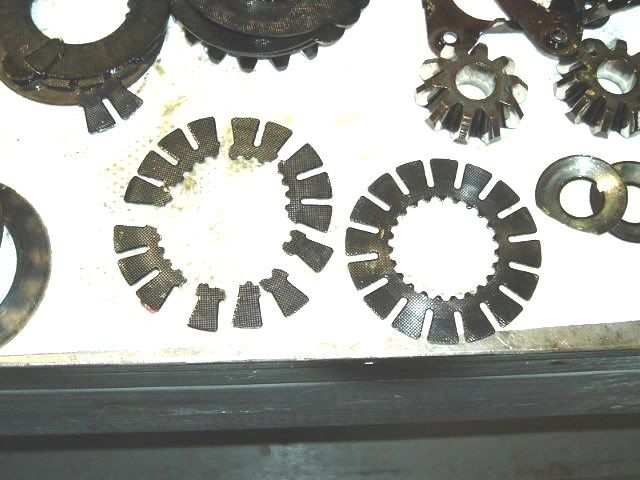
The only way to eliminate the problems are to use hardened tip yokes and tune the posi. Both time consuming and expensive if you have to farm them out.
Gary
If the yokes are worn you'll have more then .040" endplay in them. Case hardening is about .030 deep. The clutches used and the setup cause the hammering which the whale oil was thoguht to be a fix, it wasn't so they went to the snowflake clutches and this just made the clutches break in use.
The only way to eliminate the problems are to use hardened tip yokes and tune the posi. Both time consuming and expensive if you have to farm them out.
Gary

Le Mans Master
Joined: May 2005
Posts: 9,996
Likes: 0
From: if you have a ? on my avatar, please contact me directly, you spineless twit
St. Jude Donor '09
Originally Posted by gtr1999
There are 2 issues here - yoke wear from case hardening - or lack of it and posi setup procedures with the springs and clutches.
If the yokes are worn you'll have more then .040" endplay in them. Case hardening is about .030 deep. The clutches used and the setup cause the hammering which the whale oil was thoguht to be a fix, it wasn't so they went to the snowflake clutches and this just made the clutches break in use.
The only way to eliminate the problems are to use hardened tip yokes and tune the posi. Both time consuming and expensive if you have to farm them out.
Gary
If the yokes are worn you'll have more then .040" endplay in them. Case hardening is about .030 deep. The clutches used and the setup cause the hammering which the whale oil was thoguht to be a fix, it wasn't so they went to the snowflake clutches and this just made the clutches break in use.
The only way to eliminate the problems are to use hardened tip yokes and tune the posi. Both time consuming and expensive if you have to farm them out.
Gary
That broken clutch disk is exactly what happened in mine.