





What is this???
Thread Starter
Instructor


Joined: Sep 2006
Posts: 192
Likes: 0
From: Fort Lauderdale FL
 What is this???
What is the white block with the two wires connected mounted to the firewall of my 75, drivers side???
Is it suppossed to be warm when the key is on? Mine is
Thanks

or can be seen at http://i89.photobucket.com/albums/k2...whiteblock.jpg
Is it suppossed to be warm when the key is on? Mine is
Thanks
or can be seen at http://i89.photobucket.com/albums/k2...whiteblock.jpg
Racer

Joined: Apr 2005
Posts: 464
Likes: 0
From: Charleston South Carolina
Yeah, it's a resistor, I've had them on RC cars for the analogue speed controller. I remember burning my fingers on it many times because it got so hot. Never saw one that big or even on a car for that matter.
Thread Starter
Instructor
Joined: Sep 2006
Posts: 192
Likes: 0
From: Fort Lauderdale FL
Originally Posted by big_G
Ignition coil ballast resistor. Do you have an aftermarket distributor (not original HEI)? Your not supposed to have one of those...
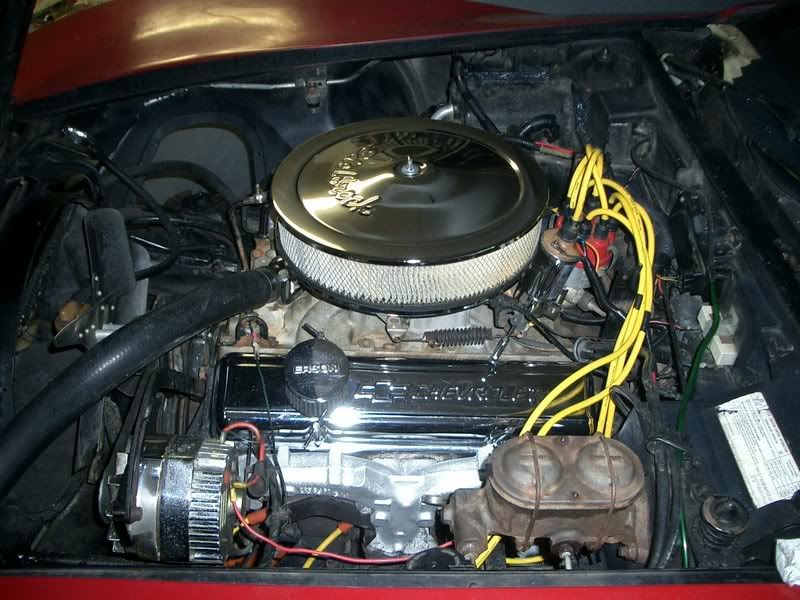
As to the set-up on the car, the PO a long time ago changed out some stuff in the late 70's adding a Edelbrock Street Avenger intake, performer carb and a Mallory Magnetic distributor and seperate coil.
I don't know why he changed to a non HEI set-up if it originally came with one? This is an ear;y 75 car and wondering if the change over to HEI was mid year or not.
Either way it works well in this L48 and runs real nice, trying to get more advance but will need a set of advance keys from Mallory to adjust.
Here's a better pic of the engine

Former Vendor
Joined: Aug 2006
Posts: 76,656
Likes: 1,851
From: Jeffersonville Indiana 812-288-7103
St. Jude Donor '08-'09-'10-'11-'12-'13-'14-'15
This is a ballast resistor, but what is it doing on your car? If your car is a 1975 then I’m baffled as to why it’s on the car. You car should have been equipped with HEI ignition (It was the first year for it)
This is either an aftermarket resistor or a replacement one sold by one of the zones (the Delco version of this is even cheesier looking) … But your car 75 coupe should not have a ballast resistor on it.
I copied your picture and blew it up so I could see the engine bettor. It looks like you have an old aftermarket distributor with a replacement style coil. (Or in a nut shell, pointed ignition that would require a voltage drop to the points).
The ballast resistor was used on cars from 1955-1967 cars but not on a C3. On cars from 1968-1974 it was replaced in the yellow resistance wire with black speckles in it.
The purpose of the resistor was to drop the voltage to the points after the car started up. Reducing the voltage to the points made them last longer. The yellow wire that replaced the resistor was a resistance wire that performed the same function.
Willcox Inc
This is either an aftermarket resistor or a replacement one sold by one of the zones (the Delco version of this is even cheesier looking) … But your car 75 coupe should not have a ballast resistor on it.
I copied your picture and blew it up so I could see the engine bettor. It looks like you have an old aftermarket distributor with a replacement style coil. (Or in a nut shell, pointed ignition that would require a voltage drop to the points).
The ballast resistor was used on cars from 1955-1967 cars but not on a C3. On cars from 1968-1974 it was replaced in the yellow resistance wire with black speckles in it.
The purpose of the resistor was to drop the voltage to the points after the car started up. Reducing the voltage to the points made them last longer. The yellow wire that replaced the resistor was a resistance wire that performed the same function.
Willcox Inc
Advanced
Joined: Sep 2006
Posts: 63
Likes: 0
Resistance Is UseFUL
Originally Posted by 75coupered
is it suppossed to warm up under use then?
Of course, it could mean that magnetic pickup is about to give off a massive EMP, killing all electronic devices in the garage... Maybe you should come back to good old lovable, dependable points while there's still time...

If it works, don't fix it. (And don't touch it, but your blisters told you that already,
 didn't they?)
Corvette Stories
The Best of Corvette for Corvette Enthusiasts

Top 10 Most Explosive Corvettes Ever Made: Power-to-Weight Ratio Ranked!
Joe Kucinski
150 hp to 1,250 hp: Every Corvette Generation Compared by the Specs That Matter
Joe Kucinski
8 Coolest Corvette Pace Cars (and Replicas) of All Time
Verdad Gallardo
Top 10 Corvette Engines RANKED by Peak Torque (70+ Years of Muscle!)
Joe Kucinski
Corvette ZR1X Will Be Pacing the Indy 500, And Could Probably Race, Too!
Verdad Gallardo
Top 10 Corvettes Coming to Mecum Indy 2026!
Brett Foote
Top 10 C9 Corvette MUST-HAVES to Fix These C8 Generation Flaws!
Michael S. Palmer
10 Revolutionary 'Corvette Firsts' Most People Don't Know
Joe Kucinski
5 Reasons to Upgrade to an LS6-Powered Corvette; 5 Reasons to Stay LT2
Michael S. Palmer
Thread Starter
Instructor
Joined: Sep 2006
Posts: 192
Likes: 0
From: Fort Lauderdale FL
Must be after market stuff. The car has a streetmaster intake and Mallory magnetic breakerless electronic distributor and a Mallory high output coil. I assume that the PO also istalled the resistor to accompany the swap and bypass the factory wire. Why I have no idea unless the performance advange was there, the car does run very well.
I was curious as to the heat if there was a danger or not but it seems to be in order. All of these add on parts are true to the period of the car with the streetmaster intake from 74-76 and the Mallory unit seems to also date from 74-78. Any of you guys have some info on this stuff?
Thanks
I was curious as to the heat if there was a danger or not but it seems to be in order. All of these add on parts are true to the period of the car with the streetmaster intake from 74-76 and the Mallory unit seems to also date from 74-78. Any of you guys have some info on this stuff?
Thanks

Le Mans Master

Joined: Jan 2006
Posts: 8,319
Likes: 7
From: Wilmington DE, Drive it like you stole it, 68 327 4 speed coupe
Originally Posted by big_G
Some low impeadance aftermarket coils require the ballast resistor when using points or other type of triggering distributor.
also if the PO put in a petronix unit or something similar, those things need a ballast resister to keep from going **** up, or at least the older versiions did, thats why I went to HEI anfter killing two pertronix units before i learned what the problem was


Pro

Joined: Oct 2002
Posts: 708
Likes: 0
From: somewhere south of normal
The ballast resistor is there because Mallory says you need it for their distributor. I have a Mallory as well, and also have the ballast resistor. However, I learned from Lars at the recent TFB session, that my 69 has a resistor wire and the aftermarket ballast resistor is not needed as a result. I have not changed it yet and my car runs like an ape......
phillip
phillip

 So does my '70 boat
Thread Starter
Instructor
Joined: Sep 2006
Posts: 192
Likes: 0
From: Fort Lauderdale FL
Originally Posted by Bob Onit
Did the 75 come with the cable drive tach?
I thought 1974 was the last year...
I thought 1974 was the last year...
I know for sure mine is a 75, but it does have a cable driven tach, and it just seems as if the car came that way originally, otherwise why go to the trouble to go from HEI to non-hei, and also have to change out your tachs, all for a distributor swap? Doesn't make sense to me trouble and expense wise...
Mine also has the aluminum wheels, which I thought were introduced in 76, but I have also seen many 75's with the aluminum wheels instead of rally's, could this have been a dealer upgrade available in 75, anyone else have this same combo and know it to be OE in 1975?
Thanks in adavance
Melting Slicks


Joined: Mar 2006
Posts: 3,342
Likes: 7
From: Connecticut
Originally Posted by HDIronman
I learned from Lars at the recent TFB session, that my 69 has a resistor wire and the aftermarket ballast resistor is not needed as a result. I have not changed it yet and my car runs like an ape......
phillip
phillip
Measure your stock ignition system voltage while the engine is at idle at the coil (+) terminal.
If the measured voltage is within 1-volt of battery voltage, an ignition ballast resistor is not present and must be installed in the wire from the ignition switch.
In general, all vehicles equipped with the Delco
point ignition were equipped with an ignition ballast resistor.
Melting Slicks
Joined: Mar 2006
Posts: 3,342
Likes: 7
From: Connecticut
Originally Posted by 75coupered
I'm also a bit confused on this part. From what I have read the switch to the HEI distributor was done by Chevy 1974 1/2 onwards...does this mean that some "75 vettes came with 74 hardware and others came with the HEI??? I'm not sure and would appreciate some history or info on this.
As long as it works I wouldnt bother changing it (From my experience ...its a mother of a job) ....of course thats up to you

As far as the aluminum wheels go I think it was after 76
My limited knowledge only goes from around 1964 to 1974 so I would wait for others to confirm these issues
