







71 charcoal canister question
Thread Starter
Burning Brakes


Joined: Mar 2006
Posts: 1,036
Likes: 2
From: Huntingburg Indiana
 71 charcoal canister question
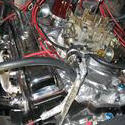
What would happen if I disconnected the small vacuum hose that goes to the canister? I am putting a holley on with an aluminum intake. Keeping the pcv hose to the canister is no problem, but the holley doesn't have a fitting to hook up the small hose.
Drifting

Joined: Feb 2005
Posts: 1,438
Likes: 2
From: Melrose Florida
Probably end up smelling gas, often the fumes were routed back to the carb for combustion in the engine. The PCV line is going to the canister. Either block off everything coming to canister (engine, fuel tank) or tee off another vacuum line to hook up the vac line.
Burning Brakes

Joined: Nov 2005
Posts: 832
Likes: 1
From: Breckenridge Colorado
Originally Posted by bondoboy
Thanks. Does it matter where the vacuum line comes from? The original was near the top of the carb. The only open fitting I have is at the base.
Le Mans Master


Joined: Oct 2002
Posts: 7,098
Likes: 378
From: Las Vegas - Just stop perpetuating myths please.
Ported vac source above the throttle plates at idle.
Originally Posted by bondoboy
Thanks. Does it matter where the vacuum line comes from? The original was near the top of the carb. The only open fitting I have is at the base.
 GM connected that cannister to a ported vac on the carb as enough vapor could be ingested on start or at idle to stall the eng or at least make a rough idle. So they plumbed it to a connection thats ported above the throttle plates at idle position and the vac doesn't take suction from that cannister until the throttle are open enough to create the eng speed to handle the rich fuel vapor from the cannister.
Yeh i rebuilt my entire EVC sys and replaced the PCV too. Learned here on the forum myself that PCV is needed to keep a negative press on the crankcase even though its kind'a a controled vac leak into the manifold. But somehow the carb can be tuned to handle crankcase blowby and EVC vapor too.
 And the ECV is just a passive sys to take fuel vapors mostly from the tank and sometimes from the fuel bowls too after eng shut/down. Doesn't hurt performance but saves the enviroment a little bit each day. Yea i replaced that 30yr old charcoal canister and all the rubber hoses too. Replaced the fuel line flex and hoses back there at he tank too. So now i can sleep a night knowing my fuel system is working as good as possible.
Now i doubt those running fuel cells have a need for these ECV's but for most of us they won't hurt performance.
Well most Holley's made for the street will have a ported vac connection. U can verify this by looking for a slot in each throttle throat (venturi) and just give the little tubing connections a shot of canned air or even WD40 to see which connection flows there.
Now speaking of sleep i think i will enjoy some of that soon.
 Good night. cardo0
Corvette Stories
The Best of Corvette for Corvette Enthusiasts

Top 10 Most Expensive Corvettes Ever Sold on Bring A Trailer
Brett Foote
10 Things Every Corvette Owner Needs (2026 Edition)
Michael S. Palmer
8 Most "Only Corvette Owners Understand" Quirks and Problems
Pouria Savadkouei
10 Reasons the C6 Z06 is Still A Performance Benchmark After 20 Years
Joe Kucinski
How Much Horsepower Every Corvette Engine "LOST" in 1972
Joe Kucinski
Top 10 DOs and DON'Ts for Protecting Your Convertible Top!
Michael S. Palmer
Top 10 Most Explosive Corvettes Ever Made: Power-to-Weight Ratio Ranked!
Joe Kucinski
150 hp to 1,250 hp: Every Corvette Generation Compared by the Specs That Matter
Joe Kucinski
