




Comparing Isky and Comp roller lifters
Thread Starter
Race Director


Joined: Nov 2000
Posts: 11,872
Likes: 12
From: Waterloo ontario Canada
 Comparing Isky and Comp roller lifters
This is my Isky red zone lifter beside a comp roller. This picture shows the difference in the center axle. The isky is much beefier in this axle
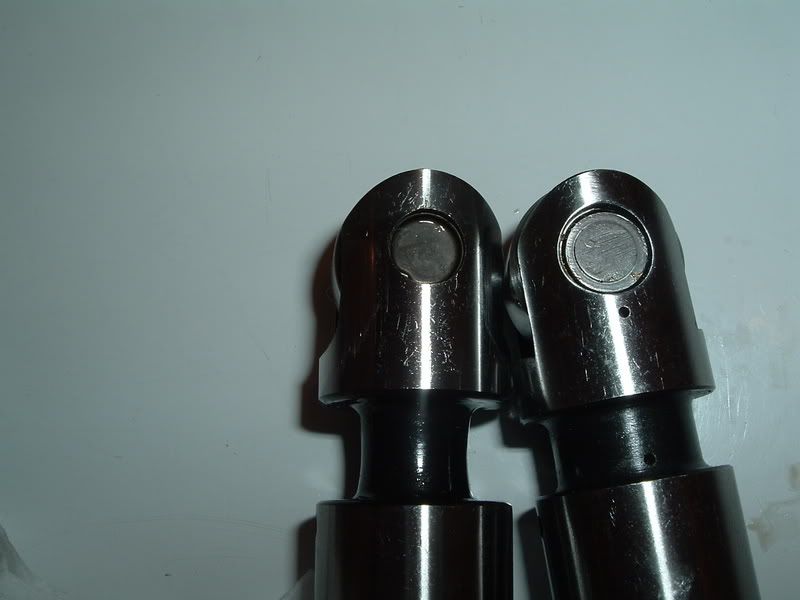
This shows the two wheels. Again the Isky seems wider then the comp. Holding the two parts in your hand gives you the impression that the roller assembly on the isky is beefier.
The Red zone also has a number of EDM holes to spray pressurized oil on the cam/roller interface and on the axle of the roller

You will notice the isky roller tappet is shorter, the oil bypass is also smaller. They both use the stand length push rod.
This oil bypass is important. Through each of the lifter bores is a oil gallery that feeds pressure oil to the next lifter. If the 1st lifter in the line blocks off this oil gallery it cuts oil flow to the one behind it etc etc. The last lifter in line would get no oil.
This is not the case. When the lifter travels throughout it’s entire travel it still leaves at least ¾ of the oil gallery unblocked so oil can still flow.
The two lifters use similar link bars to join the lifters and prevent rotation

This shows the two wheels. Again the Isky seems wider then the comp. Holding the two parts in your hand gives you the impression that the roller assembly on the isky is beefier.
The Red zone also has a number of EDM holes to spray pressurized oil on the cam/roller interface and on the axle of the roller
You will notice the isky roller tappet is shorter, the oil bypass is also smaller. They both use the stand length push rod.
This oil bypass is important. Through each of the lifter bores is a oil gallery that feeds pressure oil to the next lifter. If the 1st lifter in the line blocks off this oil gallery it cuts oil flow to the one behind it etc etc. The last lifter in line would get no oil.
This is not the case. When the lifter travels throughout it’s entire travel it still leaves at least ¾ of the oil gallery unblocked so oil can still flow.
The two lifters use similar link bars to join the lifters and prevent rotation
Pro


Joined: Nov 1999
Posts: 520
Likes: 5
From: Front Range
Originally Posted by norvalwilhelm
This shows the two wheels. Again the Isky seems wider then the comp.
What's the cost of the comp lifter compared to the Iskenderian?
Thread Starter
Race Director
Joined: Nov 2000
Posts: 11,872
Likes: 12
From: Waterloo ontario Canada
Originally Posted by iNdigo
What's the cost of the comp lifter compared to the Iskenderian?
In Canada the comp lifters are $400 and the isky red zones with my discount are $690 plus tax.

Team Owner


Joined: Apr 1999
Posts: 21,953
Likes: 1,445
From: Reno Nevada
2024 C3 of the Year Finalist- Modified
I'm going to go to summit racing and look at the isky Norval. It really looks like you would need a .200 longer push rod because of how short they are! They are actually about $50 more than my Crane Ultra pros that i am now using. I swapped them out of my 427 and into my 383. the 427 is done and waiting for lifters and manifold to button it up.
My Crane Ultra Pro's !

the only thing comp cams in the picture is the Poly dist. gear

My Crane Ultra Pro's !
the only thing comp cams in the picture is the Poly dist. gear
Last edited by gkull; Oct 26, 2006 at 01:54 PM.
Team Owner
Joined: Apr 1999
Posts: 21,953
Likes: 1,445
From: Reno Nevada
2024 C3 of the Year Finalist- Modified
Originally Posted by Little Mouse
at first glance it looks like the red zone axle is bigger but it
looks like the inner circle is the same size.
looks like the inner circle is the same size.
Thread Starter
Race Director
Joined: Nov 2000
Posts: 11,872
Likes: 12
From: Waterloo ontario Canada
Originally Posted by Little Mouse
at first glance it looks like the red zone axle is bigger but it
looks like the inner circle is the same size.
looks like the inner circle is the same size.
The big thing with the Isky is the oiling. It has 3 EDM oiling passages to dump oil on the roller and the axle. It is suppose to keep the interface between the roller and cam lobe lubed.
They both use standard push rod lengths.
Corvette Stories
The Best of Corvette for Corvette Enthusiasts

Top 10 Most Expensive Corvettes Ever Sold on Bring A Trailer
Brett Foote
10 Things Every Corvette Owner Needs (2026 Edition)
Michael S. Palmer
8 Most "Only Corvette Owners Understand" Quirks and Problems
Pouria Savadkouei
10 Reasons the C6 Z06 is Still A Performance Benchmark After 20 Years
Joe Kucinski
How Much Horsepower Every Corvette Engine "LOST" in 1972
Joe Kucinski
Top 10 DOs and DON'Ts for Protecting Your Convertible Top!
Michael S. Palmer
Top 10 Most Explosive Corvettes Ever Made: Power-to-Weight Ratio Ranked!
Joe Kucinski
150 hp to 1,250 hp: Every Corvette Generation Compared by the Specs That Matter
Joe Kucinski
8 Coolest Corvette Pace Cars (and Replicas) of All Time
Verdad Gallardo
Le Mans Master


Joined: Oct 2002
Posts: 7,098
Likes: 378
From: Las Vegas - Just stop perpetuating myths please.
How much do they weight?
Just curious, did u get to weigh them for comparision? And how do they compare in weight to a regular solid flat tappet? As u probly know heavier rotating weight means higher spring pressures and faster cam lobe wear. This inturn kind'a begs the question of whats the trade-off to run a solid roller and does cam duration justify using them?
cardo0
cardo0
Thread Starter
Race Director
Joined: Nov 2000
Posts: 11,872
Likes: 12
From: Waterloo ontario Canada
Originally Posted by cardo0
Just curious, did u get to weigh them for comparision? And how do they compare in weight to a regular solid flat tappet? As u probly know heavier rotating weight means higher spring pressures and faster cam lobe wear. This inturn kind'a begs the question of whats the trade-off to run a solid roller and does cam duration justify using them?
cardo0
cardo0
I don't need it. With a blower and large cubes the motor doesn't need rpm to put out power.
I would run lower installed springs if I could find them but running a single spring is not an option and dual springs in the size my heads need are just not available.
As for solid flat tappet I really like that better but you can't get the rapid valve openning and closing you can get with a roller cam and I want this quick opening and closing



Thread Starter
Race Director
Joined: Nov 2000
Posts: 11,872
Likes: 12
From: Waterloo ontario Canada
Originally Posted by shafrs3
What is an EDM oil passage?
I pushed a little .015 piece of pencil lead through a piece of stainless steel. A EDM sends out a little electrical spark that eats away at whatever it touches. Opposite to welding.
This allows the company to make very tiny accurate holes through the lifter body to direct oil flow.
