



Smart Struts

Le Mans Master

Joined: Nov 2004
Posts: 6,434
Likes: 0
St. Jude Donor '07
Melting Slicks


Joined: Feb 2003
Posts: 3,053
Likes: 4
St. Jude Donor '03,'11

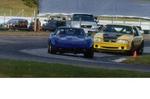
if you look at the pict below the tire should be at a right angle (90degrees) from the track surface but its not. I need to dial in quite a bit of negative camber so the wheel tilts in at the top in turns. On the straights the tread would not be flat on the surface but who cares? You don't have enough power to break the back wheels loose anyway.

Thread Starter
Race Director


Joined: Dec 1999
Posts: 19,610
Likes: 778
From: Forked River NJ
I don't have enough power? I beg to differ on that. I can't keep the tires planted in the the first 2 gears at any speed. 3rd is even tough at the upper RPMs.
I do see a lot of the road racers with a lot of negative camber when they are on the straight and I understand why. I do run a slight amount of negative myself. So the Smart Struts are not going to help. They won't fit anyways and I cancelled my order. This is good info.

Thread Starter
Race Director
Joined: Dec 1999
Posts: 19,610
Likes: 778
From: Forked River NJ

Safety Car

Joined: Oct 1999
Posts: 4,101
Likes: 10
From: NorCal
I agree with both sides of this agument and here's why. Granted, in a racetrack environment with a (generally) very smooth surface and race suspension, TT's points are right on. You either have to have some camber change or you need a totally rigid (F-1 or gokart) suspension which doesn't work either on an old vette. My observation, mostly seat of the pants, is that a little less camber change in the rear works pretty well on the street. Certainly less bump steer under load on most of the less-than-perfect twisty roads around here (which can be scary) is nice and I can dial in a little more intial negative camber than I would normally.
The factory setup is biased toward daily driving by tourists, so the suspension reflects that. Many (if not all) of the changes we make are an attempt at a compromise track/street setup, with the key word being "compromise". just little stuff like a front brace, different tie-rod or rack/pinion setups in front, poly bushings all around, and yes, the lower strut mount makes a world of difference in a street car compared to stock. Heck, the mount is relatively inexpensive so I'd try it and go back to the stock one if you don't care for it.
Hans
The factory setup is biased toward daily driving by tourists, so the suspension reflects that. Many (if not all) of the changes we make are an attempt at a compromise track/street setup, with the key word being "compromise". just little stuff like a front brace, different tie-rod or rack/pinion setups in front, poly bushings all around, and yes, the lower strut mount makes a world of difference in a street car compared to stock. Heck, the mount is relatively inexpensive so I'd try it and go back to the stock one if you don't care for it.
Hans

Race Director


Joined: Dec 1999
Posts: 16,945
Likes: 9
smooth surface or not doesn't have a lot to do with it, camber change is only there to counteract the tire tilting due to body roll. It's not just for F1 or race cars, it's for every car and everyone who is enthousiastic about improving the handling on his car. The rear steering problem is caused by the poor toe control that a trailing arm setup has, it has nothing to do with the camber curve and/or bracket/smart struts.
If there was a car that would not need a lot of camber gain it would be a formula car, they have very little suspension travel and if you observe the wishbones they are - by eye- parallel.
Why would you want more initial camber? This is an indication you require a bit more camber during bump, which you would have if you had increased the camber curve (or in case you swapped to smart struts retained the stock bracket setup), dialing initial camber does nothing but accelerate tire wear and cause uneven temps. Ideally your curve will be such that initial camber is 0 and the curve such that it perfectly coutneracts all body roll. Now, some people see touring cars and similar sedan type race cars with a lot of camber, they have this for a reason....being McPherson & chapman struts that don't offer a camber active geometry.
If stock is a street setup and you want a compromise between street and track with suspension changes yet you retain the stock weight isplacement then you have to fit stiff springs and/or bars to reduce roll, this would make the stock camber curve suit the roll a little more, why reduce the camber curve towards a static setup if you want to go aroudn the twisties? It just doesn't make sense at all.
The shock tower brace is a fix for a flexing frame, a problem even more apparent when fitting stiffer springs because you load up the frame more.
Different steering setups don't matter either, if they are engineered properly they have an acceptable (at least) bump steer characteristic and thus have the components/pivots placed in the right position. Assuming they all are, there is no big individual difference between them (although, the bumspteer in the stock system is not good)
If you want a real world comparison, swap out JUST the bracket, leave the rest stock, comparing a stock system to an aftermarket system offering more roll resistance and what not can mask the difference and is not a fair comparison.
Fiven equal ride height, weight, roll characteristics, tires...and so on, a car with a camber active suspension will be able to corner faster than one with a static setup because it will have more tire on the ground in all cicrumstances.
If there was a car that would not need a lot of camber gain it would be a formula car, they have very little suspension travel and if you observe the wishbones they are - by eye- parallel.
Why would you want more initial camber? This is an indication you require a bit more camber during bump, which you would have if you had increased the camber curve (or in case you swapped to smart struts retained the stock bracket setup), dialing initial camber does nothing but accelerate tire wear and cause uneven temps. Ideally your curve will be such that initial camber is 0 and the curve such that it perfectly coutneracts all body roll. Now, some people see touring cars and similar sedan type race cars with a lot of camber, they have this for a reason....being McPherson & chapman struts that don't offer a camber active geometry.
If stock is a street setup and you want a compromise between street and track with suspension changes yet you retain the stock weight isplacement then you have to fit stiff springs and/or bars to reduce roll, this would make the stock camber curve suit the roll a little more, why reduce the camber curve towards a static setup if you want to go aroudn the twisties? It just doesn't make sense at all.
The shock tower brace is a fix for a flexing frame, a problem even more apparent when fitting stiffer springs because you load up the frame more.
Different steering setups don't matter either, if they are engineered properly they have an acceptable (at least) bump steer characteristic and thus have the components/pivots placed in the right position. Assuming they all are, there is no big individual difference between them (although, the bumspteer in the stock system is not good)
If you want a real world comparison, swap out JUST the bracket, leave the rest stock, comparing a stock system to an aftermarket system offering more roll resistance and what not can mask the difference and is not a fair comparison.
Fiven equal ride height, weight, roll characteristics, tires...and so on, a car with a camber active suspension will be able to corner faster than one with a static setup because it will have more tire on the ground in all cicrumstances.
Corvette Stories
The Best of Corvette for Corvette Enthusiasts

5 Best & 5 Worst Corvette Daily Drivers
Joe Kucinski
The Headlights of Every Corvette Generation Explained
Joe Kucinski
5 Best & 5 Most Overrated Corvette Track Packages of All Time!
Joe Kucinski
Every 2027 Corvette Engine Explained
Joe Kucinski
Designer Imagines A Corvette That Looks More Like a Corvette Than the Corvette
Verdad Gallardo
10 Ugly Corvettes That We Still Kinda Love
Joe Kucinski
Top 10 Most Expensive Corvettes Ever Sold on Bring A Trailer
Brett Foote
10 Things Every Corvette Owner Needs (2026 Edition)
Michael S. Palmer
8 Most "Only Corvette Owners Understand" Quirks and Problems
Pouria Savadkouei
Drifting


Joined: Nov 2002
Posts: 1,951
Likes: 1
From: Shore NJ
Gordons unable to switch just the bracket because of his custom exhaust that's welded, we both have the same problem/exhaust or we would of done so and made a comparision like you suggested. He's lost his rear sway bar due to mounting larger tires/wheels 18" and stiffening up the rear with a higher composite spring weight. I don't know if just changing the bracket will help his wheel hop, I see how the smart struts and bracket would help camber wise, I still think he needs stiffer shocks to control the movement of the trailing arm/loading factor without flexing the frame...I see some have opted for the coil-overs but that involves some modifying ...jmo I think we'll strap a camera underneath and see exactly what's going on during acceleration....
Last edited by 73jst4fun; Dec 18, 2006 at 05:14 PM.
Thread Starter
Race Director
Joined: Dec 1999
Posts: 19,610
Likes: 778
From: Forked River NJ
That is what I have on the car and that looks like it will stay that way.


Safety Car
Joined: Oct 1999
Posts: 4,101
Likes: 10
From: NorCal
TT, I think your understanding of suspension engineering is far above most of our levels (certainly mine!), and I always appreciate your comments. I just think there are different outcome being sought.
Hans
Safety Car
Joined: Oct 1999
Posts: 4,101
Likes: 10
From: NorCal

Melting Slicks
Joined: Feb 2003
Posts: 3,053
Likes: 4
St. Jude Donor '03,'11
Why would you want more initial camber? This is an indication you require a bit more camber during bump, which you would have if you had increased the camber curve (or in case you swapped to smart struts retained the stock bracket setup), dialing initial camber does nothing but accelerate tire wear and cause uneven temps. Ideally your curve will be such that initial camber is 0 and the curve such that it perfectly coutneracts all body roll. Now, some people see touring cars and similar sedan type race cars with a lot of camber, they have this for a reason....being McPherson & chapman struts that don't offer a camber active geometry.
.
.
Tire temps are going to depend on the track. The tire generates very little heat when driving in a straight line. It is possible to have 3 - 4 degrees negative camber and have even temps across the tire. You generate the heat on the outside tires in a turn not on the straights.
P.S. I like the new avatar better than the cartoon thingy.
Last edited by turtlevette; Dec 18, 2006 at 09:19 PM.
Drifting
Joined: Nov 2002
Posts: 1,951
Likes: 1
From: Shore NJ
It's the "wheel hop" that he's got the problem with....the stock strut bracket with the smart struts is there to stay like mine....We both have the identical exhaust and strut setup, he's not going to change the custom welded exhaust for a bracket, there's a clearance issue there.....Yes, he's removed the rear sway bar... great info as always there TT, any other suggestions for "wheel hop" control....
any other suggestions for "wheel hop" control....
Drifting
Joined: Nov 2002
Posts: 1,951
Likes: 1
From: Shore NJ
It's the "wheel hop" that he's got the problem with....the stock strut bracket with the smart struts is there to stay like mine....We both have the identical exhaust and strut setup, he's not going to change the custom welded exhaust for a bracket, there's a clearance issue there.....Yes, he's removed the rear sway bar... great info as always there TT, any other suggestions for "wheel hop" control....
BTW: He's got plenty of HP, can sit there and just burn the hides off.. makes me sick...
any other suggestions for "wheel hop" control....BTW: He's got plenty of HP, can sit there and just burn the hides off..
makes me sick...

