









Pilot Bushing vs Bearing Keisler Install

Thread Starter
Drifting


Joined: May 2005
Posts: 1,629
Likes: 4
From: Somers CT
 Pilot Bushing vs Bearing Keisler Install
I'm getting close to the install in this TKO500, I know Keisler recommends the use of the Pilot Bearing but the things make me nervous as hell and I don't see why the GM bushing I have (which is 1 year old, about 2K miles) can't be just as precise. Is there something particular about this transmission that makes the needle bearing type manditory?
I've read on another forum the needle bearing design was designed by GM for harsh duty and extended life in diesel vehicles. But if I'm not mistaken those engines ralely if ever see over 3K rpm. Are these Needle Bearings good for the long haul under the conditions we use these cars??
I've read on another forum the needle bearing design was designed by GM for harsh duty and extended life in diesel vehicles. But if I'm not mistaken those engines ralely if ever see over 3K rpm. Are these Needle Bearings good for the long haul under the conditions we use these cars??

Pro

Joined: Sep 2006
Posts: 671
Likes: 0
From: McCook Nebraska
I have one in my 70Z28 that I put in 3 years ago in front of an M21 Muncie and it sees 8000 RPM lots of times. Just replaced the pressure plate, clutch plate and throwout bearing and the needle bearing looked like it had just been put in. I would use one again.
greg
greg

Drifting
Joined: Jan 2001
Posts: 1,841
Likes: 3
From: Halifax, NS, Canada
When you install your TKO you have to dial in your bellhousing. The reason you have to do this is because of the precision tolerance of the input shaft. A bronze bushing will wear at a faster rate than a sealed roller bearing. Therefore the roller bearing is recommended over the bushing to maintain that tolerance.
Thread Starter
Drifting
Joined: May 2005
Posts: 1,629
Likes: 4
From: Somers CT
OK Gordonm/mrnasty, thanks. 8k I guess that's a pretty good indicator.
So Binnie, if I align the bellhousing as they recommend why wouldn't the bronze bushing be just as good? They both have the same ID and if it's aligned properly it shouldn't wear.
I'm not trying to be a smart azz, I just can't figure why they say it won't last.
I guess that's a pretty good indicator.When you install your TKO you have to dial in your bellhousing. The reason you have to do this is because of the precision tolerance of the input shaft. A bronze bushing will wear at a faster rate than a sealed roller bearing. Therefore the roller bearing is recommended over the bushing to maintain that tolerance.
So Binnie, if I align the bellhousing as they recommend why wouldn't the bronze bushing be just as good? They both have the same ID and if it's aligned properly it shouldn't wear.
I'm not trying to be a smart azz, I just can't figure why they say it won't last.

Melting Slicks


Joined: Mar 2005
Posts: 2,838
Likes: 10
From: Austin TX
Not me,..I'm using only busings in my Muncie cars. I once removed a tranny from a car I bought and the needle bearings went everywhere. Bearings can fail which means a total R&R of the tranny.
Corvette Stories
The Best of Corvette for Corvette Enthusiasts

Corvette ZR1X Will Be Pacing the Indy 500, And Could Probably Race, Too!
Verdad Gallardo
Top 10 Corvettes Coming to Mecum Indy 2026!
Brett Foote
Top 10 C9 Corvette MUST-HAVES to Fix These C8 Generation Flaws!
Michael S. Palmer
10 Revolutionary 'Corvette Firsts' Most People Don't Know
Joe Kucinski
5 Reasons to Upgrade to an LS6-Powered Corvette; 5 Reasons to Stay LT2
Michael S. Palmer
2027 Corvette vs The World: Every C8 vs Its Closest Competitor
Joe Kucinski
10 Most Common Corvette Problems of the Last 20 Years!
Joe Kucinski
5 MOST and 5 LEAST Popular Corvette Model Years in History!
Joe Kucinski
2027 Corvette Buyer's Guide: Everything You Need to Know!
Joe Kucinski
Melting Slicks
Joined: May 2005
Posts: 2,826
Likes: 3
From: Tennessee
Binnie hit it right on the head!! Any mis-alignment and the bushing will wear causing "slop". If you've ever grabbed hold of the input shaft on a Muncie, you can move it up, down, side to side and in and out. You cannot do that with a TKO. The tolerances are too tight. Thats why Tremec(and Keisler, CC5S etc...)all recommend the needle roller bearing.
Richard
Tech Support
Keisler Engineering
Richard
Tech Support
Keisler Engineering
Thread Starter
Drifting
Joined: May 2005
Posts: 1,629
Likes: 4
From: Somers CT
OK, I'll do as the manufacturer suggests but as I said, if I align the bellhousing to the crank it would seem there shouldn't be any problem. Bronze is soft and will tolerate some error, the needle bearing pilot is not soft and must be perfectly aligned or it may fail.
I did check the input shaft and compare it to the Muncie and it is very tight as you said Richard
I'm making a removal tool at the moment.
Thanks for all the replies!
I did check the input shaft and compare it to the Muncie and it is very tight as you said Richard
I'm making a removal tool at the moment.
Thanks for all the replies!
Thread Starter
Drifting
Joined: May 2005
Posts: 1,629
Likes: 4
From: Somers CT
Removal Tool
I just have to pass this along, this worked so good I couldn't believe it. Thanks to Solid LT1 for this suggestion, this is a 5/8 x 11 bolt with 4 grooves cut in it with a Dremmel tool and the end has been ground off a little. Tap it in the bushing, then put a socket on it. It'll cut threads in the bushing till it reaches the crankshaft then it'll push the bushing out so neat you can hardly believe your eyes! .84 cents for the bolt!
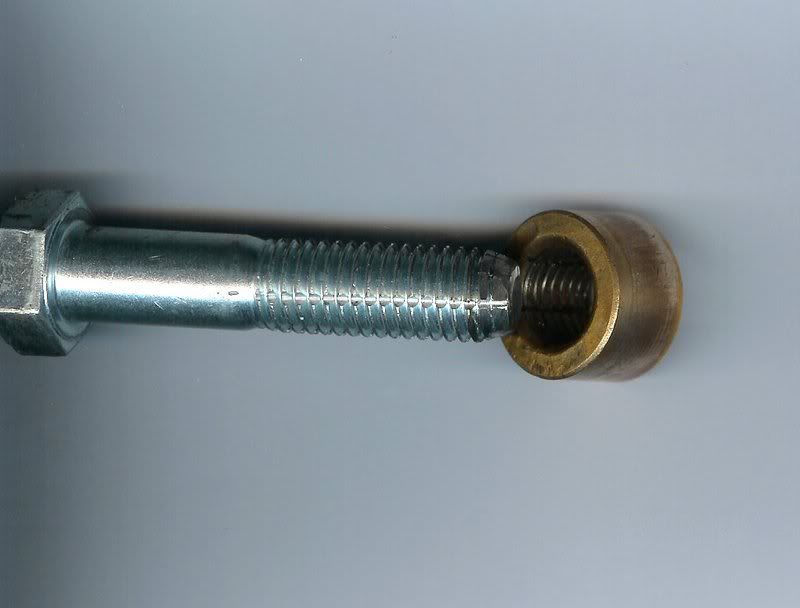
.84 cents for the bolt!
Racer

Joined: Jan 2004
Posts: 428
Likes: 2
From: Everfrost Second Life
Sorry to say, but I have to disagree with this stuff. Alignment is alignment whether you have a bronze bushing or needle set up.
The fact is whether you'd like to believe me or not that the only reason why the TKO is tigher in the front is because the maindrive internal pilot and front bearing are tapered bearings. The slightest looseness of these bearings unloads the box very quickly. The Muncie has a front ball bearing and needle pilot. These are not loaded. The TKO is not any more precise than a Muncie, or Saganaw. Here is a simple test. Drop a rear yoke in a few different TKO transmissions and notice how some slide right in and others are tighter. So much for accuracy.
The point is that if you have a misalignement with a Muncie, the needles internally will skew and chew up. The Muncie input does move up and down, but stick a yoke in the back and see that the transmission is designed to be piloted by both the yoke and "pilot" bushing.
Now about these needle roller pilots. If you have a misalignment with one or a failure, you can expect the tips of your TKO and MUNCIE to get eaten up. If your transmission is dialed in to under .005" having a bushing or needle roller won't make a difference. If you're misaligned with a bushing -- the bushing wears, if your misaligned with a needle - they fail..
The funny thing is that the Winston Cup Jerico 4 speed used the same type ball bearing and needle arangement as the Muncie...
Just get dialed in.... period.
The fact is whether you'd like to believe me or not that the only reason why the TKO is tigher in the front is because the maindrive internal pilot and front bearing are tapered bearings. The slightest looseness of these bearings unloads the box very quickly. The Muncie has a front ball bearing and needle pilot. These are not loaded. The TKO is not any more precise than a Muncie, or Saganaw. Here is a simple test. Drop a rear yoke in a few different TKO transmissions and notice how some slide right in and others are tighter. So much for accuracy.
The point is that if you have a misalignement with a Muncie, the needles internally will skew and chew up. The Muncie input does move up and down, but stick a yoke in the back and see that the transmission is designed to be piloted by both the yoke and "pilot" bushing.
Now about these needle roller pilots. If you have a misalignment with one or a failure, you can expect the tips of your TKO and MUNCIE to get eaten up. If your transmission is dialed in to under .005" having a bushing or needle roller won't make a difference. If you're misaligned with a bushing -- the bushing wears, if your misaligned with a needle - they fail..
The funny thing is that the Winston Cup Jerico 4 speed used the same type ball bearing and needle arangement as the Muncie...
Just get dialed in.... period.
Last edited by 5speeds; Jan 2, 2007 at 02:55 AM. Reason: misspelling
Thread Starter
Drifting
Joined: May 2005
Posts: 1,629
Likes: 4
From: Somers CT
Thanks.............that was exactly my point, only you said it much better. If the alignment is withen spec it shouldn't matter what type of bearing is in there.

Safety Car

Joined: Mar 1999
Posts: 3,715
Likes: 1
From: VASS, NC, USA
Guys, All make a good point, except one thing: Go with the recommended bearing. God forbid if something goes wrong in the future, and you arent running the recommended bearing: Will you tranny be replaced by warranty? It could be the loophole that voids your warranty. Who knows..........
Racer
Joined: Jan 2004
Posts: 428
Likes: 2
From: Everfrost Second Life
These is also a difference in accuracy of machining now compared to 40 years ago.

Melting Slicks

Joined: Feb 2001
Posts: 3,330
Likes: 13
From: Europe , Luxembourg
Hi
I', with you.
But I also think when you remove the old clutch/gearbox after 70.000 or more Miles and the bushing is not worn, this bellhousing does not need any further checks as it probably is perfectly aligned, isn't it ?
Of course if you install a aftermarket bellhousing, this all might be more critical.
I would also be concerned about the fact some others have posted here, that they had to hammer the bearing in. This bearings are rather thin housed and hammering them in will deform them or shrink them. This will surely lead to premature failure. A more or less tight slip fit should be perfect.
My GM bearing went into the 68 BB shaft that way. Tight , but went in without requiring hammering. Just hard push . Slight final knocking with the back wooden side of the hammer.
Günther
I', with you.
But I also think when you remove the old clutch/gearbox after 70.000 or more Miles and the bushing is not worn, this bellhousing does not need any further checks as it probably is perfectly aligned, isn't it ?
Of course if you install a aftermarket bellhousing, this all might be more critical.
I would also be concerned about the fact some others have posted here, that they had to hammer the bearing in. This bearings are rather thin housed and hammering them in will deform them or shrink them. This will surely lead to premature failure. A more or less tight slip fit should be perfect.
My GM bearing went into the 68 BB shaft that way. Tight , but went in without requiring hammering. Just hard push . Slight final knocking with the back wooden side of the hammer.
Günther
Melting Slicks
Joined: May 2005
Posts: 2,826
Likes: 3
From: Tennessee
Sorry to say, but I have to disagree with this stuff. Alignment is alignment whether you have a bronze bushing or needle set up.
The fact is whether you'd like to believe me or not that the only reason why the TKO is tigher in the front is because the maindrive internal pilot and front bearing are tapered bearings. The slightest looseness of these bearings unloads the box very quickly. The Muncie has a front ball bearing and needle pilot. These are not loaded. The TKO is not any more precise than a Muncie, or Saganaw. Here is a simple test. Drop a rear yoke in a few different TKO transmissions and notice how some slide right in and others are tighter. So much for accuracy.
The point is that if you have a misalignement with a Muncie, the needles internally will skew and chew up. The Muncie input does move up and down, but stick a yoke in the back and see that the transmission is designed to be piloted by both the yoke and "pilot" bushing.
Now about these needle roller pilots. If you have a misalignment with one or a failure, you can expect the tips of your TKO and MUNCIE to get eaten up. If your transmission is dialed in to under .005" having a bushing or needle roller won't make a difference. If you're misaligned with a bushing -- the bushing wears, if your misaligned with a needle - they fail..
The funny thing is that the Winston Cup Jerico 4 speed used the same type ball bearing and needle arangement as the Muncie...
Just get dialed in.... period.
The fact is whether you'd like to believe me or not that the only reason why the TKO is tigher in the front is because the maindrive internal pilot and front bearing are tapered bearings. The slightest looseness of these bearings unloads the box very quickly. The Muncie has a front ball bearing and needle pilot. These are not loaded. The TKO is not any more precise than a Muncie, or Saganaw. Here is a simple test. Drop a rear yoke in a few different TKO transmissions and notice how some slide right in and others are tighter. So much for accuracy.
The point is that if you have a misalignement with a Muncie, the needles internally will skew and chew up. The Muncie input does move up and down, but stick a yoke in the back and see that the transmission is designed to be piloted by both the yoke and "pilot" bushing.
Now about these needle roller pilots. If you have a misalignment with one or a failure, you can expect the tips of your TKO and MUNCIE to get eaten up. If your transmission is dialed in to under .005" having a bushing or needle roller won't make a difference. If you're misaligned with a bushing -- the bushing wears, if your misaligned with a needle - they fail..
The funny thing is that the Winston Cup Jerico 4 speed used the same type ball bearing and needle arangement as the Muncie...
Just get dialed in.... period.
My point is, Tremec will void the warranty if it is discovered that a bushing was used instead of a bearing.
Richard

Race Director

Joined: Nov 1999
Posts: 10,643
Likes: 8
From: Foxfield CO 1970 Convertible

Really, with all that money put into a transmission, why screw it up trying to use an old $3 bushing???
Thread Starter
Drifting
Joined: May 2005
Posts: 1,629
Likes: 4
From: Somers CT
The point I was trying to make was that the bronze bushings are more forgiving to very slight alignment errors. They're also oil impregnated and the cost is not an issue. There is absolutely no margin for error with the hardened steel rollers and the only lubrication is the grease that's smeared on them from the manufacturer. If they're out of alignment with the input shaft the bearings will most likely fail and it's a pretty major pain is the a$$ to fix it. To be quite honest I think the bronze bushing is better in some respects IF PROPERLY ALIGNED with the C/L of the input shaft. I'm using the roller only because the manufacturer insists on it, if it wasen't for that I don't think I would.
Bill
