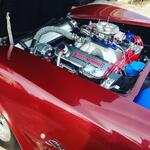
Solid roller lifter adjustment.

Pro


Joined: Apr 2006
Posts: 625
Likes: 49
From: Southern California

Case in point: last time I checked lash, I had 2 that had grown to +.010". I pulled intake last weekend and sure enough, those 2 lifters rolled "gritty"; all the rest rolled as smooth as new.
These were Crower Severe Duty solid rollers w/ HIPPO and I had somewhere in the vicinity of 6K miles on them, which is about what I expected to get out of them. I replaced them w/ newly rebuilt Morel lifters and will check again every few thousand miles, or when I hear more valve train noise.
Street running and idle time w/ solid rollers and attendant 600lb+ open spring loads and.700"+ lift = regular lifter replacement. It just goes with the territory....
These were Crower Severe Duty solid rollers w/ HIPPO and I had somewhere in the vicinity of 6K miles on them, which is about what I expected to get out of them. I replaced them w/ newly rebuilt Morel lifters and will check again every few thousand miles, or when I hear more valve train noise.
Street running and idle time w/ solid rollers and attendant 600lb+ open spring loads and.700"+ lift = regular lifter replacement. It just goes with the territory....
Sorry to hear about your Crowers. But it sounds like you stayed on top of things and caught it in time to avert disaster. Good job. Where were the bad lifters located? Did you make any attempt to compare the oil band between the Crowers and the Morels? Did you make any attempt to modify the new lifters for better oil flow? Have you been running 20W50 the whole time with the Crowers? If you feel like writing up even more details, feel free to send me an email.
RJ

Burning Brakes


Joined: Jul 1999
Posts: 922
Likes: 164
From: Hudson NH
Mark,
Sorry to hear about your Crowers. But it sounds like you stayed on top of things and caught it in time to avert disaster. Good job. Where were the bad lifters located? Did you make any attempt to compare the oil band between the Crowers and the Morels? Did you make any attempt to modify the new lifters for better oil flow? Have you been running 20W50 the whole time with the Crowers? If you feel like writing up even more details, feel free to send me an email.
RJ
Sorry to hear about your Crowers. But it sounds like you stayed on top of things and caught it in time to avert disaster. Good job. Where were the bad lifters located? Did you make any attempt to compare the oil band between the Crowers and the Morels? Did you make any attempt to modify the new lifters for better oil flow? Have you been running 20W50 the whole time with the Crowers? If you feel like writing up even more details, feel free to send me an email.
RJ

Race Director

Joined: Apr 2000
Posts: 17,676
Likes: 201
From: Who says "Nothing is impossible" ? I've been doing nothing for years.
Guys I am not getting the remote starter / bump it over idea. How the heil do you get it to bump over with the starter and stop exactly on TDC of the piston you want to adjust ? 
My cheapo non oiling CC solid roller lifters lasted about 20,000 miles on the street. Did a year end check and found one not rolling smoothly, all the rest were smooth as a ....
My cheapo non oiling CC solid roller lifters lasted about 20,000 miles on the street. Did a year end check and found one not rolling smoothly, all the rest were smooth as a ....
Race Director
Joined: Apr 2000
Posts: 17,676
Likes: 201
From: Who says "Nothing is impossible" ? I've been doing nothing for years.
Technically you are correct, whether it's the heel or TDC dosen't really matter ( personally I have been using TDC for last 35 years without any problems )
My question was how do you stop it where you want at the correct point. you don't have that much either way to play with, especially with big cam, the ramps start a long way back
My question was how do you stop it where you want at the correct point. you don't have that much either way to play with, especially with big cam, the ramps start a long way back

Le Mans Master


Joined: Apr 2007
Posts: 7,353
Likes: 72
From: Graceland in a Not Correctly Restored Stingray
One fairly reliable method, if you don't have a valve lash indexed damper, is to put the valve next to the one you want to set at approx. max lift paying attention to whether it's an exhaust or intake to make sure you're not nearing overlap.
Race Director
Joined: Apr 2000
Posts: 17,676
Likes: 201
From: Who says "Nothing is impossible" ? I've been doing nothing for years.
What I am getting at is, how do you bump the motor over with the starter and magically make it land on on the exact spot where you want to set the lash.
I am quite familiar with setting lash but I crank it over by hand.
You know this is kinda weird, this insn't the first time I asked this in a setting the valve lash thread, when someone says " All I do is bump it over with starter "
I am quite familiar with setting lash but I crank it over by hand.
You know this is kinda weird, this insn't the first time I asked this in a setting the valve lash thread, when someone says " All I do is bump it over with starter "

Thread Starter
Team Owner

Joined: Apr 1999
Posts: 21,953
Likes: 1,445
From: Reno Nevada
2024 C3 of the Year Finalist- Modified
I've never been a by the book person. I've done it in the pits for my dragster, Vette, and Sprint cars as a pit crew man. I have found that you can hand crank and see where nearly 1/2 the valves are compressed and nearly 1/2 are of course loose and ready to adjust.
I'm using the Crane ultra Pro lifters in each of my motors with higher end CC springs. I use Manley ProFlow exhaust and titanium intake valves. IN a sub 7500 rpm motor. I have over 40 psi at idle with 20W-50. So this last oil Change got 7 quarts of 10W40 full syn Mobil with one quart of 60 weight Zinc racing oil for top alki cars
All the time people ask how to do this procedure, and it seems that everyone they ask gives them a different answer. Let's see if I can make this easy to understand for just about everyone. Read this entire article to understand correct valve adjustment procedures for most engines.
Valve Adjustment The Quick Way:
Ok, now to the good stuff! First, view this little chart for Small and Big Block Chevy Engines that I made and see if you can understand it ... for other engines, use your firing order that matches your engine to do the same. You set up this procedure based upon "opposite" cylinders of your firing order. (see below)
Intake Valve Adjustment: ENGINE OFF!
with #1 cylinder Intake Valve at full valve lift .... Adjust #6 Intake Valve
with #8 cylinder Intake Valve at full valve lift .... Adjust #5 Intake Valve
with #4 cylinder Intake Valve at full valve lift .... Adjust #7 Intake Valve
with #3 cylinder Intake Valve at full valve lift .... Adjust #2 Intake Valve
with #6 cylinder Intake Valve at full valve lift .... Adjust #1 Intake Valve
with #5 cylinder Intake Valve at full valve lift .... Adjust #8 Intake Valve
with #7 cylinder Intake Valve at full valve lift .... Adjust #4 Intake Valve
with #2 cylinder Intake Valve at full valve lift .... Adjust #3 Intake Valve
Exhaust Valve Adjustment: ENGINE OFF!
If you have noticed, this is the same procedure as the intake valves listed above, just that you are now adjusting the exhaust valves the same way.
with #1 cylinder Exhaust Valve at full valve lift .... Adjust #6 Exhaust Valve
with #8 cylinder Exhaust Valve at full valve lift .... Adjust #5 Exhaust Valve
with #4 cylinder Exhaust Valve at full valve lift .... Adjust #7 Exhaust Valve
with #3 cylinder Exhaust Valve at full valve lift .... Adjust #2 Exhaust Valve
with #6 cylinder Exhaust Valve at full valve lift .... Adjust #1 Exhaust Valve
with #5 cylinder Exhaust Valve at full valve lift .... Adjust #8 Exhaust Valve
with #7 cylinder Exhaust Valve at full valve lift .... Adjust #4 Exhaust Valve
with #2 cylinder Exhaust Valve at full valve lift .... Adjust #3 Exhaust Valve
I'm using the Crane ultra Pro lifters in each of my motors with higher end CC springs. I use Manley ProFlow exhaust and titanium intake valves. IN a sub 7500 rpm motor. I have over 40 psi at idle with 20W-50. So this last oil Change got 7 quarts of 10W40 full syn Mobil with one quart of 60 weight Zinc racing oil for top alki cars
All the time people ask how to do this procedure, and it seems that everyone they ask gives them a different answer. Let's see if I can make this easy to understand for just about everyone. Read this entire article to understand correct valve adjustment procedures for most engines.
Valve Adjustment The Quick Way:
Ok, now to the good stuff! First, view this little chart for Small and Big Block Chevy Engines that I made and see if you can understand it ... for other engines, use your firing order that matches your engine to do the same. You set up this procedure based upon "opposite" cylinders of your firing order. (see below)
Intake Valve Adjustment: ENGINE OFF!
with #1 cylinder Intake Valve at full valve lift .... Adjust #6 Intake Valve
with #8 cylinder Intake Valve at full valve lift .... Adjust #5 Intake Valve
with #4 cylinder Intake Valve at full valve lift .... Adjust #7 Intake Valve
with #3 cylinder Intake Valve at full valve lift .... Adjust #2 Intake Valve
with #6 cylinder Intake Valve at full valve lift .... Adjust #1 Intake Valve
with #5 cylinder Intake Valve at full valve lift .... Adjust #8 Intake Valve
with #7 cylinder Intake Valve at full valve lift .... Adjust #4 Intake Valve
with #2 cylinder Intake Valve at full valve lift .... Adjust #3 Intake Valve
Exhaust Valve Adjustment: ENGINE OFF!
If you have noticed, this is the same procedure as the intake valves listed above, just that you are now adjusting the exhaust valves the same way.
with #1 cylinder Exhaust Valve at full valve lift .... Adjust #6 Exhaust Valve
with #8 cylinder Exhaust Valve at full valve lift .... Adjust #5 Exhaust Valve
with #4 cylinder Exhaust Valve at full valve lift .... Adjust #7 Exhaust Valve
with #3 cylinder Exhaust Valve at full valve lift .... Adjust #2 Exhaust Valve
with #6 cylinder Exhaust Valve at full valve lift .... Adjust #1 Exhaust Valve
with #5 cylinder Exhaust Valve at full valve lift .... Adjust #8 Exhaust Valve
with #7 cylinder Exhaust Valve at full valve lift .... Adjust #4 Exhaust Valve
with #2 cylinder Exhaust Valve at full valve lift .... Adjust #3 Exhaust Valve
Corvette Stories
The Best of Corvette for Corvette Enthusiasts

Top 10 Most Expensive Corvettes Ever Sold on Bring A Trailer
Brett Foote
10 Things Every Corvette Owner Needs (2026 Edition)
Michael S. Palmer
8 Most "Only Corvette Owners Understand" Quirks and Problems
Pouria Savadkouei
10 Reasons the C6 Z06 is Still A Performance Benchmark After 20 Years
Joe Kucinski
How Much Horsepower Every Corvette Engine "LOST" in 1972
Joe Kucinski
Top 10 DOs and DON'Ts for Protecting Your Convertible Top!
Michael S. Palmer
Top 10 Most Explosive Corvettes Ever Made: Power-to-Weight Ratio Ranked!
Joe Kucinski
150 hp to 1,250 hp: Every Corvette Generation Compared by the Specs That Matter
Joe Kucinski
8 Coolest Corvette Pace Cars (and Replicas) of All Time
Verdad Gallardo



Race Director

Joined: Jan 2000
Posts: 13,018
Likes: 2,262
From: Corsicana, Tx
2020 C2 of the Year - Modified Winner
2020 Corvette of the Year (performance mods)
C2 of Year Winner (performance mods) 2019
2017 C2 of Year Finalist
It's not as dead serious as all of that. Set it both ways and check and you'll see.
Been doing the bump over method for years and most racers I know do the same.
You just have to think through the valve events.
I bump it over until the exhaust valve just starts to open. When it does...I set the intake valve for that cylinder. Think about it, if the exhaust is opening.....you know piston is on the way down and it's going to be a long time before the intake is anywhere near starting to open.
Then I bump it until the intake is almost closed. All the way open....going back closed and almost there. At that point I set the exhaust valve for that cylinder. Same deal. if the intake is closing, you know it's starting compression stroke...it's going to be a long time before exhaust is anywhere near opening.
Try it just for fun....set it by TDC method......and go back and forth across the motor. Then roll it over to the points I described above and recheck them. You'll find them the same.
I just pull the valve cover...and start bumping the motor and go right down the line from front to rear. No going back and forth. Literally takes less than a minute to check them all......2-5 minutes if I have to adjust anything...and that's with a stud girdle.
Works for me!
JIM
Been doing the bump over method for years and most racers I know do the same.
You just have to think through the valve events.
I bump it over until the exhaust valve just starts to open. When it does...I set the intake valve for that cylinder. Think about it, if the exhaust is opening.....you know piston is on the way down and it's going to be a long time before the intake is anywhere near starting to open.
Then I bump it until the intake is almost closed. All the way open....going back closed and almost there. At that point I set the exhaust valve for that cylinder. Same deal. if the intake is closing, you know it's starting compression stroke...it's going to be a long time before exhaust is anywhere near opening.
Try it just for fun....set it by TDC method......and go back and forth across the motor. Then roll it over to the points I described above and recheck them. You'll find them the same.
I just pull the valve cover...and start bumping the motor and go right down the line from front to rear. No going back and forth. Literally takes less than a minute to check them all......2-5 minutes if I have to adjust anything...and that's with a stud girdle.
Works for me!
JIM
Burning Brakes
Joined: Jul 1999
Posts: 922
Likes: 164
From: Hudson NH

EO - IC method
Exhaust begins to open: set intake lash
Intake nearly closes: set exhaust lash
do one cylinder hot and let cool overnight. Re-check lash and you've determined how much lash changes and now you can set them all on a cold engine.