



Dedicated nitrous fuel system question...

Thread Starter
Team Owner

Joined: Jul 2001
Posts: 182,997
Likes: 88
From: Lakeland, FL
Cruise-In IV-V-VI-VII-VIII Veteran
St. Jude Donor '03, '06, '17
 Dedicated nitrous fuel system question...
I finally hooked up my nitrous fuel pump for my dedicated nitrous fuel system..
I'm running a 2nd fuel pump in separate fuel lines for the nitrous. The fuel lines go to a non-bypass regulator and then to the fuel system of the nitrous.
Turned on the pumps to adjust the fuel pressure at the nitrous side. The fuel pressure kept on climbing and I had to shut off the pumps. Looks like the non-bypass regulator allows pressure to build up if there's no bypass... Is my analysis correct? Do I need a bypass regulator for a dedicated nitrous fuel system?? Is there any way to run a regular regulator?
I'm running a 2nd fuel pump in separate fuel lines for the nitrous. The fuel lines go to a non-bypass regulator and then to the fuel system of the nitrous.
Turned on the pumps to adjust the fuel pressure at the nitrous side. The fuel pressure kept on climbing and I had to shut off the pumps. Looks like the non-bypass regulator allows pressure to build up if there's no bypass... Is my analysis correct? Do I need a bypass regulator for a dedicated nitrous fuel system?? Is there any way to run a regular regulator?
Pro

Joined: Jun 2004
Posts: 700
Likes: 0
From: Lantana TX
It all depends on the fuel pump that you bought. usually they will specifically state if you need a by-pass of not. However the higher the GPM/pressure the more likely you are goinng to need a bypass or you will blow your pump and don't forget to install a pressure switch.
I was thinking of doing the same thing so I will be carefully watching your progress...any pics of the set up? Where are you putting your tank and what size 3 gal maybe?
later
I was thinking of doing the same thing so I will be carefully watching your progress...any pics of the set up? Where are you putting your tank and what size 3 gal maybe?
later
Thread Starter
Team Owner
Joined: Jul 2001
Posts: 182,997
Likes: 88
From: Lakeland, FL
Cruise-In IV-V-VI-VII-VIII Veteran
St. Jude Donor '03, '06, '17
It all depends on the fuel pump that you bought. usually they will specifically state if you need a by-pass of not. However the higher the GPM/pressure the more likely you are goinng to need a bypass or you will blow your pump and don't forget to install a pressure switch.
I was thinking of doing the same thing so I will be carefully watching your progress...any pics of the set up? Where are you putting your tank and what size 3 gal maybe?
later
I was thinking of doing the same thing so I will be carefully watching your progress...any pics of the set up? Where are you putting your tank and what size 3 gal maybe?
later
Safety Car


Joined: Aug 2001
Posts: 3,892
Likes: 13
From: Pettis Performance 565 with two stages of Nitrous Supply nitrous 1.082, 4.61 at 155, 7.17 at 192
Dead head the nitrous fuel side into the reg, no by-pass....especially with a small pump !!! You can not set your flowing pressure the way you described. Only two ways to do it, one get a flow tool http://nitroussupply.com/proddetail.php?prod=NS-25960 Get one Oliver, there are a MUST HAVE for any semi serious nitrous car. The other way to flow the fuel side is to put your plate over a bucket and turn the fuel on....then adjust the regulator to the FLOWING pressure you want. When ever nitrous guys talk about fuel pressure they are referring to flowing pressure. If you just turn the pump on and it is dead headed into a reg the pressure will build as you observed.
Can you post a pic; just so I can take a look at what you have going on.
What are you using for the dedicated pump ? Is there any way for the nitrous system to be armed and the second pump not be on ? make sure they both come on together, if the nitrous flows with no fuel you will be buying 8 new pistons......at a minimum.
I am not a fan of dedicated nitrous fuel systems, just one more thing to go wrong. It is best to just get one BIG pump that will feed the engine and the unit(s). I know that Oliver was trying to save a few bucks and already had a pump for the engine, fair enough, it will work......as long as the nitrous side fuel pump is on and can keep up.
Can you post a pic; just so I can take a look at what you have going on.
What are you using for the dedicated pump ? Is there any way for the nitrous system to be armed and the second pump not be on ? make sure they both come on together, if the nitrous flows with no fuel you will be buying 8 new pistons......at a minimum.
I am not a fan of dedicated nitrous fuel systems, just one more thing to go wrong. It is best to just get one BIG pump that will feed the engine and the unit(s). I know that Oliver was trying to save a few bucks and already had a pump for the engine, fair enough, it will work......as long as the nitrous side fuel pump is on and can keep up.
Thread Starter
Team Owner
Joined: Jul 2001
Posts: 182,997
Likes: 88
From: Lakeland, FL
Cruise-In IV-V-VI-VII-VIII Veteran
St. Jude Donor '03, '06, '17


The nitrous fuel line comes into the regulator IN side and one of the outlets goes to the low pressure switch and the other one goes to the nitrous solenoid. Both fuel pumps are running and the fuel pressure on the carb side is steady and the one on the nitrous side is consistently rising.
BTW - I also installed the transbrake switch.. Installed it on the steering wheel. Also hooked up the 2-step to the same power feed as the transbrake. (I'm running the t-brake setup through a 30 amp relay)
Here's a pick of the transbrake button..

Last edited by GrandSportC3; Dec 17, 2007 at 07:35 AM.
Race Director


Joined: Jan 2000
Posts: 13,015
Likes: 2,259
From: Corsicana, Tx
2020 C2 of the Year - Modified Winner
2020 Corvette of the Year (performance mods)
C2 of Year Winner (performance mods) 2019
2017 C2 of Year Finalist
Olllie...pay attention here. Whatever John says..do it. I don't think there is anyone around here that has made as many high HP N20 runs WITHOUT hurting anything in the motor. You're getting into serious territory here with strong motor and N20. Plus John has the ear of some of the folks who basically invented the N20 world we know today. if I was to ever go back to using nitrous, there is no way John wouldn't be the first person I'd call!
If for whatever reason you do the fuel in the bucket trick...be VERY careful. I used to do my N20 tuning that way many years ago until I got a great big flash fire and no more eyebrows and a lot less hair!
We were doing it the way we always did. I was holding the plate over the bucket and we used extra long wires to activate the solenoids with a switch from a battery under the hood of another car that was probably 20 ft away. We had been spraying and adjusting for a little while when all of a sudden I caught a little spark out of the corner of my eye over under the hood of my buddy's Roadrunner. One of the wire clips popped off the battery and made a spark. Before I could react a huge fireball came across the shop consuming all the fumes in the air and flashed right to the bucket of gas at my fingertips. THEN I found out just how much gas had splashed on my shirt as it caught fire and started burning. As you can imagine, it was a very tense few seconds. I'm on fire- shirt, hands and arms as well as a neat burning haze on my pants legs, the bucket is burning BIG (plastic bucket of course..you can see where this is headed!), the Roadrunner has a fire going under the hood, the shop floor is on fire etc etc.
We managed to get me put out, threw a bunch of oil dry on the Roadrunner and got the bucket put out. I can tell you burning hair is not good!
Anyway, just be VERY VERY careful when tuning like that. Makes a test tool seem awful cheap!
JIM
If for whatever reason you do the fuel in the bucket trick...be VERY careful. I used to do my N20 tuning that way many years ago until I got a great big flash fire and no more eyebrows and a lot less hair!
We were doing it the way we always did. I was holding the plate over the bucket and we used extra long wires to activate the solenoids with a switch from a battery under the hood of another car that was probably 20 ft away. We had been spraying and adjusting for a little while when all of a sudden I caught a little spark out of the corner of my eye over under the hood of my buddy's Roadrunner. One of the wire clips popped off the battery and made a spark. Before I could react a huge fireball came across the shop consuming all the fumes in the air and flashed right to the bucket of gas at my fingertips. THEN I found out just how much gas had splashed on my shirt as it caught fire and started burning. As you can imagine, it was a very tense few seconds. I'm on fire- shirt, hands and arms as well as a neat burning haze on my pants legs, the bucket is burning BIG (plastic bucket of course..you can see where this is headed!), the Roadrunner has a fire going under the hood, the shop floor is on fire etc etc.
We managed to get me put out, threw a bunch of oil dry on the Roadrunner and got the bucket put out. I can tell you burning hair is not good!
Anyway, just be VERY VERY careful when tuning like that. Makes a test tool seem awful cheap!
JIM
Thread Starter
Team Owner
Joined: Jul 2001
Posts: 182,997
Likes: 88
From: Lakeland, FL
Cruise-In IV-V-VI-VII-VIII Veteran
St. Jude Donor '03, '06, '17
Olllie...pay attention here. Whatever John says..do it. I don't think there is anyone around here that has made as many high HP N20 runs WITHOUT hurting anything in the motor. You're getting into serious territory here with strong motor and N20. Plus John has the ear of some of the folks who basically invented the N20 world we know today. if I was to ever go back to using nitrous, there is no way John wouldn't be the first person I'd call!
If for whatever reason you do the fuel in the bucket trick...be VERY careful. I used to do my N20 tuning that way many years ago until I got a great big flash fire and no more eyebrows and a lot less hair!
We were doing it the way we always did. I was holding the plate over the bucket and we used extra long wires to activate the solenoids with a switch from a battery under the hood of another car that was probably 20 ft away. We had been spraying and adjusting for a little while when all of a sudden I caught a little spark out of the corner of my eye over under the hood of my buddy's Roadrunner. One of the wire clips popped off the battery and made a spark. Before I could react a huge fireball came across the shop consuming all the fumes in the air and flashed right to the bucket of gas at my fingertips. THEN I found out just how much gas had splashed on my shirt as it caught fire and started burning. As you can imagine, it was a very tense few seconds. I'm on fire- shirt, hands and arms as well as a neat burning haze on my pants legs, the bucket is burning BIG (plastic bucket of course..you can see where this is headed!), the Roadrunner has a fire going under the hood, the shop floor is on fire etc etc.
We managed to get me put out, threw a bunch of oil dry on the Roadrunner and got the bucket put out. I can tell you burning hair is not good!
Anyway, just be VERY VERY careful when tuning like that. Makes a test tool seem awful cheap!
JIM
If for whatever reason you do the fuel in the bucket trick...be VERY careful. I used to do my N20 tuning that way many years ago until I got a great big flash fire and no more eyebrows and a lot less hair!
We were doing it the way we always did. I was holding the plate over the bucket and we used extra long wires to activate the solenoids with a switch from a battery under the hood of another car that was probably 20 ft away. We had been spraying and adjusting for a little while when all of a sudden I caught a little spark out of the corner of my eye over under the hood of my buddy's Roadrunner. One of the wire clips popped off the battery and made a spark. Before I could react a huge fireball came across the shop consuming all the fumes in the air and flashed right to the bucket of gas at my fingertips. THEN I found out just how much gas had splashed on my shirt as it caught fire and started burning. As you can imagine, it was a very tense few seconds. I'm on fire- shirt, hands and arms as well as a neat burning haze on my pants legs, the bucket is burning BIG (plastic bucket of course..you can see where this is headed!), the Roadrunner has a fire going under the hood, the shop floor is on fire etc etc.
We managed to get me put out, threw a bunch of oil dry on the Roadrunner and got the bucket put out. I can tell you burning hair is not good!
Anyway, just be VERY VERY careful when tuning like that. Makes a test tool seem awful cheap!
JIM

Safety Car
Joined: Aug 2001
Posts: 3,892
Likes: 13
From: Pettis Performance 565 with two stages of Nitrous Supply nitrous 1.082, 4.61 at 155, 7.17 at 192
Flowing into a bucket is no way for a bracket racer to do it anyway.....works well for a little hit that you want to set and forget but the regulators will always creep a little....even the little Holley's that Oliver has....BTW, Those are the best regs there are for nitrous use. I have seen 5 of them on Fulton's new 800++ in. nitrous engines controlling 5 stages of nitrous. If they are good enough for Gene, and every other PM, Outlaw 10.5 racer, etc, they are good enough for me.
To be a consistent bracket racer you really should flow your fuel at least before every race. I flow mine between every pass....and had to adjust it a little between almost every pass. I try to keep my flowing fuel pressure to within 1/10 #...helps keep the car consistent. I put a T fitting with a cap on it right before the fuel solenoid. You can unscrew the cap, put your flow tool on it,turn the pump on and adjust the fuel pressure at the reg, turn off the pump remove the flow tool, put the cap back on and go make a pass.
With as much compression as your 434 has there is no doubt I would get a flow tool, make small changes in the tune and use C-16 fuel, can not skimp here, just because a fuel has a high octane does not make it a suitable fuel for high compression and nitrous. I know of a few guys who tried to use C-25 (pro stock fuel) 18+ to 1 dynamic compression ratios (pro stock engines) and it detonated in a nitrous motor.....lots of octane but was not compatible in a nitrous engine. A friend of mine tried to use some 118 octane no name fuel and it detonated in a 13.5 to 1 engine....can not skimp on fuel in a real race engine. I told him not to buy that crap.
If that flow tool from NS gives you sticker shock you can make your own, or do an ebay search....after all you are the ebay king Ollie !!
To be a consistent bracket racer you really should flow your fuel at least before every race. I flow mine between every pass....and had to adjust it a little between almost every pass. I try to keep my flowing fuel pressure to within 1/10 #...helps keep the car consistent. I put a T fitting with a cap on it right before the fuel solenoid. You can unscrew the cap, put your flow tool on it,turn the pump on and adjust the fuel pressure at the reg, turn off the pump remove the flow tool, put the cap back on and go make a pass.
With as much compression as your 434 has there is no doubt I would get a flow tool, make small changes in the tune and use C-16 fuel, can not skimp here, just because a fuel has a high octane does not make it a suitable fuel for high compression and nitrous. I know of a few guys who tried to use C-25 (pro stock fuel) 18+ to 1 dynamic compression ratios (pro stock engines) and it detonated in a nitrous motor.....lots of octane but was not compatible in a nitrous engine. A friend of mine tried to use some 118 octane no name fuel and it detonated in a 13.5 to 1 engine....can not skimp on fuel in a real race engine. I told him not to buy that crap.
If that flow tool from NS gives you sticker shock you can make your own, or do an ebay search....after all you are the ebay king Ollie !!
Last edited by 69 N.O.X. RATT; Dec 16, 2007 at 01:16 AM.
Corvette Stories
The Best of Corvette for Corvette Enthusiasts

150 hp to 1,250 hp: Every Corvette Generation Compared by the Specs That Matter
Joe Kucinski
8 Coolest Corvette Pace Cars (and Replicas) of All Time
Verdad Gallardo
Top 10 Corvette Engines RANKED by Peak Torque (70+ Years of Muscle!)
Joe Kucinski
Corvette ZR1X Will Be Pacing the Indy 500, And Could Probably Race, Too!
Verdad Gallardo
Top 10 Corvettes Coming to Mecum Indy 2026!
Brett Foote
Top 10 C9 Corvette MUST-HAVES to Fix These C8 Generation Flaws!
Michael S. Palmer
10 Revolutionary 'Corvette Firsts' Most People Don't Know
Joe Kucinski
5 Reasons to Upgrade to an LS6-Powered Corvette; 5 Reasons to Stay LT2
Michael S. Palmer
2027 Corvette vs The World: Every C8 vs Its Closest Competitor
Joe Kucinski
Thread Starter
Team Owner
Joined: Jul 2001
Posts: 182,997
Likes: 88
From: Lakeland, FL
Cruise-In IV-V-VI-VII-VIII Veteran
St. Jude Donor '03, '06, '17
Flowing into a bucket is no way for a bracket racer to do it anyway.....works well for a little hit that you want to set and forget but the regulators will always creep a little....even the little Holley's that Oliver has....BTW, Those are the best regs there are for nitrous use. I have seen 5 of them on Fulton's new 800++ in. nitrous engines controlling 5 stages of nitrous. If they are good enough for Gene, and every other PM, Outlaw 10.5 racer, etc, they are good enough for me.
To be a consistent bracket racer you really should flow your fuel at least before every race. I flow mine between every pass....and had to adjust it a little between almost every pass. I try to keep my flowing fuel pressure to within 1/10 #...helps keep the car consistent. I put a T fitting with a cap on it right before the fuel solenoid. You can unscrew the cap, put your flow tool on it,turn the pump on and adjust the fuel pressure at the reg, turn off the pump remove the flow tool, put the cap back on and go make a pass.
With as much compression as your 434 has there is no doubt I would get a flow tool, make small changes in the tune and use C-16 fuel, can not skimp here, just because a fuel has a high octane does not make it a suitable fuel for high compression and nitrous. I know of a few guys who tried to use C-25 (pro stock fuel) 18+ to 1 dynamic compression ratios (pro stock engines) and it detonated in a nitrous motor.....lots of octane but was not compatible in a nitrous engine. A friend of mine tried to use some 118 octane no name fuel and it detonated in a 13.5 to 1 engine....can not skimp on fuel in a real race engine. I told him not to buy that crap.
If that flow tool from NS gives you sticker shock you can make your own, or do an ebay search....after all you are the ebay king Ollie !!
To be a consistent bracket racer you really should flow your fuel at least before every race. I flow mine between every pass....and had to adjust it a little between almost every pass. I try to keep my flowing fuel pressure to within 1/10 #...helps keep the car consistent. I put a T fitting with a cap on it right before the fuel solenoid. You can unscrew the cap, put your flow tool on it,turn the pump on and adjust the fuel pressure at the reg, turn off the pump remove the flow tool, put the cap back on and go make a pass.
With as much compression as your 434 has there is no doubt I would get a flow tool, make small changes in the tune and use C-16 fuel, can not skimp here, just because a fuel has a high octane does not make it a suitable fuel for high compression and nitrous. I know of a few guys who tried to use C-25 (pro stock fuel) 18+ to 1 dynamic compression ratios (pro stock engines) and it detonated in a nitrous motor.....lots of octane but was not compatible in a nitrous engine. A friend of mine tried to use some 118 octane no name fuel and it detonated in a 13.5 to 1 engine....can not skimp on fuel in a real race engine. I told him not to buy that crap.
If that flow tool from NS gives you sticker shock you can make your own, or do an ebay search....after all you are the ebay king Ollie !!
Checked on Ebay and found this one:
http://cgi.ebay.com/ebaymotors/Nitro...spagenameZWD1V
That should work ok... As for fuel, I'm planning on running Sunoco 116 if running the nitrous. I like Sunoco fuels as they have higher motor octane rating than VP fuels..
I still don't know why my fuel pressure is rising on the nitrous fuel system???
EDIT: Tried again today and the fuel pressure was steady.. I have no idea what caused it to rise yesterday.. I did have a little fuel leak at the gauge but I can't see how that would cause the pressure to rise??
Last edited by GrandSportC3; Dec 16, 2007 at 09:43 AM.
Race Director
Joined: Jan 2000
Posts: 13,015
Likes: 2,259
From: Corsicana, Tx
2020 C2 of the Year - Modified Winner
2020 Corvette of the Year (performance mods)
C2 of Year Winner (performance mods) 2019
2017 C2 of Year Finalist
I'd do a little research on that tool. Look at the one John showed you. Look at the size of the gauge..AND the part about being accurate within 1%. John is talking about keeping it within 1/10th of a pound flowing....that's going to be tough to see with that little gauge....even if by some freak chance it IS that accurate, which I doubt.
Again, you're in new territory here. You already have a high compression race engine. Even just throwing a 150-200 shot on it is more critical than say on a much milder motor. You're much closer to the edge already.
I've heard from many serious N20 folks that the Holley regs are the best for N20. Jeff Prock among them. But they still have to be monitored closely. They are all just simple springs and a diaphragm....nothing fancy . But the Holley's seem to react to the pressure change quicker when the solenoids open and are less likely to go instantly lean.
Steve Barker did some interesting data logger stuff with his and was shocked to see what was actually happening the instant the N20 went active. And he used separate dedicated huge pumps and tanks also.
You also want all your wiring completely bullet proof. Many motors have been fried from poor wiring. Eliminate slip connections as much as possible. Solder connections, use heavy wire for low resistance, isolate them from vibration or chances of working loose when you are working on something else etc etc. Best to use some weatherpak connectors that will not get damaged or get corrosion in them. Wiring on N20 is something you want to do right and only one time.
JIM
Again, you're in new territory here. You already have a high compression race engine. Even just throwing a 150-200 shot on it is more critical than say on a much milder motor. You're much closer to the edge already.
I've heard from many serious N20 folks that the Holley regs are the best for N20. Jeff Prock among them. But they still have to be monitored closely. They are all just simple springs and a diaphragm....nothing fancy . But the Holley's seem to react to the pressure change quicker when the solenoids open and are less likely to go instantly lean.
Steve Barker did some interesting data logger stuff with his and was shocked to see what was actually happening the instant the N20 went active. And he used separate dedicated huge pumps and tanks also.
You also want all your wiring completely bullet proof. Many motors have been fried from poor wiring. Eliminate slip connections as much as possible. Solder connections, use heavy wire for low resistance, isolate them from vibration or chances of working loose when you are working on something else etc etc. Best to use some weatherpak connectors that will not get damaged or get corrosion in them. Wiring on N20 is something you want to do right and only one time.
JIM
Safety Car
Joined: Aug 2001
Posts: 3,892
Likes: 13
From: Pettis Performance 565 with two stages of Nitrous Supply nitrous 1.082, 4.61 at 155, 7.17 at 192
That little gauge is a lot better than what you had. Keep in mind liquid filled gauges can be heat sensitive, so keep that in mind. I "think" they normally only have problems when exposed to under hood temps...so you should be ok. That being said I still highly recommend the better gauge from NS. If you are at all interested shoot me a PM and I can get you a deal on it. If you figure how long you are going to race and how many nitrous passes you will make...it is really a very cheap insurance policy. You have talked about running some pretty aggressive tunes and there is not way I would run big hits with that little cheapy flow tool you are planning on.
I like Sunoco fuels also....the 116 should be fine for what you are doing. I would prefer C-16 though. C-16 is the fuel 90+% of guys with engines like yours burn. I will run C and Q-16 (oxygenated) in my 555. What plugs are you planning on ?? -8's on the motor and -9's on nitrous ? NGK's ? or the Autolites ? I prefer the NGK's, the caduim plating tends to burn off and makes it easy to read the plugs, no doubt NGK's are the easiest to read. Some say they are a bit of a "fuse" also....in other words you will normally burn the tip off the plug before you torch a piston. Where as the Autolites are a tougher plug and if burn one of those you have probably burned a piston. I do not know, I have never nipped a plug.
What is the quench in your motor ? did your builder do anything to set the engine up for nitrous ? rings (brand ?), ring gap ? smooth sharp edges on pistons and combustion chamber, etc. With as much compression as you have and as much nitrous as you want to run all these little things add up.
Good luck Oliver, I wish my car was as close to done as yours is
John
I like Sunoco fuels also....the 116 should be fine for what you are doing. I would prefer C-16 though. C-16 is the fuel 90+% of guys with engines like yours burn. I will run C and Q-16 (oxygenated) in my 555. What plugs are you planning on ?? -8's on the motor and -9's on nitrous ? NGK's ? or the Autolites ? I prefer the NGK's, the caduim plating tends to burn off and makes it easy to read the plugs, no doubt NGK's are the easiest to read. Some say they are a bit of a "fuse" also....in other words you will normally burn the tip off the plug before you torch a piston. Where as the Autolites are a tougher plug and if burn one of those you have probably burned a piston. I do not know, I have never nipped a plug.
What is the quench in your motor ? did your builder do anything to set the engine up for nitrous ? rings (brand ?), ring gap ? smooth sharp edges on pistons and combustion chamber, etc. With as much compression as you have and as much nitrous as you want to run all these little things add up.
Good luck Oliver, I wish my car was as close to done as yours is
John
Safety Car
Joined: Aug 2001
Posts: 3,892
Likes: 13
From: Pettis Performance 565 with two stages of Nitrous Supply nitrous 1.082, 4.61 at 155, 7.17 at 192
Great Points on the wiring !!
Your right about the gauges also Jim....that little gauge is nowhere near as accurate as the big gauge. I have a similar huge accurate gauge to moniter the nitrous pressure.
Your right about the gauges also Jim....that little gauge is nowhere near as accurate as the big gauge. I have a similar huge accurate gauge to moniter the nitrous pressure.
Last edited by 69 N.O.X. RATT; Dec 16, 2007 at 12:27 PM.
Racer

Joined: Jul 2004
Posts: 332
Likes: 0
From: Geneva Ohio
Probably just had some air in the line causing the gage to creep. You'll need to purge the fuel line to the system, of course, before you use it.
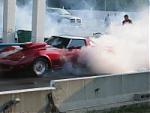
You can see in the pic, above the water pump, a fuel log that will clean up your fuel system and regulator installation.
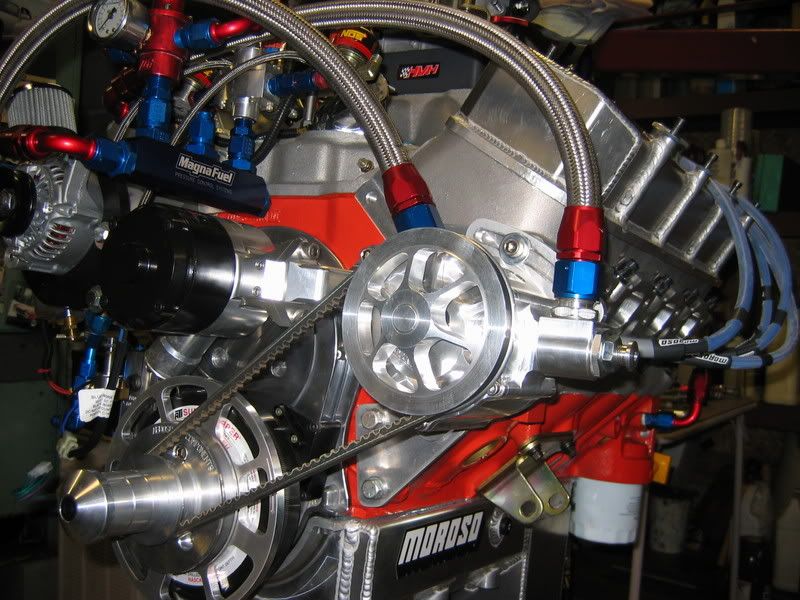
You can see in the pic, above the water pump, a fuel log that will clean up your fuel system and regulator installation.
Thread Starter
Team Owner
Joined: Jul 2001
Posts: 182,997
Likes: 88
From: Lakeland, FL
Cruise-In IV-V-VI-VII-VIII Veteran
St. Jude Donor '03, '06, '17
That little gauge is a lot better than what you had. Keep in mind liquid filled gauges can be heat sensitive, so keep that in mind. I "think" they normally only have problems when exposed to under hood temps...so you should be ok. That being said I still highly recommend the better gauge from NS. If you are at all interested shoot me a PM and I can get you a deal on it. If you figure how long you are going to race and how many nitrous passes you will make...it is really a very cheap insurance policy. You have talked about running some pretty aggressive tunes and there is not way I would run big hits with that little cheapy flow tool you are planning on.
I like Sunoco fuels also....the 116 should be fine for what you are doing. I would prefer C-16 though. C-16 is the fuel 90+% of guys with engines like yours burn. I will run C and Q-16 (oxygenated) in my 555. What plugs are you planning on ?? -8's on the motor and -9's on nitrous ? NGK's ? or the Autolites ? I prefer the NGK's, the caduim plating tends to burn off and makes it easy to read the plugs, no doubt NGK's are the easiest to read. Some say they are a bit of a "fuse" also....in other words you will normally burn the tip off the plug before you torch a piston. Where as the Autolites are a tougher plug and if burn one of those you have probably burned a piston. I do not know, I have never nipped a plug.
What is the quench in your motor ? did your builder do anything to set the engine up for nitrous ? rings (brand ?), ring gap ? smooth sharp edges on pistons and combustion chamber, etc. With as much compression as you have and as much nitrous as you want to run all these little things add up.
Good luck Oliver, I wish my car was as close to done as yours is
John
I like Sunoco fuels also....the 116 should be fine for what you are doing. I would prefer C-16 though. C-16 is the fuel 90+% of guys with engines like yours burn. I will run C and Q-16 (oxygenated) in my 555. What plugs are you planning on ?? -8's on the motor and -9's on nitrous ? NGK's ? or the Autolites ? I prefer the NGK's, the caduim plating tends to burn off and makes it easy to read the plugs, no doubt NGK's are the easiest to read. Some say they are a bit of a "fuse" also....in other words you will normally burn the tip off the plug before you torch a piston. Where as the Autolites are a tougher plug and if burn one of those you have probably burned a piston. I do not know, I have never nipped a plug.
What is the quench in your motor ? did your builder do anything to set the engine up for nitrous ? rings (brand ?), ring gap ? smooth sharp edges on pistons and combustion chamber, etc. With as much compression as you have and as much nitrous as you want to run all these little things add up.
Good luck Oliver, I wish my car was as close to done as yours is
John

Something is definetely wrong.. I'm getting a great deal on the Sunoco 116 fuel ($8.25/gallon), so that's what I'll keep running. I'm running #8 NGK plugs (racing plugs - non resistor) on engine and I'm planning on running #10 plugs for the nitrous (up to 250 shot). I don't know details on what the builder did to set the engine up for nitrous but I know that it was designed for a 250 shot..
Thread Starter
Team Owner
Joined: Jul 2001
Posts: 182,997
Likes: 88
From: Lakeland, FL
Cruise-In IV-V-VI-VII-VIII Veteran
St. Jude Donor '03, '06, '17
Probably just had some air in the line causing the gage to creep. You'll need to purge the fuel line to the system, of course, before you use it.
You can see in the pic, above the water pump, a fuel log that will clean up your fuel system and regulator installation.
You can see in the pic, above the water pump, a fuel log that will clean up your fuel system and regulator installation.

I think that the air is already mostly out of the system as I had a little leak. Now the pressure is steady.. Anyways, when I'll flow the system, the rest of the air should be out soon.
Safety Car
Joined: Aug 2001
Posts: 3,892
Likes: 13
From: Pettis Performance 565 with two stages of Nitrous Supply nitrous 1.082, 4.61 at 155, 7.17 at 192
That is the same log I have....make sure you have the nitrous reg all the way to the rear of the log like Daren has.
What pan is that Daren ?? I think I have the same one......you had to drill and tap the block ?? if so what starter are you using ?
What pan is that Daren ?? I think I have the same one......you had to drill and tap the block ?? if so what starter are you using ?
Racer
Joined: Jul 2004
Posts: 332
Likes: 0
From: Geneva Ohio
The pan is a Moroso 20385 Pro Eliminator. No drilling necessary. Starter is a Summit Protorque, the 342 Ft/Lbs one. You will need to stick with the Denso style starter with this pan. I found out that the high torque Hitachi starter does not fit.
Safety Car
Joined: Aug 2001
Posts: 3,892
Likes: 13
From: Pettis Performance 565 with two stages of Nitrous Supply nitrous 1.082, 4.61 at 155, 7.17 at 192
I could not tell from the pic which one you had...mine is the 21600. I guess you could not run the 21600 anyway because you have a front cross member.
Thanks
Thanks
Last edited by 69 N.O.X. RATT; Dec 16, 2007 at 07:24 PM.
Race Director
Joined: Jan 2000
Posts: 13,015
Likes: 2,259
From: Corsicana, Tx
2020 C2 of the Year - Modified Winner
2020 Corvette of the Year (performance mods)
C2 of Year Winner (performance mods) 2019
2017 C2 of Year Finalist
Man Daren....if I smoked...I'd be needing a cigarette about right now after looking at that bad boy! Just pure car-****!
Sweeetttttt!!!
JIM
Sweeetttttt!!!
JIM
Safety Car
Joined: Aug 2001
Posts: 3,892
Likes: 13
From: Pettis Performance 565 with two stages of Nitrous Supply nitrous 1.082, 4.61 at 155, 7.17 at 192